
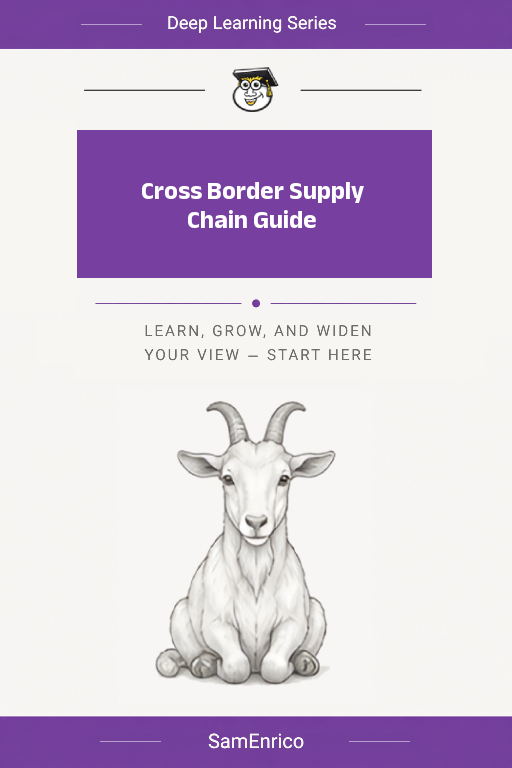
Cross Border Supply Chain Guide eBook
Establish local supplier networks for internationa
by Savoy Fatima
Establish local supplier networks for international franchisees. Balance global quality standards with local sourcing availability and costs.
Formats
Free sample
Chapter 1: The Forty-Million-Dollar Mistake--–- The first time Marco Alvarez watched a year of his work literally rot in a Brazilian warehouse, he stopped believing in the perfect global supply chain.The frozen dough had traveled 5,000 miles from Ohio in three refrigerated containers, cleared customs after a seventeen-day delay, and arrived at the distribution center in São Paulo looking exactly as it should—cold, white, and ready to become pizza. Marco's team had done everything right. They had followed the exact logistics playbook that worked in Chicago, London, and Tokyo. They had calculated lead times, secured insurance, and trained the local franchisees on proper thawing procedures.What they had not done was ask a single Brazilian franchisee about their actual experience with imported frozen dough.Within three weeks, the calls started. The dough was arriving at stores partially thawed.
The local delivery trucks lacked functioning temperature recorders. The franchisees, frustrated by the unreliable supply, had begun buying fresh dough from neighborhood bakeries—dough that tasted nothing like the brand's signature crust. Customer complaints spiked. A quality audit revealed that 40 percent of stores were serving off-spec product. And when the Brazilian health authority inspected the central warehouse, they found temperature excursions that required destroying all 40,000 kilograms of dough.The total loss, including destroyed inventory, cancelled franchise agreements, and legal settlements: forty-two million dollars.Marco's boss delivered the verdict in a two-sentence email: "We're not importing dough to Brazil anymore.
Figure out how to make it there. And don't screw this up again."That email, sent on a Tuesday afternoon in 2018, became the unlikely birth of a career-defining insight: the companies that win at global franchising are not the ones with the most efficient central supply chains. They are the ones that know exactly when to let go.The Myth We Need to Kill First Let us name the enemy at the outset. It is not competition, tariffs, or currency fluctuations, though all of those will cause plenty of trouble. The enemy is a seductive idea that has wrecked more international expansions than any other single belief: the assumption that what works at home will work everywhere else.This assumption sounds reasonable.
After all, your domestic supply chain is probably excellent. You have negotiated favorable rates with suppliers, optimized delivery routes, and built quality control systems that protect your brand. Why would you not export that success to new markets?Because the physics of supply chains change when they cross borders.Consider the variables that shift the moment your products leave your home country. Customs clearance times vary by a factor of fifteen between the fastest and slowest ports. Humidity and temperature differ dramatically, affecting everything from paper packaging to chocolate.
Local infrastructure ranges from world-class (Singapore, Germany) to deeply challenging (Lagos, Mumbai). Labor skills, regulatory enforcement, and business ethics are not constants but spectrums.Yet most franchisors approach international expansion as if these variables do not exist. They copy the domestic model, adjust for exchange rates, and assume that execution will follow. The data say otherwise.A 2022 study by the International Franchise Association examined 1,200 cross-border franchise launches across fourteen industries. The researchers tracked two groups: companies that replicated their home-country supply chain exactly, and companies that adapted at least 40 percent of their sourcing to local markets within the first twelve months.
The replication group experienced a failure rate of 68 percent within two years. The adaptation group failed at less than half that rate—31 percent.Sixty-eight percent. Let that number sit with you for a moment.Nearly seven out of ten executives who read this chapter have already lost money they have not yet admitted to losing, because the losses were buried in "market entry costs" or "one-time adjustment expenses." The losses were not one-time. They were structural. And they will repeat in every new market until the myth of the perfect global supply chain is abandoned.The Case That Proves the Rule: Yum!
Brands To understand why replication fails and adaptation succeeds, we need to look at a company that has made every mistake in the book and then written a new one. Yum! Brands, which owns KFC, Pizza Hut, and Taco Bell, operates more than 55,000 restaurants globally. Nearly all of them are franchised. And the company learned its supply chain lessons the hard way.Let us examine KFC's chicken sourcing in two critical markets: China and India.
The contrast reveals everything about why local context matters.China: The Scale Solution When KFC entered China in 1987, the country had virtually no commercial poultry industry capable of supplying a fast-food chain. Small farmers raised chickens in backyards. There were no cold chains, no quality standards, and no consistent supply. The conventional wisdom said KFC should import chicken from Thailand or Brazil.The company did the opposite. It invested directly in building a domestic poultry industry from scratch.Over a decade, KFC partnered with Chinese agricultural companies to develop industrial-scale farms.
It taught farmers about feed formulations, biosecurity, and processing standards. It built cold storage facilities and trained logistics providers in temperature-controlled transport. It created quality inspection protocols that did not exist before.By 2010, KFC China was sourcing 100 percent of its chicken domestically from large-scale farms that produced birds of consistent size, texture, and food safety standards. The supply chain was shorter, cheaper, and more reliable than any import option. And because KFC controlled the system, it could enforce brand standards at every step.The lesson from China: when local supply does not exist, you can build it.
But only if you have the capital, patience, and long-term commitment.India: The Small-Holder Solution Now consider KFC in India, which presented a completely different challenge. India already had a massive poultry industry. Tens of thousands of small farmers raised chickens on plots of one to two acres. The problem was not absence of supply but fragmentation of quality.No single farm could produce enough birds to satisfy KFC's volume requirements. The existing cold chain was patchy.
Farmers had no experience with the specific breed of chicken KFC preferred. And the regulatory environment required traceability from farm to fork.Importing chicken was theoretically possible but economically absurd given India's domestic production. So KFC did something different than it had done in China. It did not build industrial farms. Instead, it built an aggregation system.The company established collection centers where small farmers could bring birds for quality inspection.
It trained farmers on KFC's specifications—bird weight, feed type, veterinary protocols. It created a distributed cold chain with smaller trucks that could navigate rural roads. And it paid premiums for farmers who met standards consistently.Today, KFC India sources from more than 15,000 small farmers. The system is more complex to manage than China's centralized model. It requires more training, more audits, and more relationship management.
But it works because it fits the local reality.Here is the critical insight: Yum! did not have one global chicken sourcing strategy. It had a global quality standard and two completely different local execution strategies. The standard was non-negotiable. The methods were entirely flexible.Most franchisors get this backwards.
They treat their methods as sacred and their standards as adjustable. The successful ones do the reverse.The Trust Deficit: The…
This is the end of the free sample. Get the eBook to keep going. Buy now
About this book
Details
- Author
- Savoy Fatima
- Publisher
- SamEnrico
- Language
- English
- Genre
- Non-Fiction, Business Brief
- Released
- 2026-06-01
- Pages (approx.)
- 151
- Available as
- eBook, Audiobook

Read better in the ZLOADR app
Your eBooks on your phone or tablet. Sign in with your SamEnrico account and start reading.
More by Savoy Fatima
 Road Rage Reporting GuideSavoy Fatima$11.99
 Eczema Ayurveda GuideSavoy Fatima$11.99
 Loving Kindness for a Aging ParentSavoy Fatima$11.99
 Depreciation of Intangible AssetsSavoy Fatima$11.99
 Stress And Seizure FrequencySavoy Fatima$11.99
 Reading Working MemorySavoy Fatima$11.99
 Kim Dae JungSavoy Fatima$11.99
 Immigrant Beauty Brand Founder MemoirSavoy Fatima$11.99
 NVC For Teen CommunicationSavoy Fatima$11.99
 The Last Voyage of the Phoenix: How a 19th-Century Ship Defied the ImpossibleSavoy Fatima$11.99
 The Golden Voice of Axum: A Love Song for the Queen of ShebaSavoy Fatima$11.99
 The Pink Panther Heist: A Diamond’s Deadly TrailSavoy Fatima$11.99
You may also like
 Hong Kong Handover 1997Dunn Johnnie$11.99
 Zumba For Postnatal Recovery CourseNeal Christian$11.99
 Zumba for BeginnersLadner Nikia$11.99
 YouTube Comment Mining GuideHumes Pandora$12.99
 Worry Box MeditationCarlin Rudy$11.99
 Workplace Stress MeditationNguyen Lynn$11.99
 Workplace Stress and Sleep RepairHawley Ivory$11.99
 Workplace Perfectionism CureDelaney Jeffry$11.99
 Workplace Injustice Anger GuideWallen Isabelle$11.99
 Work Addiction and Burnout LinkGreenwood Ester$11.99
 Women in Yoga and WellnessBeattie Galina$11.99
 Women in Stand Up ComedyChun Evangeline$11.99