

Non-FictionBusiness BriefLogisticsSupply Chain
Cross Border Pop Up Logistics eBook
Ship inventory between London, Lagos, and NYC for
Ship inventory, fixtures and staff between London, Lagos and NYC without customs delays or stock loss.
Formats
Free sample
Chapter 1: The Inventory Triangle--–- The first time Marcus tried to move two hundred limited-edition sneakers from a pop-up in Shoreditch to a festival in Lagos, he learned a lesson that no logistics textbook had ever bothered to teach him: a shipping container does not care about your brand’s hype. It does not care about your Instagram followers, your sold-out London show, or the VIP customers already waiting in Lagos. The container sits on a dock, in the rain, while paperwork moves at the speed of a government clerk’s lunch break. Marcus lost thirty thousand dollars in cancelled sales, another twelve thousand in storage fees, and nearly lost his mind. That was the moment he understood that cross-border pop-up logistics is not a support function.
It is the entire business.This book exists because of Marcus and the hundreds of other fashion founders, tour managers, and retail directors who have discovered that moving inventory between London, New York City, and Lagos is fundamentally different from any other logistics challenge. You cannot treat it as three separate domestic operations glued together by expensive air freight. It is one system. And like any system, it has friction points, feedback loops, and failure modes that emerge only when you try to move goods across three continents with three completely different regulatory regimes, infrastructure realities, and cultural expectations around commerce.The purpose of this chapter is to establish the foundational problem that the rest of the book will solve. We will introduce the Inventory Triangle, the canonical tour order used throughout this book, the Agile versus Lean decision framework, and the Velocity of Goods formula—a quantitative tool that will transform how you think about delay costs.
By the end of this chapter, you will understand why most cross-border pop-up tours fail before they even begin, and you will have the mental model to ensure yours does not.The Three Cities as Three Different Worlds Before we can solve the problem, we must name it precisely. London, New York City, and Lagos are not just different cities. They are different logistical universes. Understanding the unique personality of each is the first step toward building a system that can survive all three.London is the mature market. It is predictable, efficient, and brutally expensive.
The paperwork is extensive but standardized. The customs officers follow rules rather than whims. The roads are paved, the addresses are clear, and the delivery drivers show up within a thirty-minute window. However, post-Brexit realities have added layers of complexity that did not exist five years ago. You now need UK-specific EORI numbers.
You must make separate customs declarations from the EU. The Transfer of Residence relief, which once allowed easy temporary imports, now requires proving that you do not intend to sell the goods—an awkward legal fiction for a pop-up tour. London’s strength is reliability. Its weakness is that reliability comes at a premium. Warehousing costs per square foot are among the highest in the world.
Labor rates for load-in crews include mandatory breaks, overtime premiums, and union rules that can turn a three-hour job into a six-hour bill.New York City is speed. The JFK airport customs infrastructure is designed for velocity. The de minimis rule under Section 321 allows shipments valued under eight hundred dollars to enter duty-free with minimal paperwork, which has fueled an entire economy of direct-to-consumer brands shipping from Chinese warehouses to Brooklyn apartments. For pop-up tours, this means that small, high-value shipments can move through NYC faster than almost anywhere else. But speed has its own costs.
The union rules for venue load-ins are strict, with mandatory coffee breaks, strict hour limits, and overtime rates that double after eight hours. The competition for dock appointments is fierce. And while customs is fast, the last-mile delivery within Manhattan can turn a twenty-minute drive into a two-hour crawl through midtown traffic. NYC rewards agility but punishes complacency.Lagos is the wildcard. This is where logistics plans go to die or to make fortunes.
The market potential is enormous—a young, fashion-hungry population with disposable income and a love for international streetwear brands. But the infrastructure is a daily negotiation. Apapa port, the main gateway for container shipping into Lagos, is famous for congestion that can delay clearance by weeks or months. The paperwork requirements are extensive and unforgiving: SONCAP certification for apparel (a six-week process), Form M (an electronic import form that must be filed before goods ship), and a customs valuation system that sometimes seems designed to maximize uncertainty. Cash is king.
Relationships matter more than contracts. And the roads from the port to the venue are not just traffic jams; they are force majeure events that can add six hours to a two-hour trip.The key insight is that these three cities cannot be managed with the same playbook. What works in London—meticulous paperwork, advance scheduling, strict adherence to rules—will drown you in Lagos bureaucracy. What works in NYC—speed, de minimis splitting, just-in-time delivery—will fail in London’s post-Brexit customs regime. And what works in Lagos—flexibility, relationships, cash payments—will get you audited or arrested in the other two.
The successful cross-border operator must be multilingual in logistics, switching mindsets as easily as switching currencies.The Canonical Tour: London to NYC to Lagos and Back Throughout this book, we will follow a specific tour order to ensure consistency across examples, case studies, and templates. The canonical tour is:London → New York City → Lagos → back to London This is not an arbitrary choice. This order reflects both the logistical realities and the commercial opportunities of multi-city pop-up tours. Starting in London allows you to test your inventory, refine your merchandising, and build hype before moving to the larger NYC market. Moving from NYC to Lagos takes advantage of the fact that Lagos consumers value products that have already succeeded in Western markets—a sold-out London show and a buzzy NYC pop-up are powerful marketing tools in Lagos.
Finally, returning to London closes the loop, allowing you to recover unsold inventory, re-enter Carneted goods under the original bond, and analyze performance data before planning the next tour.This circular route also minimizes customs complications. When you start and end in the same country (the UK), you can use a single ATA Carnet for the entire tour, provided you re-export within the validity period. You avoid the nightmare of trying to close a Carnet in a third country without a bonded warehouse to receive the goods. And you create a natural rhythm for your business: test in London, scale in NYC, conquer in Lagos, recover in London.Every example in this book—from the load-in time comparisons in Chapter 7 to the buffer day calculations in Chapter 9—will assume this canonical order. If your actual tour follows a different sequence, the principles still apply, but you will need to adjust the specific numbers based on the customs clearance data provided in Chapter 3.The Inventory Triangle: Location as Value The single most important concept in this book is what I call the Inventory Triangle.
It is deceptively simple, yet almost every cross-border logistics failure I have witnessed can be traced back to a violation…
This is the end of the free sample. Get the eBook to keep going. Buy now
About this book
Details
- Author
- Shoemaker Eliseo
- Publisher
- SamEnrico
- Language
- English
- Genre
- Non-Fiction, Business Brief, Logistics, Supply Chain
- Released
- 2026-06-01
- Pages (approx.)
- 133
- Available as
- eBook, Audiobook

Read better in the ZLOADR app
Your eBooks on your phone or tablet. Sign in with your SamEnrico account and start reading.
More by Shoemaker Eliseo
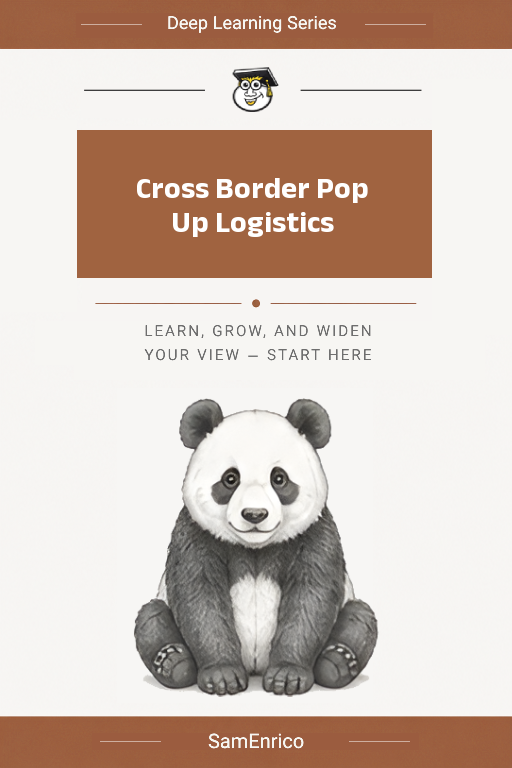 Cross Border Pop Up LogisticsShoemaker Eliseo$12.99
 The Mindfulness Body Scan WorkbookShoemaker Eliseo$11.99
 Loneliness and Group ActivitiesShoemaker Eliseo$11.99
 Academic Stress for Business StudentsShoemaker Eliseo$11.99
 The Forge of Hephaestus: Fire and the Lame God's RevengeShoemaker Eliseo$11.99
 How to Produce a Badge Holder and AccessoriesShoemaker Eliseo$11.99
 How to Start a Diamond Working Business (Beginners Guide)Shoemaker Eliseo$11.99
 Boeing 737 MAX: The Quality Control CrisisShoemaker Eliseo$11.99
You may also like
 Hong Kong Handover 1997Dunn Johnnie$11.99
 Zumba For Postnatal Recovery CourseNeal Christian$11.99
 Zumba for BeginnersLadner Nikia$11.99
 YouTube Comment Mining GuideHumes Pandora$12.99
 Worry Box MeditationCarlin Rudy$11.99
 Workplace Stress MeditationNguyen Lynn$11.99
 Workplace Stress and Sleep RepairHawley Ivory$11.99
 Workplace Perfectionism CureDelaney Jeffry$11.99
 Workplace Injustice Anger GuideWallen Isabelle$11.99
 Work Addiction and Burnout LinkGreenwood Ester$11.99
 Women in Yoga and WellnessBeattie Galina$11.99
 Women in Stand Up ComedyChun Evangeline$11.99