
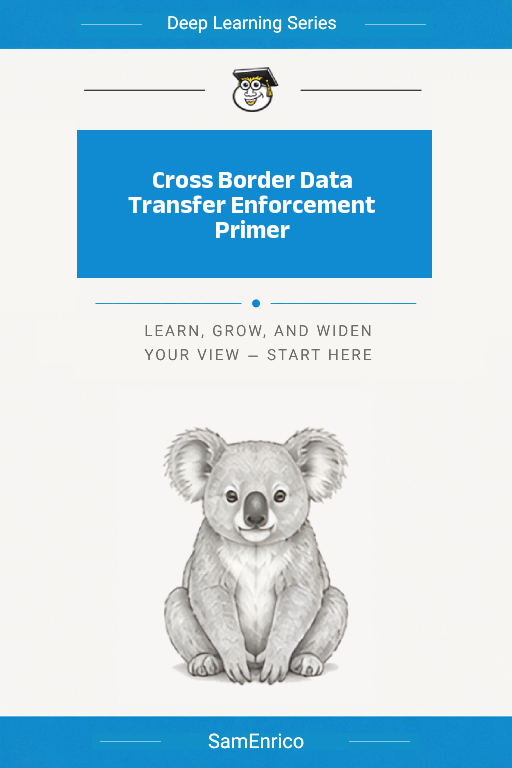
Non-FictionAnnual CheckupPrivacy UpdateTransfer Guide
Cross Border Data Transfer Enforcement Primer eBook
Navigate 2025 Schrems III risks, EU-US DPF updates
by Muir Abigail
Navigate 2025 Schrems III risks, EU-US DPF updates, and UK adequacy decisions. Covers standard contractual clause changes, transfer impact assessments, and enforcement fine trends.
Formats
Free sample
Chapter 1: The Deadly Loop...–- In October 2015, an Austrian privacy activist named Max Schrems ordered a pizza in Vienna. That mundane transaction triggered a chain reaction that would, within five years, invalidate two transatlantic data agreements, force thousands of companies to rewrite their compliance programs, and expose a fundamental truth: the legal mechanisms governing where your data travels are as fragile as they are essential.Few people inside corporate legal departments remember the pizza. What they remember is the aftermath. The Court of Justice of the European Union (CJEU) had just struck down the Safe Harbor Framework—the legal bridge that allowed 4,000+ companies to transfer EU citizen data to US servers. Overnight, compliance officers scrambled.
Contracts needed renegotiation. Data flows needed remapping. And the message from regulators was clear: you should have seen this coming.But they did not see it coming. And when the same pattern repeated in 2020 with the invalidation of the Privacy Shield, the collective failure of imagination became undeniable. Today, in 2025, we are staring at the third iteration of this cycle.
The EU-US Data Privacy Framework (DPF)—hailed as the permanent solution—is already facing an appeal to the CJEU. Legal scholars have dubbed it "Schrems III." And once again, organizations are caught between operational necessity and legal uncertainty.This chapter tells the story of how we arrived at this moment. It is a story of good intentions, institutional overreach, surveillance laws written in the shadow of 9/11, and a legal standard—"essential equivalence"—that has grown sharper with every ruling. More importantly, this chapter extracts the lessons that most compliance programs miss. Because if you do not understand the dead loop—the cycle of invalidation, replacement, and re-invalidation—you are doomed to repeat it.The Anatomy of a Legal Earthquake To understand where we are heading, we must first understand what actually happens when the CJEU strikes down an adequacy decision.
The term "adequacy decision" sounds technical. It is. But at its core, it represents a political and legal judgment that a non-EU country provides data protection "essentially equivalent" to that within the EU.When the CJEU invalidates such a decision, the consequences are immediate and unforgiving. The legal bridge collapses. Transfers that were lawful at 9:00 AM become unlawful at 9:01 AM.
There is no grandfather clause. No transition period. No safe harbor for the safe harbor. Organizations must cease transfers, find alternative mechanisms (usually Standard Contractual Clauses or Binding Corporate Rules), renegotiate vendor agreements, and notify regulators—all while the clock ticks on their core business operations.In 2015, after the Safe Harbor invalidation, the European authorities granted a three-month grace period. Companies breathed a collective sigh of relief.
Then, in 2020, after the Privacy Shield fell, there was no grace period. The message had changed: you had three years of warning. The CJEU's opinion in Schrems II was explicit—organizations should have been preparing alternative transfer mechanisms all along.By 2025, the regulatory posture has hardened further. The European Data Protection Board (EDPB) has issued guidance stating that organizations relying on the DPF must have fully executed fallback Standard Contractual Clauses (SCCs) in place before any potential invalidation. Waiting for the ruling is no longer an acceptable risk management strategy.The Legal Standard That Keeps Getting Sharper The CJEU's jurisprudence rests on a single, deceptively simple phrase: "essentially equivalent protection." But like a knife that is sharpened with each use, this standard has cut deeper with every ruling.In the 2015 Schrems I decision, the Court held that the US Safe Harbor failed because it allowed mass surveillance to override privacy protections.
The standard was applied at a macro level: the entire US legal regime, as a whole, did not measure up.In the 2020 Schrems II decision, the Court went further. It ruled that even if the US had improved its framework (Privacy Shield), the persistence of FISA Section 702 surveillance and the lack of independent judicial redress for non-US persons meant the standard was still not met. Crucially, the Court also held that organizations using SCCs must conduct their own Transfer Impact Assessments (TIAs) to evaluate whether the laws of the destination country undermine the clauses' effectiveness.By 2025, after the General Court's Latombe decision (discussed below) and the pending appeal, the standard is being applied at yet another level of granularity. The question is no longer whether the US regime as a whole is adequate. The question is whether the specific institutional safeguards—the Data Protection Review Court (DPRC), the Privacy and Civil Liberties Oversight Board (PCLOB)—can withstand scrutiny when tested against real-world surveillance requests.Each iteration tightens the screws.
And each iteration catches organizations off guard, because they assume the new framework will be the one that finally sticks.The Latombe Decision: A Pyrrhic Victory In September 2025, the General Court of the EU issued a ruling that sent a brief wave of relief through the transatlantic business community. In Latombe v. European Commission, the Court upheld the EU-US Data Privacy Framework against a legal challenge brought by French privacy activist Yann Padova (representing the plaintiff, whose name gave the case its shorthand). The DPF, the Court ruled, included sufficient improvements over Privacy Shield: the creation of the DPRC, binding commitments from the US Office of the Director of National Intelligence, and an annual review mechanism.Headlines celebrated. "EU Court Upholds Transatlantic Data Pact," read the Financial Times.
"Data Flows Safe for Now," echoed Politico. For organizations that had bet on the DPF, it felt like validation.Do not be fooled.The General Court is not the CJEU. It is a lower court. And the losing party has already announced an appeal. That appeal will be heard by the CJEU—the same court that invalidated Safe Harbor and Privacy Shield.
The same court that has never once ruled in favor of a US adequacy framework on final appeal. The same court whose judges have consistently signaled that US surveillance laws are incompatible with EU fundamental rights.The appeal, expected to be argued in mid-2026 and decided in late 2026 or early 2027, is widely anticipated to become "Schrems III." And legal scholars who have tracked the CJEU's trajectory place the probability of invalidation at over 80 percent. The unresolved issues remain exactly the same as they were in 2020: FISA Section 702, Executive Order 12333, and the lack of meaningful judicial redress for EU citizens whose data is accessed by US intelligence agencies.The DPF, in other words, is a temporary bridge. Organizations that treat it as a permanent solution are making the same mistake they made in 2015 and 2020.Why US Surveillance Laws Are the Unmovable Obstacle To understand why the CJEU keeps rejecting US adequacy frameworks, one must understand FISA Section 702. This provision of the Foreign Intelligence Surveillance Act, originally enacted in 2008 and most recently reauthorized in 2023, allows the US intelligence community to collect communications of non-US persons located outside the United States without a warrant.
The targeting is authorized by the Foreign Intelligence Surveillance Court (FISC) not on a per-person basis, but on a "certification" basis—approving categories of targets.For EU privacy advocates, this is anathema. The GDPR requires that any interference with privacy must be based on specific, targeted, and judicially reviewed grounds. Bulk surveillance, even if nominally "directed" at foreign nationals…
This is the end of the free sample. Get the eBook to keep going. Buy now
About this book
Details
- Author
- Muir Abigail
- Publisher
- SamEnrico
- Language
- English
- Genre
- Non-Fiction, Annual Checkup, Privacy Update, Transfer Guide
- Released
- 2026-05-30
- Pages (approx.)
- 133
- Available as
- eBook, Audiobook

Read better in the ZLOADR app
Your eBooks on your phone or tablet. Sign in with your SamEnrico account and start reading.
More by Muir Abigail
 Loneliness Myths DebunkedMuir Abigail$11.99
 Car Wash Prosecutor DiariesMuir Abigail$11.99
 A B Testing Email CampaignsMuir Abigail$11.99
 Chronic Back Pain StretchingMuir Abigail$11.99
 The Marble Empire: How One Family Built a Global Real Estate JuggernautMuir Abigail$11.99
 The Labors of Atalanta: The Hunted and the HunterMuir Abigail$11.99
 Understanding Hypomelia Mullerian Duct AnomaliesMuir Abigail$17.99
 Business Acquisition Sales ExecutiveMuir Abigail$11.99
 Dark Warehouse AutomationMuir Abigail$12.99
 Ultimate Handbook Guide to Ulyanovsk : (Russia) Travel GuideMuir Abigail$11.99
You may also like
 Hong Kong Handover 1997Dunn Johnnie$11.99
 Zumba For Postnatal Recovery CourseNeal Christian$11.99
 Zumba for BeginnersLadner Nikia$11.99
 YouTube Comment Mining GuideHumes Pandora$12.99
 Worry Box MeditationCarlin Rudy$11.99
 Workplace Stress MeditationNguyen Lynn$11.99
 Workplace Stress and Sleep RepairHawley Ivory$11.99
 Workplace Perfectionism CureDelaney Jeffry$11.99
 Workplace Injustice Anger GuideWallen Isabelle$11.99
 Work Addiction and Burnout LinkGreenwood Ester$11.99
 Women in Yoga and WellnessBeattie Galina$11.99
 Women in Stand Up ComedyChun Evangeline$11.99