
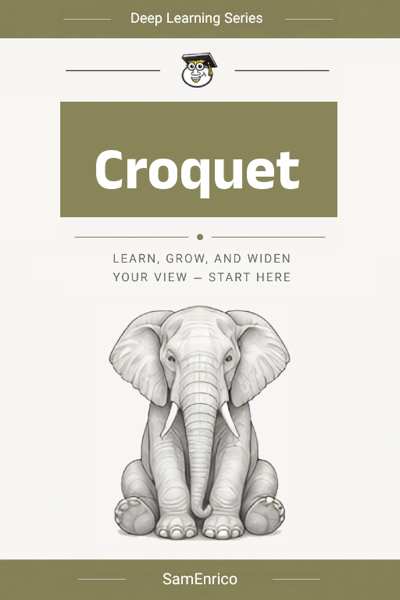
Non-FictionInformativeEducational
Croquet eBook
A Coursebook on Croquet
A Coursebook on Croquet
Formats
Free sample
Chapter 1: The Lawn Before Tennis...--The most important tennis venue in the world was built for croquet. This is not a metaphor, a joke, or an obscure footnote buried in a Victorian diary. It is a fact of sporting history, and it tells you almost everything you need to know about the strange, beautiful, and deeply misunderstood game you are about to learn. Wimbledon’s hallowed Centre Court—cathedral of baseline rallies, standing ovations, and strawberries and cream—was originally laid out for the All England Croquet Club. The club formed in 1868.
Croquet was the headline act. Tennis was the afterthought, the desperate diversification attempt of an organization watching its primary sport slide into irrelevance.And yet, here we are. Tennis became a global religion. Croquet became a punchline.If you picked up this book, you likely have some image in your head of what croquet is. Perhaps you remember a childhood birthday party, a rusted set of wire hoops pulled from a sagging cardboard box, mallets with loose heads, and balls that wobbled more than they rolled.
Perhaps you recall a scene from a movie—some posh family on an immaculate lawn, dressed in white, sipping lemonade between shots that seemed to take forever. Perhaps you have never thought about croquet at all, except to dismiss it as the sport your grandparents played before they discovered bridge.That version of croquet exists. It is harmless. It is pleasant. It is also, for the purposes of this book, almost entirely irrelevant.The croquet you are about to discover is not the backyard pastime of Victorian postcards.
It is a gladiatorial mental duel played on grass, a game of such intricate strategy that top players compare it to chess played at sprinting speed. It is a sport where a single turn can last forty-five minutes, where a player can run all twelve hoops and strike the finishing peg without ever allowing their opponent back onto the lawn. It is a sport with its own vocabulary (roquette, croquet, deadness, bisque, peel, rush, leave) that sounds like a foreign language to the uninitiated. And it is a sport that almost died—not once, but twice—only to be resurrected by the very people who refused to let its peculiar magic fade.This chapter is not a rulebook. You will learn the rules in Chapter 3, and you will learn them properly, without the shortcuts and myths that plague backyard instruction.
This chapter is something more important. It is the story of how croquet became what it is, why its rules reward patience over power, and why understanding that history will make you a better player before you ever pick up a mallet.The Victorian Invention Every sport has an origin story. Most of them are lies dressed up as legend. Abner Doubleday did not invent baseball in a Cooperstown pasture. James Naismith did invent basketball, but only because he was ordered to create an indoor winter activity for a YMCA training school.
Croquet falls somewhere between these extremes—it was not the spontaneous birth of a folk game, nor was it the deliberate creation of a single inventor. Croquet was engineered.Before 1851, people across Europe hit balls through hoops with mallets. The French had jeu de mail, a game played on long strips of packed earth. The Irish had crookey, a rough-and-tumble lawn game played by peasants. The Italians had pallamaglio, a nobleman’s pursuit that involved heavy wooden balls and iron hoops.
None of these were croquet as we know it. They were regional variations, disorganized, inconsistent, played with whatever equipment was at hand. A hoop in one village might be twice as wide as a hoop in the next. A mallet in one county might be half the weight of a mallet across the river. This did not matter, because nobody was traveling to play.
You played the game that your neighbors played, with the equipment that your grandfather had whittled.All of that changed in 1851, the year of the Great Exhibition in London’s Hyde Park. This was the Victorian era at its most confident, an age of steam engines, telegraph wires, and empire. The Great Exhibition was meant to showcase the best of British industry—massive iron girders, printing presses, locomotives, and the extraordinary Crystal Palace that housed them all. In the midst of this industrial marvel, a sporting goods company named Jaques of London unveiled a product that would change lawns forever.Jaques did not invent croquet. They standardized it.What Jaques presented at the Great Exhibition was a complete, boxed game: six wrought-iron hoops, a wooden peg, four mallets turned from a single piece of hardwood, and four balls polished to a smooth, uniform finish.
The hoops were all the same width. The mallets were all the same weight. The balls were all the same diameter. Most importantly, the box included a printed rulebook—the first time any version of the game had been codified in writing. Jaques called their product “Croquet,” borrowing from the French croquet (a small hook) and perhaps nodding to the Irish crookey.
The name stuck. The game spread.The Victorian elite loved Croquet for reasons that had nothing to do with athleticism. It was a garden game, played on the manicured lawns of country estates. It was mixed-gender at a time when most sports were strictly segregated—men and women could play together, side by side, without impropriety (or so the Victorians convinced themselves). It was slow enough that players could converse, flirt, and display their finest summer attire.
It was also, crucially, a game of restraint. The physical explosion of sports like rugby or boxing was beneath the dignity of a Victorian drawing room. Croquet asked for precision, not power. It asked for thought, not reflex. It was the sport of the thinking class, and the thinking class adored it.By 1868, the croquet craze had reached such heights that a group of enthusiasts formed the All England Croquet Club on a plot of land in Worple Road, Wimbledon.
The club had four croquet lawns. It hosted tournaments. It published rules. It was, for a brief and shining moment, the center of the croquet universe.Then came tennis.The Fall and the Miracle The decline of croquet was not slow. It was abrupt, almost violent in its speed.
In 1875, the All England Croquet Club added lawn tennis to its offerings—partly as a novelty, partly because croquet memberships were already beginning to stagnate. The new game was faster, more athletic, more telegenic (a word nobody used yet, but the concept existed). Tennis could be watched from the sidelines with genuine excitement. Croquet, to the untrained eye, looked like people walking slowly and hitting balls gently.By 1877, the club had renamed itself the All England Croquet and Lawn Tennis Club. By 1879, the word “Croquet” had been quietly dropped from the official name.
By 1882, the club was simply the All England Lawn Tennis Club. The lawns that had hosted croquet championships now hosted tennis tournaments. The hoops were pulled from the ground. The mallets gathered dust in storage sheds. The first Wimbledon Championships were played in 1877, and croquet was already an afterthought.If the…
This is the end of the free sample. Get the eBook to keep going. Buy now
About this book
Details
- Author
- Case Clementina
- Publisher
- SamEnrico
- Language
- English
- Genre
- Non-Fiction, Informative, Educational
- Released
- 2026-05-09
- Pages (approx.)
- 133
- Available as
- eBook, Audiobook

Read better in the ZLOADR app
Your eBooks on your phone or tablet. Sign in with your SamEnrico account and start reading.
More by Case Clementina
 Gambling Addiction Recovery MilestonesCase Clementina$11.99
 Meredith Kercher Life RememberedCase Clementina$11.99
 Right Tribe Social CircleCase Clementina$11.99
 Global Talent Migration and Remote Work HubsCase Clementina$11.99
 Having a Voice Self Worth GuideCase Clementina$11.99
 The Banshee's Last Lament: A Celtic Dirge of War and WoeCase Clementina$11.99
 Real Estate Property Management GuideCase Clementina$12.99
 Understanding Leukemia, B-cell, ChronicCase Clementina$17.99
 A Beginners Guide to Duplicate Bridge (Volume 1)Case Clementina$11.99
You may also like
 Hong Kong Handover 1997Dunn Johnnie$11.99
 Zumba For Postnatal Recovery CourseNeal Christian$11.99
 Zumba for BeginnersLadner Nikia$11.99
 YouTube Comment Mining GuideHumes Pandora$12.99
 Worry Box MeditationCarlin Rudy$11.99
 Workplace Stress MeditationNguyen Lynn$11.99
 Workplace Stress and Sleep RepairHawley Ivory$11.99
 Workplace Perfectionism CureDelaney Jeffry$11.99
 Workplace Injustice Anger GuideWallen Isabelle$11.99
 Work Addiction and Burnout LinkGreenwood Ester$11.99
 Women in Yoga and WellnessBeattie Galina$11.99
 Women in Stand Up ComedyChun Evangeline$11.99