
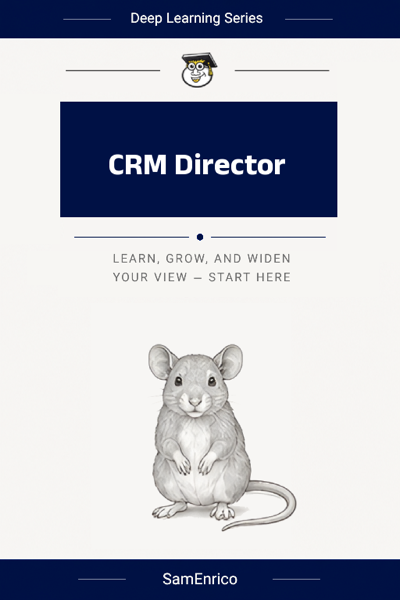
Non-FictionInformativeEducational
CRM Director eBook
A Coursebook on CRM Director
A Coursebook on CRM Director
Formats
Free sample
Chapter 1: The 70% Lie--The first time I watched a CRM implementation fail, I was sitting in a glass-walled conference room on the thirty-second floor of a Saa S company that would be acquired for scrap eighteen months later. The VP of Sales, a man named Doug who wore expensive shoes and never remembered anyone's name, stood at the whiteboard and drew a rocket ship. "We're going to Salesforce," he announced. "It's going to fix everything."Six hundred thousand dollars in licensing and customization later, nothing was fixed. Sales reps still kept their deals in Excel spreadsheets.
Forecasts were still made of optimism and lies. The CRM, that expensive rocket ship, had become what most CRMs become: a digital parking lot where data went to die.Doug was fired. The CRM director was fired. The implementation partner was fired. And then the company quietly hired a new CRM director and did the exact same thing again, because nobody had stopped to ask the only question that matters: Why do 70 percent of CRM implementations fail to meet ROI expectations?The answer, which this chapter will reveal, is not the software.
It's not the vendor. It's not the implementation partner. The answer is a lie that the CRM industry has been telling for twenty years: the lie that technology alone can solve a people and process problem.This chapter exposes that lie, redefines what it means to be a CRM director in the modern revenue organization, and introduces the framework that will turn you from a glorified system administrator into a strategic partner at the executive table. By the end of this chapter, you will understand why your predecessor failed, why your current CRM feels like a burden rather than a weapon, and exactly what you need to do differently starting tomorrow morning.The Anatomy of a $50,000 Paperweight Let me tell you about Maria. She is a composite character built from twenty-three real CRM directors I have coached, mentored, or consoled over the past decade.
Maria was hired as Director of CRM at a mid-market logistics company after their previous director quit following an eighteen-month Salesforce implementation that had produced exactly zero measurable business results.On her first day, Maria logged into the CRM and found two hundred and forty-seven custom fields, thirty-one reports that nobody used, and a pipeline so corrupted with duplicates and missing data that the CEO had instructed everyone to ignore the system entirely. Sales reps were keeping their deals in Google Sheets. Customer success was using Trello. Marketing was sending emails to contacts who had churned two years ago.Maria did what most CRM directors do: she scheduled meetings. She met with sales to understand their needs.
She met with marketing to align on lead definitions. She met with IT to understand integration constraints. She spent three months gathering requirements, documenting processes, and building consensus. She was diligent, thoughtful, and thorough. And she failed.She failed because she was doing the work of a business analyst when she needed to be doing the work of a revenue engineer.
She was asking people what they wanted instead of measuring what actually happened. She was trying to please everyone instead of architecting a system that served the business. She was treating the CRM as a software project rather than a strategic asset.The CRM that Maria inherited was not a technology failure. Salesforce worked exactly as configured. The failure was upstream of the technology: a failure of leadership to define what success looked like, a failure of process design before configuration began, a failure of governance to maintain data integrity, and a failure of change management to bring users along.
In other words, the CRM failed because nobody was doing the job that this book will train you to do.Redefining the CRM Director: From Janitor to Pilot The single biggest obstacle to CRM success is not bad data or user resistance or integration complexity. The biggest obstacle is how the role of CRM director is understood by the organizations that create it.Walk into any company with more than two hundred employees, and you will find someone with a version of this title: CRM Manager, Salesforce Administrator, Revenue Operations Analyst, Hub Spot Admin. The specific label varies, but the job description is almost always the same. "Maintain the CRM system. Create reports and dashboards.
Manage user access and security. Provide training and support."This is a job description for a janitor. It treats the CRM as a mess that needs cleaning rather than an engine that needs engineering. It assumes the system is static and the job is maintenance. It measures success by uptime and ticket resolution rather than revenue acceleration and forecast accuracy.The CRM director I want you to become is something entirely different.
You are not a janitor. You are not a system administrator. You are not a support desk. You are a strategic partner responsible for the architecture, operation, and continuous improvement of the systems that generate and manage customer relationships. You sit at the intersection of sales process, data governance, and revenue intelligence.
You speak the language of the C-suite and the language of the developer. You are part engineer, part psychologist, part diplomat, and part detective.Let me be specific about what this means in practice. A janitor-CRM director asks, "How do I create a report that shows pipeline by stage?" A strategic CRM director asks, "Why is our pipeline coverage ratio declining, and what process change will fix it before the end of the quarter?" A janitor-CRM director asks, "How do I add a custom field for lead source?" A strategic CRM director asks, "What is the marginal ROI of capturing lead source, and are we actually using that data to inform marketing spend?"The distinction is not academic. The companies that treat CRM as a janitorial function spend millions on software that delivers nothing. The companies that treat CRM as a strategic function build durable competitive advantages in data, process, and intelligence.
The difference is not the technology stack. The difference is who is driving.The LUCK Principle: Your Four-Pillar Framework Throughout this book, you will encounter a framework called the LUCK Principle. The name is intentional. It is not a coincidence that the word "luck" appears in the acronym. In my experience, the companies that succeed with CRM are not luckier than the companies that fail.
They have simply built systems that make success more likely. The LUCK Principle is that system.LUCK stands for four interdependent pillars: Leadership, User adoption, Culture, and Knowledge. Each pillar is essential. Each pillar reinforces the others. And each pillar is under the direct influence of the CRM director, even when you do not have formal authority over the people or processes involved.Let me define each pillar briefly before we spend the rest of this book exploring them in depth.Leadership means establishing clear accountability for CRM success at the executive level.
It means defining what success looks like in measurable terms. It means having the authority to say no to requests that would undermine system integrity. It means being invited to the table where revenue decisions are made, not just the table where…
This is the end of the free sample. Get the eBook to keep going. Buy now
About this book
Details
- Author
- Mcmurray Lieselotte
- Publisher
- SamEnrico
- Language
- English
- Genre
- Non-Fiction, Informative, Educational
- Released
- 2026-06-02
- Pages (approx.)
- 157
- Available as
- eBook, Audiobook

Read better in the ZLOADR app
Your eBooks on your phone or tablet. Sign in with your SamEnrico account and start reading.
More by Mcmurray Lieselotte
 Gambling Addiction and SpiritualityMcmurray Lieselotte$11.99
 Downshifting Daily Stress GuideMcmurray Lieselotte$11.99
 Return Migration of Diaspora TalentMcmurray Lieselotte$11.99
 Sports Performance Self EsteemMcmurray Lieselotte$11.99
 The Italian Justice System ExposedMcmurray Lieselotte$11.99
 Whispers in the Bazaar: The Djinn Trader of BaghdadMcmurray Lieselotte$11.99
 How to Become a Cold-mill OperatorMcmurray Lieselotte$11.99
 Real Estate Capital Markets GuideMcmurray Lieselotte$12.99
 One Page Referral Program HandbookMcmurray Lieselotte$12.99
 Understanding LeucinosisMcmurray Lieselotte$17.99
You may also like
 Hong Kong Handover 1997Dunn Johnnie$11.99
 Zumba For Postnatal Recovery CourseNeal Christian$11.99
 Zumba for BeginnersLadner Nikia$11.99
 YouTube Comment Mining GuideHumes Pandora$12.99
 Worry Box MeditationCarlin Rudy$11.99
 Workplace Stress MeditationNguyen Lynn$11.99
 Workplace Stress and Sleep RepairHawley Ivory$11.99
 Workplace Perfectionism CureDelaney Jeffry$11.99
 Workplace Injustice Anger GuideWallen Isabelle$11.99
 Work Addiction and Burnout LinkGreenwood Ester$11.99
 Women in Yoga and WellnessBeattie Galina$11.99
 Women in Stand Up ComedyChun Evangeline$11.99