
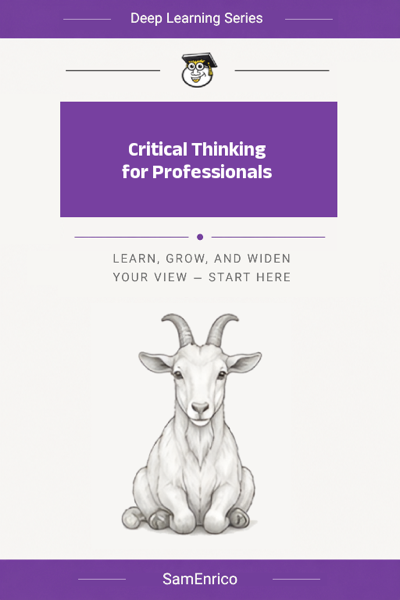
Non-FictionInformativeEducational
Critical Thinking for Professionals eBook
A Coursebook on Critical Thinking for Professional
by Worth Oliva
A Coursebook on Critical Thinking for Professionals
Formats
Free sample
Chapter 1: The Urgency Trap--–- The email arrived at 9:47 AM on a Tuesday. By 9:52 AM, I had committed $200,000 to a project that should never have existed. By Friday, that number had ballooned to $2 million. And by the end of the quarter, I was sitting across from our CEO explaining why we had nothing to show for it except a spreadsheet full of regret and a team that had worked eighty-hour weeks chasing a fantasy.I was not stupid. I had an Ivy League MBA, ten years of experience in my industry, and a reputation for being "the smart one" in every room I entered.
But none of that mattered. Because on that Tuesday morning, I fell into the Urgency Trap—and I stayed there for four months.The trap was simple. A client had called with an "emergency." Their vendor was failing. They needed a solution in forty-eight hours or they would take their business elsewhere. My team and I skipped the problem-framing, skipped the evidence-gathering, skipped everything this book will teach you.
We went straight to execution because that was what the situation seemed to demand. Speed felt like competence. Action felt like leadership. And by the time we realized we had solved the wrong problem, we were already $2 million in.This chapter is about why smart people make expensive mistakes when the clock is ticking—and how you can stop being one of them.The Myth of the Natural-Born Thinker Let me start with a claim that will annoy some readers: you are not as good a thinker as you think you are. Neither am I.
Neither is your boss, your CEO, or the consultant who charges $2,000 an hour.This is not an insult. It is a description of how human brains work. The psychologist Daniel Kahneman spent a lifetime documenting the systematic errors that smart people make, and his central finding was that intelligence does not protect you from cognitive bias. In fact, high intelligence often makes bias worse because smart people are better at generating post-hoc justifications for their flawed intuitions.The problem is not a lack of brainpower. The problem is that most professionals have never been taught how to think.
We have been taught what to think—the facts of our industries, the models of our disciplines, the best practices of our roles. But the process of thinking itself—the deliberate, conscious, structured evaluation of evidence and assumptions—is something we are expected to absorb by osmosis.We do not absorb it. We learn to mimic the appearance of thinking while actually doing something else entirely.Consider the typical executive meeting. A problem is presented. Within thirty seconds, someone offers a solution.
Within two minutes, the group has aligned around that solution—not because it is the best solution, but because the social pressure to appear decisive overwhelms the cognitive effort required to evaluate alternatives. The meeting ends. The solution is implemented. Six months later, everyone wonders why nothing changed.This pattern is so common that we have stopped noticing it. We call it "decisiveness" or "execution focus" or "bias for action." But those are euphemisms for what it really is: intellectual laziness dressed up as leadership.System 1 and System 2: The Two Engines of Your Brain To understand why we think poorly under pressure, we need to understand the basic architecture of human cognition.
Kahneman popularized a useful model that divides thinking into two systems.System 1 is fast, automatic, effortless, and emotional. It is the part of your brain that recognizes a face in a crowd, completes the phrase "bread and ___," or flinches when you hear a loud noise. System 1 operates below the level of conscious awareness. You cannot turn it off. It processes vast amounts of information in milliseconds and delivers conclusions that feel like instincts.
Most of the time, System 1 serves you well. It keeps you from having to deliberate about whether to step out of the way of a moving car.System 2 is slow, deliberate, effortful, and analytical. It is the part of your brain that solves a complex math problem, evaluates a logical argument, or decides between two competing job offers. System 2 requires conscious attention. It tires easily.
It is lazy by nature and will offload work to System 1 whenever possible. System 2 is the part of you that reads a dense contract, checks the calculations in a spreadsheet, or forces yourself to consider a perspective you find uncomfortable.Here is the critical insight: System 1 is not stupid. It is actually brilliant at what it does. But what it does is pattern-matching, not analysis. System 1 is optimized for speed, not accuracy.
In environments that are stable, predictable, and full of repeated patterns, System 1 makes excellent judgments. A firefighter who knows instantly that a floor is about to collapse is using System 1—but that judgment is based on thousands of hours of deliberate practice that have trained the pattern-recognition machinery.In professional environments, however, we frequently face novel problems, incomplete information, and high stakes. These are precisely the conditions where System 1 fails. It matches the current situation to the nearest available pattern from the past, even when the match is imperfect. It delivers confident conclusions based on incomplete data.
And because the conclusions feel instinctive, we trust them.This is the central tragedy of professional decision-making: we use System 1 for problems that require System 2, and we are so confident in our System 1 judgments that we never realize we have made an error until it is too late.The Urgency Trap Defined The Urgency Trap is a specific failure mode that occurs when perceived time pressure causes professionals to default to System 1 thinking on problems that require System 2 analysis.The trap has three components.First, artificial urgency. Most professional "emergencies" are not actual emergencies. No one will die. No one will go bankrupt. The building will not burn down.
But the language of urgency—"ASAP," "critical," "we need this yesterday"—activates the same threat response in your brain as a genuine physical danger. Your amygdala fires. Your cortisol rises. Your body prepares for fight-or-flight. And in that state, System 2 is suppressed because your brain has decided that speed matters more than accuracy.Second, reward for speed.
Professional cultures systematically reward fast answers and punish slow ones, regardless of quality. The person who gives an answer in thirty seconds is seen as decisive and confident. The person who says "I need two hours to analyze this" is seen as slow or uncertain. This creates a powerful incentive to produce System 1 answers immediately rather than System 2 answers after deliberation.Third, the illusion of competence. When you answer quickly, you feel smart.
Your colleagues nod. The meeting moves on. You receive positive reinforcement for the very behavior that leads to poor outcomes. And because the negative consequences of your quick answer may not appear for weeks or months, you never directly connect the speed of your response to the quality of the outcome. Your brain learns the wrong lesson: fast thinking works.The result is a self-reinforcing loop.
Perceived urgency triggers System 1. System 1 produces a fast answer. The fast answer is socially rewarded. The reward strengthens the habit of answering quickly. And the next…
This is the end of the free sample. Get the eBook to keep going. Buy now
About this book
Details
- Author
- Worth Oliva
- Publisher
- SamEnrico
- Language
- English
- Genre
- Non-Fiction, Informative, Educational
- Released
- 2026-06-02
- Pages (approx.)
- 114
- Available as
- eBook, Audiobook

Read better in the ZLOADR app
Your eBooks on your phone or tablet. Sign in with your SamEnrico account and start reading.
More by Worth Oliva
 Creative Warm Up Team GuideWorth Oliva$11.99
 NVC for Faith CommunitiesWorth Oliva$11.99
 Risk Reversal Writing TechniquesWorth Oliva$11.99
 Focus Block CalendarWorth Oliva$11.99
 Breaking The Yelling CycleWorth Oliva$11.99
 Lymphoma Survivor MemoirWorth Oliva$11.99
 Intuitive Eating for BingersWorth Oliva$11.99
 Blue Zone Sunlight ExposureWorth Oliva$11.99
 Judy Garland RainbowWorth Oliva$11.99
 The Lost Tapes of the Titanic's Last CallWorth Oliva$11.99
 Codebreaker: The Untold Story of Margaret Hamilton and Apollo 11Worth Oliva$11.99
 The Ballot That Broke the EmpireWorth Oliva$11.99
You may also like
 Hong Kong Handover 1997Dunn Johnnie$11.99
 Zumba For Postnatal Recovery CourseNeal Christian$11.99
 Zumba for BeginnersLadner Nikia$11.99
 YouTube Comment Mining GuideHumes Pandora$12.99
 Worry Box MeditationCarlin Rudy$11.99
 Workplace Stress MeditationNguyen Lynn$11.99
 Workplace Stress and Sleep RepairHawley Ivory$11.99
 Workplace Perfectionism CureDelaney Jeffry$11.99
 Workplace Injustice Anger GuideWallen Isabelle$11.99
 Work Addiction and Burnout LinkGreenwood Ester$11.99
 Women in Yoga and WellnessBeattie Galina$11.99
 Women in Stand Up ComedyChun Evangeline$11.99