
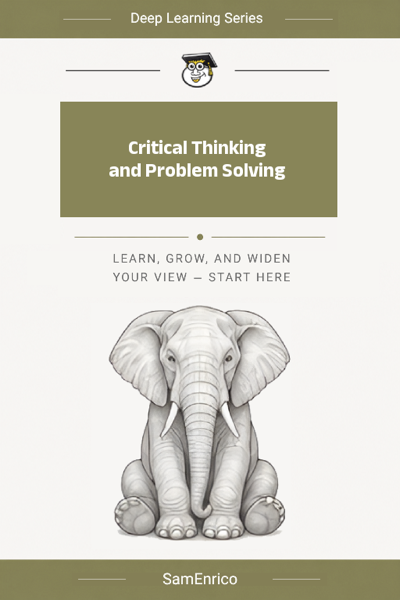
Critical Thinking and Problem Solving eBook
A Coursebook on Critical Thinking and Problem Solv
A Coursebook on Critical Thinking and Problem Solving
Formats
Free sample
Chapter 1: The Two Wolves--– The first time I understood that my own brain was lying to me, I was sitting in a casino in Las Vegas, down four hundred dollars, absolutely certain that the next hand of blackjack would turn everything around. I could feel it in my gut. The dealer had been hot, but her streak had to end soon. That was just statistics. I had been watching.
I had a system. I was due.I lost another two hundred dollars before I walked away, humiliated and confused. On the drive back to my hotel, I replayed every hand in my head, still convinced that my logic had been sound. It was only months later, when I read Daniel Kahneman’s work on cognitive biases, that I realized the truth: I had not been thinking at all. I had been feeling.
And I had mistaken that feeling for thought.That mistake cost me six hundred dollars. But the same mistake, in different contexts, costs people their careers, their relationships, and sometimes their lives. Doctors make it when they dismiss a patient’s symptoms because the patient “looks fine.” Investors make it when they double down on a losing stock because they’ve already committed so much. Managers make it when they hire someone who reminds them of themselves, convinced that resemblance equals competence.This book is about teaching you to catch yourself in the act of making that mistake. Not to eliminate your gut feelings—they are essential, powerful, and often correct—but to know when to trust them and when to set them aside.
The first step is understanding that you have not one brain but two. And they are constantly fighting for control.The Lazy Genius and the Grumpy Accountant Let me introduce you to the two characters who live inside your skull. The first is fast, emotional, effortless, and almost always on. Let us call her the Storyteller. The second is slow, logical, energy-intensive, and easily bored.
Let us call him the Accountant.Psychologists Daniel Kahneman and Amos Tversky, who won a Nobel Prize for this work, called them System 1 and System 2. But those names are forgettable. The Storyteller and the Accountant are not.The Storyteller is why you know your friend is lying before you have proof. She is why you can catch a ball without calculating trajectory. She is why you feel uneasy walking down a dark alley even when nothing is visibly wrong.
She processes millions of bits of information every second, recognizes patterns, jumps to conclusions, and delivers a verdict before you have even finished asking the question. She is brilliant, efficient, and almost always confident.She is also wrong far more often than you think.The Accountant is the opposite. He wakes up only when something is hard. When you do long division, he is at work. When you read a contract, he is reading alongside you.
When you compare two mortgage rates, he is doing the math. He is precise, careful, and slow. He burns through your mental energy like a furnace. And because he is so exhausting, he is incredibly lazy. Most of the time, he simply endorses whatever the Storyteller has already decided, adding a thin veneer of rational justification after the fact.Here is the truth that most people never realize: you are not the CEO of your own brain, calmly evaluating evidence and making rational choices.
You are more like a press secretary, standing at a podium, explaining and defending decisions that were already made in a back room you cannot see.The Wason Selection Task: Proof That You Are Not as Rational as You Think Let me prove it to you with a simple puzzle. It is called the Wason Selection Task, and it has been administered to thousands of people—undergraduates, doctors, lawyers, judges, even Nobel laureates in economics. Almost everyone gets it wrong. I want you to try it now.You are shown four cards. Each card has a letter on one side and a number on the other.
The visible sides show: A, K, 4, and 7.You are given a rule: If a card has a vowel on one side, then it has an even number on the other side.Your job is to test whether this rule is true. You may turn over only the minimum number of cards necessary. Which cards do you turn over?Take a moment. Most people say: turn over the A (to check that it has an even number) and the 4 (to check that it has a vowel on the other side). That seems logical, right?It is wrong.The correct answer is A and 7.
Here is why. The rule is: if vowel, then even. That means any card with a vowel must have an even number on the back. Turning over A tests that directly. Turning over 4 tells you nothing useful, because the rule does not say anything about what must be on the back of an even number.
An even number could have a vowel or a consonant—both are fine. The card that matters is the 7. Why? Because if the 7 has a vowel on the other side, that would violate the rule (vowel with an odd number). You must check for violations.What you just experienced is the most powerful bias in human thinking: confirmation bias.
The Storyteller loves to look for evidence that confirms what she already believes. She wanted to confirm the rule by checking A and 4. She did not want to look for disconfirming evidence (the 7) because that felt like challenging herself. The Accountant, if he had been awake, would have said, “Wait, we need to check for violations, not just confirmations.” But he was napping.Why Confirmation Bias Kills More Than Your Poker Game Confirmation bias is not a trivial quirk. It is the engine behind failed predictions, bad investments, wrongful convictions, and unnecessary wars.
When a doctor dismisses a rare diagnosis because “it’s probably just the flu,” that is confirmation bias. When a jury ignores exculpatory DNA evidence because they already believe the defendant is guilty, that is confirmation bias. When a product manager adds features that existing users love while ignoring the reasons why non-users never signed up, that is confirmation bias.The most dangerous thing about confirmation bias is that it feels like critical thinking. You are gathering evidence. You are testing hypotheses.
You are being rigorous. But you are only testing the hypotheses you already believe. You are only gathering evidence that supports your case. You have become a lawyer defending a client, not a scientist searching for truth.I once worked with a startup founder who was convinced that her company’s poor sales were due to bad marketing. She spent three months and forty thousand dollars redesigning the website, rewriting the copy, and launching new ad campaigns.
Sales did not improve. When I asked her to consider that the product itself might be the problem, she dismissed me. “Our user testing was positive,” she said. What she did not mention was that she had only tested the product with friends and family—people who were unlikely to give negative feedback. She had designed a…
This is the end of the free sample. Get the eBook to keep going. Buy now
About this book
Details
- Author
- Brittain Landon
- Publisher
- SamEnrico
- Language
- English
- Genre
- Non-Fiction, Informative, Educational
- Released
- 2026-05-04
- Pages (approx.)
- 130
- Available as
- eBook, Audiobook

Read better in the ZLOADR app
Your eBooks on your phone or tablet. Sign in with your SamEnrico account and start reading.
More by Brittain Landon
 Migraine and Cold Therapy GuideBrittain Landon$11.99
 Team Play For Creativity GuideBrittain Landon$11.99
 Deflection Scripts GuideBrittain Landon$11.99
 Drew Barrymore FlowerBrittain Landon$11.99
 NVC for Political DialogueBrittain Landon$11.99
 The Stress and Sciatica LinkBrittain Landon$11.99
 Leukemia Survivor StoryBrittain Landon$11.99
 Food Addiction DBT GuideBrittain Landon$11.99
 Blue Zone Nature ConnectionBrittain Landon$11.99
 The Waltz of Empires: Habsburg Splendor in Vienna's Golden AgeBrittain Landon$11.99
 The Visionaries of Stone and Clay: Architects of the Swahili CoastBrittain Landon$11.99
 The Sound of Silence: The Infamous Aum Shinrikyo Gas AttacksBrittain Landon$11.99