
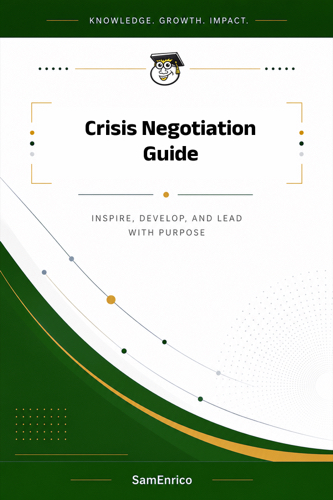
Non-FictionBusiness BriefCrisis
Crisis Negotiation Guide eBook
Uses principled methods under extreme time pressur
Uses principled methods under extreme time pressure and high stakes.
Formats
Free sample
Chapter 1: The 80/80 Suicide...--–- The conference room on the 47th floor had floor-to-ceiling windows overlooking the Hudson River, a mahogany table that cost more than most cars, and the stench of impending disaster. Eighteen million dollars sat on the table—eighteen million that my client, a mid-sized pharmaceutical company, stood to lose if the next thirty minutes went badly. Across from me sat three lawyers from a multinational distributor, each with a stack of papers neatly aligned like soldiers awaiting orders. Their lead negotiator, a woman named Carolyn with silver hair and reading glasses perched on her nose, had just delivered what she called their "final, non-negotiable position."I watched my client, a vice president named Marcus, grip the arm of his chair until his knuckles turned white. His breathing had shifted from normal to shallow.
His eyes had that glazed look people get when they are doing math in their heads—the terrible arithmetic of how much this was going to cost, how many jobs, how many bonuses, how many conversations with his CFO that he would rather never have."We need forty-eight hours," Marcus said, his voice just a little too high. "Just to review the numbers."Carolyn smiled the smile of someone who had done this a thousand times before. "The offer expires at five o'clock. That's thirty-one minutes from now. You can take it, or you can leave it.
Those are your only two options."I looked at my watch. 4:29 PM.In thirty-one minutes, Marcus was going to do something very stupid. I had seen it happen before. I had done it myself, years ago, before I learned what this chapter is going to teach you. Under extreme time pressure, even smart, experienced, rational people make the same predictable errors.
They rush to yes when they should walk away. They give away value they will never recover. They confuse motion with progress, activity with results, and fear with urgency.This chapter is about why that happens and how to stop it. It is the foundation of everything that follows.The Two Ways to Lose Under extreme time pressure, most negotiators commit one of two fatal errors. There is no third path.
You either become aggressive, or you become desperate. Both lose.The first error is what I call the Hardball Trap. When the clock starts screaming, some negotiators abandon all pretense of collaboration and shift into pure aggression. They make demands instead of requests. They threaten instead of explain.
They treat the other side as an enemy to be conquered rather than a counterpart to be convinced.Here is what the Hardball Trap looks like in practice: "You have ten minutes. Take this offer or we walk." "That is ridiculous and you know it." "I am not here to negotiate. I am here to tell you how this is going to work."The seduction of the Hardball Trap is obvious. It feels powerful. It feels decisive.
In movies, the tough negotiator always wins. But in real life, hardball tactics destroy long-term value. They burn relationships. They create hidden resistance that emerges later, after the deal is signed, in the form of slow-walked implementations, creative interpretations of vague terms, and the silent sabotage of people who felt steamrolled.I once watched a procurement executive named David use hardball tactics to extract a 12 percent price reduction from a supplier. He was proud of himself.
He came back to the office like a hunter displaying a trophy. Six months later, that supplier had reassigned its best account managers to other clients, "lost" three critical shipments during the busy season, and found creative ways to interpret the contract's quality standards that cost David's company more than the 12 percent they had saved. David won the battle and lost the war. He never understood why.The second error is the opposite and equally destructive. I call it the Rush-to-Yes Trap.
When the clock starts screaming, some negotiators panic and give away everything just to get a signature. They confuse agreement with success. They tell themselves they can fix the bad terms later, during implementation—a lie they will believe exactly once.The Rush-to-Yes Trap looks like this: "Okay, fine, we can accept that timeline." "I guess we can absorb that cost if it gets the deal done." "Let me check with my boss, but I am sure we can make it work."The seduction of the Rush-to-Yes Trap is the relief of closure. The human brain craves resolution. Unresolved tension feels like a physical weight.
When someone offers you a path to relief—"Just say yes and this will all be over"—your brain floods with the neurological equivalent of a sigh. You will say yes to almost anything to make the pressure stop.I learned this lesson in a negotiation room in Chicago ten years ago. I was representing a software company in a licensing dispute. The other side had given us a deadline of midnight. At 11:15 PM, after nine hours of back-and-forth, I was exhausted.
My head ached. My vision blurred when I looked at spreadsheets. The other side made a final offer that was still bad—not catastrophic, but bad—and I said yes just to go home.I walked out of that building at 12:30 AM feeling relieved. I woke up at 6:00 AM feeling sick. Over the next three months, that "yes" cost my client $340,000 in unexpected expenses that I had been too tired to foresee.
I had won the signature and lost the value.The Hardball Trap and the Rush-to-Yes Trap are the Scylla and Charybdis of high-stakes negotiation. One destroys relationships. The other destroys value. Every negotiator under time pressure is navigating between them.This book exists because there is a third path.The Principled Trinity The third path rests on three pillars that must be maintained simultaneously. I call them the Principled Trinity: Rapport, Leverage, and Integrity.Sacrifice any one of these three, and the entire negotiation collapses into one of the two traps.
Lose rapport, and you default to hardball. Lose leverage, and you default to rushing to yes. Lose integrity, and you lose everything—because once you are caught in a lie or a manipulation, your credibility never recovers.Let me define each pillar precisely because these words get thrown around carelessly in business literature.Rapport is not friendship. You do not need to like the other person, and they do not need to like you. Rapport is the absence of defensiveness.
It is the state in which the other party stops preparing their counterargument while you are still talking. It is measured by a single observable metric: do they interrupt you? If they interrupt, you have no rapport. If they let you finish your sentences, even when they disagree, you have rapport.Rapport is built through a specific set of behaviors that we will cover in detail in Chapter 3. For now, understand that rapport is the lubricant of difficult conversations.
Without it, every exchange is an argument. With it, even sharp disagreements become problem-solving sessions.Leverage is not power. Power is the ability to force someone to do something they do not want to do. Leverage is the ability to make the other…
This is the end of the free sample. Get the eBook to keep going. Buy now
About this book
Details
- Author
- Mcintire Raylene
- Publisher
- SamEnrico
- Language
- English
- Genre
- Non-Fiction, Business Brief, Crisis
- Released
- 2026-06-09
- Pages (approx.)
- 129
- Available as
- eBook, Audiobook

Read better in the ZLOADR app
Your eBooks on your phone or tablet. Sign in with your SamEnrico account and start reading.
More by Mcintire Raylene
 The Self Compassion at Work HandbookMcintire Raylene$11.99
 Interruption ResearchMcintire Raylene$11.99
 Gambling Addiction and Gambling Triggers DiaryMcintire Raylene$11.99
 The Verbal Working Memory GuideMcintire Raylene$11.99
 Pinterest Perfection RecoveryMcintire Raylene$11.99
 Exercise for Divorce RecoveryMcintire Raylene$11.99
 Environmental Legacy GuideMcintire Raylene$11.99
 The Bloodied Fields of Fontenoy: The Last Great Cavalry Charge of EuropeMcintire Raylene$11.99
 The Last Voyage of the *Kaiwo Maru*: A Forgotten Arctic ExpeditionMcintire Raylene$11.99
 How to Produce Industrial Filtration EquipmentMcintire Raylene$11.99
 A Collector's Handbook to the Riley 2.6Mcintire Raylene$11.99
 Anomaly Detection for Expense AuditsMcintire Raylene$12.99
You may also like
 Hong Kong Handover 1997Dunn Johnnie$11.99
 Zumba For Postnatal Recovery CourseNeal Christian$11.99
 Zumba for BeginnersLadner Nikia$11.99
 YouTube Comment Mining GuideHumes Pandora$12.99
 Worry Box MeditationCarlin Rudy$11.99
 Workplace Stress MeditationNguyen Lynn$11.99
 Workplace Stress and Sleep RepairHawley Ivory$11.99
 Workplace Perfectionism CureDelaney Jeffry$11.99
 Workplace Injustice Anger GuideWallen Isabelle$11.99
 Work Addiction and Burnout LinkGreenwood Ester$11.99
 Women in Yoga and WellnessBeattie Galina$11.99
 Women in Stand Up ComedyChun Evangeline$11.99