
Non-FictionSelf-HelpCrisis Counseling
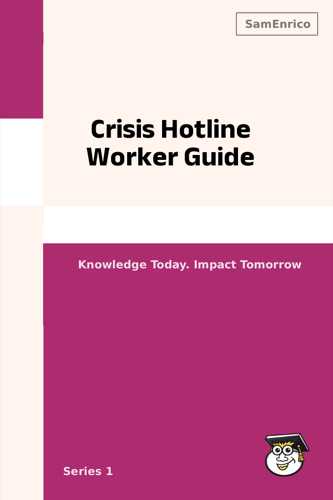
Crisis Hotline Worker Guide Audiobook
Secondary trauma from suicide and abuse calls.
Secondary trauma from suicide and abuse calls.
Formats
Free sample
Chapter 1: The Biology of Broken Calls--–- The phone rings. You take a breath. You answer. And in the next thirty seconds, a stranger will pour their worst moment into your ear—suicide plans, childhood rape, the sound of their own sobbing. You will stay calm.
You will say the right things. And when the call ends, you will hang up and take another breath. But something will stay with you. Not the words, exactly. The feeling.
A low hum of dread that follows you home, sits next to you during dinner, lies down beside you at 2 a.m. That hum has a name. It has a biology. And if you do not understand it, it will end your career before you ever burn out.This chapter is not a warm welcome. It is not an inspirational pep talk about how noble and selfless you are.
You already know you are doing difficult work. What you may not know is that your body is processing every call as if you were the one in danger. Your heart rate rises when a caller describes being strangled. Your palms sweat when you hear the click of a gun being checked for ammunition. Your sleep fragments because your nervous system cannot tell the difference between listening to trauma and experiencing it.
That is not weakness. That is physiology. And once you understand the anatomy of a crisis call—the stress-crisis-trauma continuum, the window of tolerance, the two types of dissociation, and the critical distinction between cognitive and emotional empathy—you will stop fighting your own body and start working with it.Let us begin with what happens the moment your finger touches the answer button.The Stress-Crisis-Trauma Continuum Every call exists somewhere on a continuum. At one end is stress—the caller is upset, maybe crying, but they can still tell you their address, follow simple directions, and make decisions. At the middle is crisis—the caller is overwhelmed, their thinking is fragmented, and they cannot see a way out.
At the far end is trauma—the event is still happening (an abuser is in the next room, a hand is tightening around a throat) or has just happened so recently that the caller’s brain has not yet begun to process it. Your job is to identify where on this continuum the caller currently sits, because each position requires a completely different intervention.A caller…
This is the end of the free sample. Get the Audiobook to keep going. Buy now
About this book
Details
- Author
- Cardillo Towanda
- Publisher
- SamEnrico
- Language
- English
- Genre
- Non-Fiction, Self-Help, Crisis Counseling
- Released
- 2026-06-05
- Pages (approx.)
- 142
- Available as
- eBook, Audiobook

Listen in the VoxFlicks app
Audiobooks and audio dramas wherever you go. Sign in with your SamEnrico account and press play.
More by Cardillo Towanda
 The Boat People ReunionCardillo Towanda$11.99
 Nurse Shift Work StressCardillo Towanda$11.99
 NVC For Anxiety ConversationsCardillo Towanda$11.99
 The Iron Forges of Meroë: Blacksmiths of the NileCardillo Towanda$11.99
 Warehouse PickerCardillo Towanda$11.99
 How to Produce Billiard Cue CasesCardillo Towanda$11.99
 Annual Attack Drill ScheduleCardillo Towanda$12.99
 Ultimate Handbook Guide to Contagem : (Brazil) Travel GuideCardillo Towanda$11.99
You may also like
 Hong Kong Handover 1997Dunn Johnnie$11.99
 Zumba For Postnatal Recovery CourseNeal Christian$11.99
 Zumba for BeginnersLadner Nikia$11.99
 YouTube Comment Mining GuideHumes Pandora$12.99
 Worry Box MeditationCarlin Rudy$11.99
 Workplace Stress MeditationNguyen Lynn$11.99
 Workplace Stress and Sleep RepairHawley Ivory$11.99
 Workplace Perfectionism CureDelaney Jeffry$11.99
 Workplace Injustice Anger GuideWallen Isabelle$11.99
 Work Addiction and Burnout LinkGreenwood Ester$11.99
 Women in Yoga and WellnessBeattie Galina$11.99
 Women in Stand Up ComedyChun Evangeline$11.99