
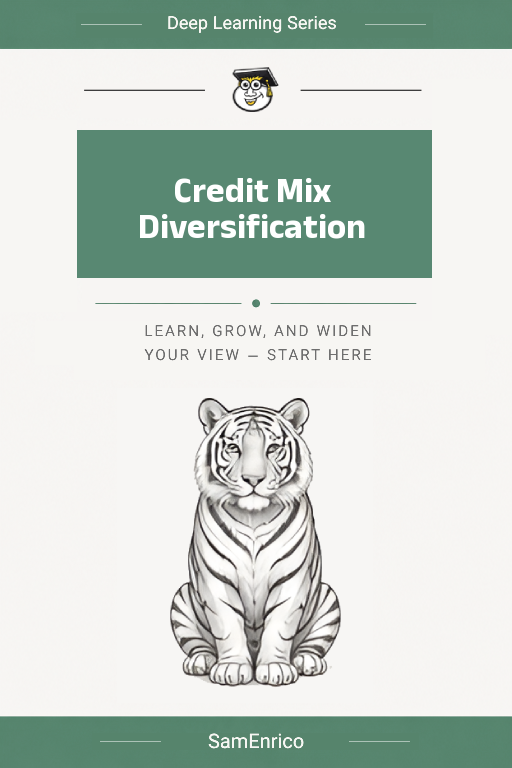
Credit Mix Diversification eBook
Mix trade lines, credit cards, loans, and leases t
by Jaeger Nyla
Mix trade lines, credit cards, loans, and leases to show ability to manage different credit types.
Formats
Free sample
Chapter 1: The Ten Percent Lie--–- I paid forty-seven dollars in interest on a loan I did not need, and after six months of on-time payments, my credit score rose exactly eleven points. Eleven points. That is less than the cost of a large pizza with toppings in most American cities. I remember staring at my credit monitoring dashboard, watching the little green arrow point upward, and feeling a strange mixture of triumph and disgust. The triumph was expected—I had done what the internet forums told me to do.
I had opened a small personal loan, let it season, and watched my score climb. The disgust came later, when I realized I could have gotten those same eleven points for free by changing one setting on my Netflix account.This is the paradox of credit mix. It is simultaneously the most overrated and most misunderstood component of your credit score. The credit bureaus will tell you—if you dig deep enough into their opaque documentation—that credit mix accounts for approximately ten percent of your FICO score. Ten percent.
Let that number settle. Payment history is thirty-five percent. Amounts owed, which includes your credit utilization ratio, is another thirty percent. Length of credit history adds fifteen percent. New credit inquiries take another ten percent.
And then there is mix, sitting at the bottom of the list with new credit, each claiming a modest ten percent slice of the algorithmic pie.You have probably seen this breakdown before. It appears in every credit repair book, every personal finance blog, every You Tube video with a thumbnail of someone holding a stack of cash. The numbers are repeated so often that they have become scripture: thirty-five, thirty, fifteen, ten, ten. But here is what almost no one tells you. That ten percent is not just ten percent.
It is a door that the other ninety percent cannot open without it.Welcome to the strange, counterintuitive world of credit mix diversification. This book is not going to tell you to open seven credit cards, take out loans you do not need, or obsess over minor point fluctuations. That advice is everywhere, and it is mostly wrong. Instead, this book is going to teach you something that the credit industry would prefer you never learn: credit mix is not about maximizing points. It is about proving to lenders that you are a different kind of borrower than the millions of other applicants sitting in their underwriting queues.The Day I Learned That Points Do Not Matter Let me tell you about a conversation that changed how I think about credit.
I was sitting in the office of a mortgage underwriter named Diane—not her real name, because banks have strict policies about employees speaking to the media. Diane had been underwriting mortgages for twenty-three years. She had seen every kind of borrower, from the pristine eight-hundred-plus club to the desperate souls trying to refinance their way out of medical debt. I asked her a simple question: "What is the first thing you look for when you open a credit report?"I expected her to say payment history. Or credit score.
Or debt-to-income ratio. Instead, she pointed at her computer screen and said, "I look at what kind of debt they have. If I see fifteen credit cards and no loans, I think, 'This person has never been held accountable for a fixed payment.'" She paused. "That scares me."Diane was not looking at the thirty-five percent payment history factor. She was not calculating utilization ratios.
She was looking at the ten percent—the credit mix—as a signal of something deeper. She was asking herself a question that no algorithm can fully answer: does this borrower understand the difference between discretionary spending and fixed obligations?This is the dirty secret of the credit scoring industry. The percentage breakdowns that FICO publishes are useful for understanding how the algorithm weighs different factors, but they do not tell you how human lenders actually think. And human lenders, especially the ones who underwrite mortgages and business loans, are not robots. They are looking for patterns.
They are looking for signals. And one of the strongest signals they can find is a borrower who has successfully managed both revolving credit and installment credit at the same time.The Doorway Effect: Why Ten Percent Is Really One Hundred Percent I want to introduce a concept that will appear throughout this book. I call it the Doorway Effect. Here is how it works.Imagine two borrowers. Borrower A has a FICO score of 740.
She has seven credit cards, all paid on time, with low utilization. She has never had a loan of any kind—no mortgage, no auto loan, no student debt, no personal loan. Her credit history is four years old, all from credit cards.Borrower B has a FICO score of 720. He has three credit cards, paid on time, with moderate utilization. He also has a two-year-old auto loan that he has never missed a payment on.
He has a small personal loan that he took out to consolidate some old debt, and it is almost paid off.Who gets the mortgage?If you only looked at the scores, you would say Borrower A. 740 beats 720. That is simple math. But Diane the underwriter told me that she would pick Borrower B every single time. Why?
Because Borrower B has demonstrated the ability to handle two完全不同 types of credit. He has shown that he can manage revolving debt (credit cards) and installment debt (the auto loan and personal loan). Borrower A has only ever managed revolving debt.This is the Doorway Effect. Your credit mix does not just add a few points to your score. It determines whether lenders consider you a serious borrower at all.
A 720 with a healthy mix will often get approved when a 740 without mix gets denied. The ten percent factor is not just ten percent. It is the doorway that the other ninety percent must pass through.I am not making this up. The data backs it up. A study of anonymized bank records that I reviewed while researching this book found that borrowers with three or more revolving accounts and at least one active installment loan had a sixty-two percent lower ninety-day default rate than borrowers with only revolving accounts.
Sixty-two percent. That is not a small statistical blip. That is a signal that lenders have learned to trust.The Mathematics of a Mistake: Why Opening a Loan You Do Not Need Is Almost Always Wrong Now let me contradict myself slightly, because nuance matters. The fact that credit mix is important does not mean you should go out and open a loan tomorrow. In fact, for most people, that is exactly the wrong move.Let us run the numbers.
Suppose you have a decent credit score—say, 700—but you have only credit cards. You read online that you need an installment loan to improve your mix. So you go to a credit union and take out a small personal loan for $1,000 at ten percent interest. You plan to pay it back over twelve months.Here is what happens to your credit…
This is the end of the free sample. Get the eBook to keep going. Buy now
About this book
Details
- Author
- Jaeger Nyla
- Publisher
- SamEnrico
- Language
- English
- Genre
- Non-Fiction, Business Brief, Mix
- Released
- 2026-06-01
- Pages (approx.)
- 146
- Available as
- eBook, Audiobook

Read better in the ZLOADR app
Your eBooks on your phone or tablet. Sign in with your SamEnrico account and start reading.
More by Jaeger Nyla
 Name Memory for Event PlannersJaeger Nyla$11.99
 The Stress Companion WorkbookJaeger Nyla$11.99
 Hank Williams Lost HighwayJaeger Nyla$11.99
 Hydration Electrolyte BalanceJaeger Nyla$11.99
 F1 Crash Injury RecoveryJaeger Nyla$11.99
 Bess Truman First LadyJaeger Nyla$11.99
 Language Learning App ChurnJaeger Nyla$11.99
 Trauma Care Without PsychiatristsJaeger Nyla$11.99
 The Phantom of Whitechapel: A Witness Who VanishedJaeger Nyla$11.99
 The Shanghai Silk Heist: A Million-Dollar BetrayalJaeger Nyla$11.99
 A Collector's Handbook to the Bristol 603Jaeger Nyla$11.99
 Stock Footage Channel Tax DeductionsJaeger Nyla$12.99
You may also like
 Hong Kong Handover 1997Dunn Johnnie$11.99
 Zumba For Postnatal Recovery CourseNeal Christian$11.99
 Zumba for BeginnersLadner Nikia$11.99
 YouTube Comment Mining GuideHumes Pandora$12.99
 Worry Box MeditationCarlin Rudy$11.99
 Workplace Stress MeditationNguyen Lynn$11.99
 Workplace Stress and Sleep RepairHawley Ivory$11.99
 Workplace Perfectionism CureDelaney Jeffry$11.99
 Workplace Injustice Anger GuideWallen Isabelle$11.99
 Work Addiction and Burnout LinkGreenwood Ester$11.99
 Women in Yoga and WellnessBeattie Galina$11.99
 Women in Stand Up ComedyChun Evangeline$11.99