
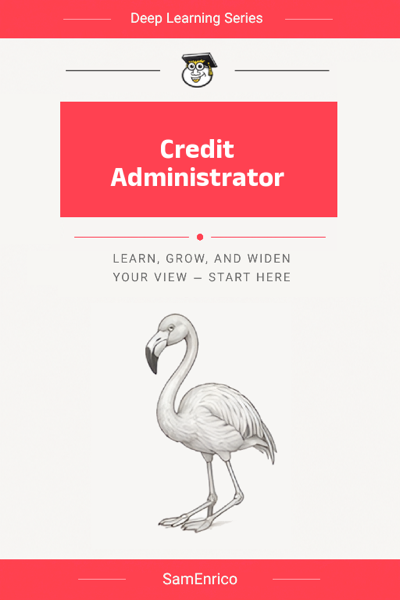
Non-FictionInformativeEducational
Credit Administrator eBook
A Coursebook on Credit Administrator
A Coursebook on Credit Administrator
Formats
Free sample
Chapter 1: The Gatekeeper’s Dilemma--–- The first time I watched a credit administrator make a $10 million decision, he didn’t lean back in his chair, stroke his chin, or ask for another spreadsheet. He leaned forward, picked up the phone, and called a customer he had never met. “Tell me about your mother’s illness,” he said. The borrower on the other end went silent, then cried. That loan was approved with looser covenants than the model recommended.
It paid back in full. The next week, the same administrator declined a brand-new customer with perfect financials, a pristine Dun & Bradstreet report, and a personal guarantee from a known philanthropist. “Something feels wrong,” he told me. Six months later, that borrower was indicted for accounting fraud.This is not a book about spreadsheets, though you will master them. It is not a book about ratios, though you will calculate thousands.
It is a book about judgment—the kind of judgment that sits at the intersection of hard data and human instinct, of policy and exception, of profit and prudence. The credit administrator is the person standing between a company’s ambition and its ruin. Every day, in banks, manufacturing firms, wholesale distributors, and fintech lenders, someone decides who gets money and who does not. That someone is you, or will be you.Before we dive into the mechanics of cash flow analysis, the intricacies of the Uniform Commercial Code, or the mathematics of probability of default, we must first understand what this role actually is—and what it is not. The popular imagination pictures a credit administrator as a bureaucrat in a gray cubicle, stamping “DENIED” on loan applications while salespeople roll their eyes.
That image is not only wrong; it is dangerous. The modern credit administrator is a strategic partner, a data scientist, a psychologist, a diplomat, and sometimes a detective. And when a loan goes bad, that same administrator becomes a legal warrior, a negotiator, and occasionally the bearer of devastating news.This chapter establishes the foundation for everything that follows. We will trace the historical evolution of credit administration from a clerical back-office function to a strategic profit driver. We will examine the three forces reshaping the profession today: e-commerce, supply chain finance, and artificial intelligence.
We will explore the dual mandate—the constant, unending tension between mitigating default risk and supporting revenue growth. We will introduce the ethical codes that separate professionals from amateurs. And we will, through stories and case studies, begin to develop the mindset that separates great credit administrators from merely competent ones.By the end of this chapter, you will understand not just what a credit administrator does, but why the role matters more today than at any point in the last century. You will see that every “yes” creates growth, every “no” prevents disaster, and every “maybe” is an art form. And you will be ready to begin the journey from aspiring analyst to strategic gatekeeper.The Historical Evolution: From Clerk to Strategist A century ago, the credit administrator—though not yet called that—was a clerk with a ledger book and a black pen.
His job was simple: track who paid late and report to the owner. Decisions were made on handshakes and reputations. If you knew a merchant’s father, you extended credit. If you heard a rumor at church, you tightened terms. There were no credit scores, no automated underwriting, no regulatory capital requirements.
There was only judgment, often flawed, and relationships, often exploited.The Great Depression changed everything. Banks failed not because they made bad loans to strangers but because they made loans to friends who turned out to be broke. In response, the modern credit function began to take shape. Commercial credit reporting agencies like Dun & Bradstreet (founded in 1841 but expanded dramatically after the Depression) systematized the collection of trade payment data. The first formal credit policies emerged: rules about maximum exposure, required financial statements, and approval hierarchies.
The credit administrator became a gatekeeper, and the gate was heavy.For the next fifty years, the role remained largely reactive. A salesperson would bring a deal to the credit department. The credit administrator would request financial statements, call three trade references, pull a credit report, and return a verdict. The relationship was adversarial more often than collaborative. Sales called credit “the deal killers.” Credit called sales “the cowboys.” Neither side trusted the other, and the customer—the borrower—was caught in the middle.The 1990s brought the first wave of data-driven credit scoring.
Large banks began using statistical models to predict default, replacing some (but not all) human judgment. The credit administrator’s job shifted from “say yes or no” to “interpret what the model says and decide whether to override.” This was uncomfortable. Many veteran credit administrators had built careers on instinct, and suddenly a computer was second-guessing them. The best adapted, learning to use models as tools rather than oracles. The worst fought the change and were eventually replaced.The 2008 financial crisis was the crucible that forged the modern credit administrator.
When mortgage-backed securities collapsed and banks realized that their models had systematically underestimated risk, the profession faced an existential question: If the models failed so spectacularly, what is the value of human judgment? The answer, it turned out, was everything—but only when combined with rigorous data. The post-crisis era gave us the Basel III framework, which demanded more sophisticated risk measurement (which we will cover in Chapters 8 and 12), but also demanded that banks have “qualified personnel” making credit decisions. The gatekeeper became a guardian.Today, the credit administrator sits at the intersection of three powerful trends: the digitization of commerce, the financialization of supply chains, and the automation of underwriting. E-commerce has compressed order-to-cash cycles from weeks to hours.
Cross-border trade means that a credit administrator in Chicago might approve a loan to a supplier in Vietnam based on real-time shipping data from Rotterdam. Supply chain finance—dynamic discounting, reverse factoring, payables financing—has blurred the line between trade credit and bank lending. And artificial intelligence is now capable of analyzing thousands of data points in milliseconds, flagging anomalies that no human would notice.Yet the core of the role remains unchanged. A credit administrator decides whether to trust another human being with someone else’s money. That decision cannot be fully automated, because trust is not a data point.
It is a story.The Dual Mandate: Profit vs. Safety Every credit administrator lives with a fundamental tension written into the job description, though rarely in the actual words. I call it the dual mandate. On one side, you are responsible for mitigating default risk—ensuring that the company does not lose money on bad loans. On the other side, you are responsible for supporting revenue growth—enabling the company to make profitable loans that generate interest income, fees, and customer loyalty.These two responsibilities are not merely in tension; they are often in direct opposition.
The safest loan is no loan at all. A credit administrator who never approves anything will have a perfect loss ratio and will also be fired for killing the business. Conversely, a credit administrator who approves everything…
This is the end of the free sample. Get the eBook to keep going. Buy now
About this book
Details
- Author
- Baumgartner Erich
- Publisher
- SamEnrico
- Language
- English
- Genre
- Non-Fiction, Informative, Educational
- Released
- 2026-05-04
- Pages (approx.)
- 160
- Available as
- eBook, Audiobook

Read better in the ZLOADR app
Your eBooks on your phone or tablet. Sign in with your SamEnrico account and start reading.
More by Baumgartner Erich
 Familial Migraine GuideBaumgartner Erich$11.99
 Active Listening For HR ProfessionalsBaumgartner Erich$11.99
 Lunch Break Recovery TechniquesBaumgartner Erich$11.99
 Meth Employment Re entry GuideBaumgartner Erich$11.99
 The Butcher of Buenos Aires: The Gruesome Reign of Cayetano Santos GodinoBaumgartner Erich$11.99
 Multilingual Technical DocumentationBaumgartner Erich$12.99
 Learn to Play the PibgornBaumgartner Erich$11.99
 How to Start a Dental Clinic (health Service) Business (Beginners Guide)Baumgartner Erich$11.99
You may also like
 Hong Kong Handover 1997Dunn Johnnie$11.99
 Zumba For Postnatal Recovery CourseNeal Christian$11.99
 Zumba for BeginnersLadner Nikia$11.99
 YouTube Comment Mining GuideHumes Pandora$12.99
 Worry Box MeditationCarlin Rudy$11.99
 Workplace Stress MeditationNguyen Lynn$11.99
 Workplace Stress and Sleep RepairHawley Ivory$11.99
 Workplace Perfectionism CureDelaney Jeffry$11.99
 Workplace Injustice Anger GuideWallen Isabelle$11.99
 Work Addiction and Burnout LinkGreenwood Ester$11.99
 Women in Yoga and WellnessBeattie Galina$11.99
 Women in Stand Up ComedyChun Evangeline$11.99