
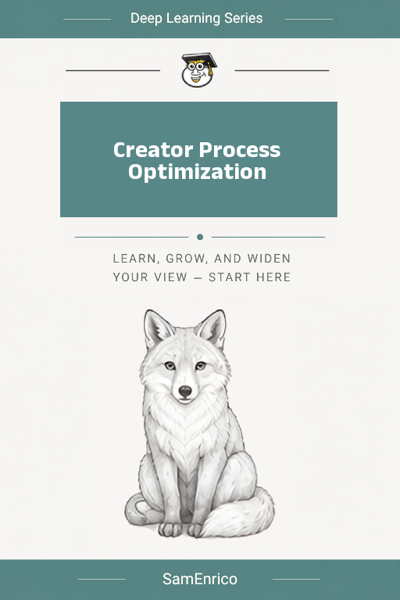
Creator Process Optimization eBook
A Coursebook on Creator Process Optimization
A Coursebook on Creator Process Optimization
Formats
Free sample
Chapter 1: The Resistance Audit--You have forty-seven unfinished drafts. A notes app overflowing with “brilliant ideas” you will never revisit. A quiet, growing resentment for the passion project you once claimed to love. And every morning, you open your laptop, stare at the blinking cursor, and feel a familiar wave of nausea that you have learned to call by the wrong name.You call it procrastination.I call it Resistance. And it is not a time management problem.Before you can optimize a single minute of your calendar, before you can batch a single video or train a single AI prompt, you must diagnose why you are avoiding the work in the first place.
Because here is the uncomfortable truth that most productivity books will not tell you: you can have the perfect system, the perfect template, the perfect schedule, and still produce nothing. Systems do not fail because they are poorly designed. Systems fail because the person running them finds a thousand creative ways to not press publish.This chapter is not about efficiency. It is about honesty.The Procrastination Lie You Have Been Telling Yourself Let us start with a radical reframe that will either liberate you or annoy you. Ready?You are not lazy.Read that again.
You are not lazy. Lazy people do not feel guilty about being lazy. Lazy people do not spend three hours watching lighting tutorials when they should be filming. Lazy people do not reorganize their hard drive by color code instead of editing that video. Lazy people do not read ten books on SEO before writing a single newsletter.
Lazy people simply do nothing and feel fine about it.You are not fine about it. You are exhausted, anxious, and secretly ashamed. That is not laziness. That is fear wearing a productivity costume.Procrastination is not a time management problem. It is an emotional regulation problem.
This is not my opinion; it is the consensus of decades of psychological research. When you avoid a creative task, your brain is not malfunctioning. It is protecting you from a perceived threat. What threat? Judgment.
Failure. The terrifying realization that you might try your hardest and still produce something mediocre. The blank page is not the problem. What the blank page represents is the problem: a mirror that will reflect back exactly how good you actually are.Your brain would rather do almost anything than look into that mirror.The Two Faces of Creative Avoidance Not all procrastination looks like scrolling Tik Tok for three hours. In fact, the most dangerous form of procrastination often wears a mask of productivity.
This chapter draws a critical distinction between two very different animals.Lazy Procrastination Lazy procrastination is what most people think of when they hear the word. It is deliberate, low-value, and you know exactly what you are doing. You choose to watch Netflix instead of working. You play video games instead of writing. You scroll social media instead of recording.
Lazy procrastination feels guilty, but it is honest. You are not pretending to work. You are simply choosing not to.Here is the surprising truth: lazy procrastination is actually easier to fix than the other kind. Because when you are being lazy, you know it. There is no self-deception to untangle.
You just need better discipline, better accountability, or simply to admit that you do not actually want to do this project.The real enemy is the second kind.Creative Procrastination Creative procrastination is the wolf in sheep’s clothing. It looks like work. It feels like work. You might even describe it as work to your partner or your therapist. But it is not the work.
It is the work adjacent.Creative procrastination is watching one more lighting tutorial instead of filming. It is reading a tenth book on SEO instead of writing a single post. It is reorganizing your hard drive, creating a new Notion database, designing a logo, researching cameras, or building a content calendar for a channel that does not exist yet. All of these activities are useful in small doses. But when they become a substitute for the actual creative act, they are poison.Here is how to tell if you are creatively procrastinating: ask yourself whether this activity is moving you closer to publishing something today.
Not this week. Not this month. Today. If the answer is no, you are likely avoiding the thing that scares you.Creative procrastination is especially dangerous because it generates plausible deniability. You can tell yourself you are “preparing” or “researching” or “getting organized.” And those things are not lies.
You are preparing. You are researching. You are getting organized. But you are also hiding. The preparation has become a permanent residency rather than a brief layover on the way to actual creation.The Neuroscience of Avoidance Why does your brain do this?
Why would it rather watch a lighting tutorial for the fourth time than just film the damn video?The answer lives in your anterior cingulate cortex, a small region of your brain that processes both physical pain and social pain. Neuroimaging studies have shown that the same neural circuitry that activates when you touch a hot stove also activates when you anticipate being judged by others. Your brain literally cannot tell the difference between burning your hand and receiving a negative comment on a video you poured your heart into.When you sit down to create something original, your brain runs a rapid threat assessment. Here is what it finds: you are about to produce something that did not exist before. That thing will be seen by others.
Those others might laugh at it, ignore it, or criticize it. All of these outcomes are uncertain. And your brain hates uncertainty more than it hates almost anything else. Uncertainty is, to your ancient neural architecture, a survival threat.So your brain offers you an escape hatch. It suggests a “useful” task instead.
Organize those files. Clean that desk. Watch that tutorial. Research that platform. These tasks feel productive.
They generate small hits of dopamine. And they carry zero risk of judgment because no one will ever see your organized hard drive.You are not fighting laziness. You are fighting a neurological pain response that has been honed over millions of years of evolution. That is a much bigger opponent. But it is also one you can learn to outsmart.Invisible Work: The Productivity Killer No One Talks About There is a term for the kind of work that feels productive but produces no output.
I call it invisible work.Invisible work is the rumination you do while staring at the ceiling. It is the decision paralysis that eats your afternoon. It is the perfectionist research that turns a twenty-minute script into a three-day rabbit hole. It is the mental rehearsal of conversations you will never have, the imaginary scenarios you run through before recording, the quiet self-negotiation about whether today is really the right day to start.Invisible work is exhausting. It drains your cognitive reserves without leaving any trace.
You can spend six hours on invisible work and have absolutely nothing to show for it except a vague sense of having…
This is the end of the free sample. Get the eBook to keep going. Buy now
About this book
Details
- Author
- Beasley Werner
- Publisher
- SamEnrico
- Language
- English
- Genre
- Non-Fiction, Informative, Educational
- Released
- 2026-05-04
- Pages (approx.)
- 123
- Available as
- eBook, Audiobook

Read better in the ZLOADR app
Your eBooks on your phone or tablet. Sign in with your SamEnrico account and start reading.
More by Beasley Werner
 Fifteen Minute Micro BlocksBeasley Werner$11.99
 Nap WorkbookBeasley Werner$11.99
 Road Rage and Out of State DriversBeasley Werner$11.99
 MACRS Depreciation Schedule GuideBeasley Werner$11.99
 Crown Dream Jungian ViewBeasley Werner$11.99
 The 10 10 10 Morning RuleBeasley Werner$11.99
 Association TechniquesBeasley Werner$11.99
 Immigrant PR Agency Founder MemoirBeasley Werner$11.99
 NVC For Co ParentingBeasley Werner$11.99
 Pets.com: The $300 Million Puppy BowlBeasley Werner$11.99
 The Fox of the North: Peter the Great's War to Reshape RussiaBeasley Werner$11.99
 Bootstrapper Cash Flow Statement WorkbookBeasley Werner$12.99