
Non-FictionStartup GuideCreator Economy
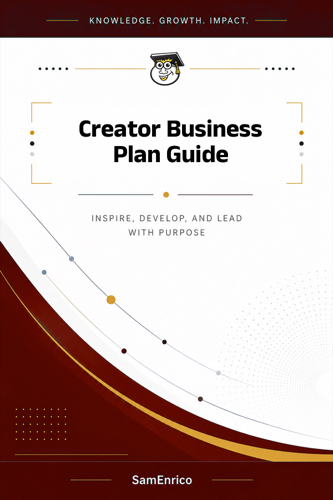
Creator Business Plan Guide eBook
Plan audience building, content production, and mo
by Munn Jacque
Plan audience building, content production, and monetization for creators.
Formats
Free sample
Chapter 1: The Tension Spot--–- Most creators begin in the wrong place. They open a laptop, pick a topic they enjoy—cooking, video games, fitness, marketing—and start posting. They call this "finding their niche." They believe that if they just keep creating content about that topic, an audience will eventually materialize. Then monetization. Then freedom.This is the standard advice.
It is also, for the vast majority of creators, a slow path to burnout and disappointment.The problem is not effort. The problem is the starting point. A niche—a category of content—is static. It says nothing about why anyone should care. You can be the world's most passionate creator about antique typewriters or vegan baking or Java Script frameworks, and still build zero audience because no one feels a need for what you're making.
Passion without tension is just noise.This chapter introduces a different foundation. Not a niche. Not a topic. Not a category. A Tension Spot—the specific, unresolved contradiction or frustration your target audience feels daily but cannot articulate.
Tensions create urgency. Urgency creates attention. Attention, when directed consistently, becomes trust. And trust is the only thing that converts into revenue.By the end of this chapter, you will not have a niche. You will have a tension so sharp that your ideal audience will feel it in their gut when they read a single sentence.
And you will know, with certainty, that you are solving something they actually want solved.The Niche Trap: Why Categories Don't Create Customers Let us name the lie first, so we can bury it.The lie is this: "Find your niche and dominate it."This advice comes from good intentions. Specialization is valuable. Being known for something specific is better than being known for nothing. But the advice confuses category with value proposition. A niche tells you what you make.
It does not tell anyone why they should care.Consider two creators. Creator A says, "I make videos about productivity." Creator B says, "I help overworked freelancers stop feeling guilty about taking Sundays off." Both could produce similar content—time-blocking techniques, task management tools, morning routines. But Creator B has identified a tension. The tension is not "lack of productivity." The tension is guilt about rest. That is a specific emotional contradiction: wanting to work less but feeling broken when you do.
Creator B's audience will watch every video not because they need another time-management tip, but because they need permission to stop hating themselves for taking a break.The niche approach asks: "What topic do I enjoy?" The Tension Spot approach asks: "What problem is my audience frustrated by, stuck in, or secretly ashamed of?"Most creators skip the second question. They jump from "I like cooking" to "I will post cooking videos." Then they wonder why the algorithm ignores them. The algorithm is not ignoring them. The algorithm is reflecting reality: no one wakes up searching for "another cooking video." People wake up searching for "how do I cook dinner in 15 minutes when I'm exhausted from work and my kids are screaming." That is a tension. The niche is cooking.
The tension is time-scarce parents who want to feed their families without losing their minds.Defining the Tension Spot: Three Essential Components A true Tension Spot has exactly three components. Miss one, and you have a weak spot that will not sustain attention.Component One: A Specific Audience with a Shared Identity The audience cannot be "everyone" or "millennials" or "small business owners." It must be narrow enough that the audience recognizes themselves instantly. "Freelance graphic designers who work from home" is better than "creatives." "First-time managers under 30 who feel imposter syndrome" is better than "leaders." The shared identity creates an instant tribal connection: you are like me.Component Two: A Contradiction or Unresolved Frustration This is the emotional engine. The contradiction must be something the audience has tried to solve and failed—or believes is unsolvable. Examples:"I want to save for retirement, but every finance book makes me feel stupid.""I want to grow my Instagram account, but I hate playing the algorithm game.""I want to start a side business, but I'm terrified my boss will find out."Notice that each example contains the word "but." The "but" is the tension.
Without it, you have a simple desire ("I want to save money"). With it, you have a conflict. Conflicts create stories. Stories create attention.Component Three: A Clear Consequence of Not Solving the Tension If the tension remains unresolved, what happens? The freelancer keeps undercharging.
The manager keeps feeling like a fraud. The parent keeps serving frozen chicken nuggets and feeling guilty. The consequence must be tangible and painful. Vague consequences ("I'll be unhappy") do not create urgency. Specific consequences ("I'll lose $10,000 this year because I'm too scared to raise my rates") create a countdown clock.When all three components align, you have a Tension Spot that can power a creator business for years.The 3-Box Test: Finding Your Tension Spot Theory is useful.
Application is everything. This section introduces The 3-Box Test—a repeatable process for identifying your Tension Spot, whether you are a complete beginner or an established creator looking to pivot.Draw three overlapping circles on a piece of paper (or open a blank document). Label them:Box 1: Passion — What could you talk about for hours without getting bored? What topics do you consume in your free time? What problems have you personally overcome?
Do not censor yourself here. Passion alone does not build a business, but without it, you will burn out before the first dollar arrives.Box 2: Skill — What are you objectively good at? What have people paid you for in the past? What certifications, degrees, or informal expertise do you possess? Skill does not require formal credentials.
Ten thousand hours of parenting is a skill. Recovering from debt is a skill. Navigating corporate politics is a skill. If you have done it repeatedly and successfully, it counts.Box 3: Market Hunger — This is the box most creators ignore. Market hunger asks: "What are people actively searching for, frustrated by, or spending money to solve?" Hunger is not "this would be nice." Hunger is "I will pay to make this problem go away." To assess hunger, look for:Existing paid products (courses, coaching, software) with good reviews Online communities (Reddit, Facebook groups) where people ask the same questions repeatedly Search volume (use free tools like Answer The Public or Google autocomplete)Competitors who are clearly making money (multiple ads running, large followings, premium pricing)The Tension Spot lives in the intersection of all three boxes.
Passion without hunger is a hobby. Skill without passion is a job you will eventually hate. Hunger without skill is a opportunity you cannot execute.Case Study: Finding the Intersection Consider a creator who loves fitness (Passion), has trained for marathons (Skill), but the fitness market is saturated (low Hunger? Not necessarily). She digs deeper.
She notices that in online running forums, a specific question appears constantly: "How do I train for a marathon when I have a 50-hour work week and three kids?" The tension is not "how to run." The tension…
This is the end of the free sample. Get the eBook to keep going. Buy now
About this book
Details
- Author
- Munn Jacque
- Publisher
- SamEnrico
- Language
- English
- Genre
- Non-Fiction, Startup Guide, Creator Economy
- Released
- 2026-06-08
- Pages (approx.)
- 147
- Available as
- eBook, Audiobook

Read better in the ZLOADR app
Your eBooks on your phone or tablet. Sign in with your SamEnrico account and start reading.
More by Munn Jacque
 Space and Layout InfluenceMunn Jacque$11.99
 Online Casino Self Exclusion GuideMunn Jacque$11.99
 Money Anxiety Coping GuideMunn Jacque$11.99
 The Wool Barons of Australia: Spinning Gold from the OutbackMunn Jacque$11.99
 Learn to Play the Lyra (Byzantine)Munn Jacque$11.99
 India Job Notice Period GuideMunn Jacque$12.99
 How to Start a Bottles Made of Plastic Business (Beginners Guide)Munn Jacque$11.99
 Microcline MiningMunn Jacque$11.99
You may also like
 Hong Kong Handover 1997Dunn Johnnie$11.99
 Zumba For Postnatal Recovery CourseNeal Christian$11.99
 Zumba for BeginnersLadner Nikia$11.99
 YouTube Comment Mining GuideHumes Pandora$12.99
 Worry Box MeditationCarlin Rudy$11.99
 Workplace Stress MeditationNguyen Lynn$11.99
 Workplace Stress and Sleep RepairHawley Ivory$11.99
 Workplace Perfectionism CureDelaney Jeffry$11.99
 Workplace Injustice Anger GuideWallen Isabelle$11.99
 Work Addiction and Burnout LinkGreenwood Ester$11.99
 Women in Yoga and WellnessBeattie Galina$11.99
 Women in Stand Up ComedyChun Evangeline$11.99