
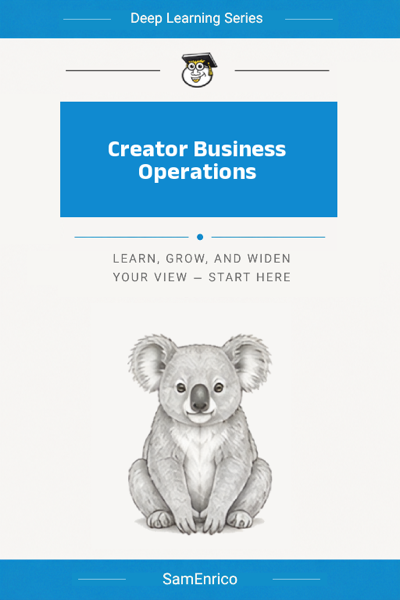
Non-FictionInformativeEducational
Creator Business Operations eBook
A Coursebook on Creator Business Operations
by Abel Rebekah
A Coursebook on Creator Business Operations
Formats
Free sample
Chapter 1: The Burnout Lie...--–- On a Tuesday afternoon in March, a You Tuber with 1.2 million subscribers sat in her parked car and cried for forty-five minutes. She had just posted her forty-seventh video of the year, a sponsorship integration for a meal kit company she didn't use, edited over three sleepless nights, and the comments were already calling her a sellout. Her revenue that month? 14,000,whichsoundedlikeadreamuntilyousubtractedhereditor(14,000, which sounded like a dream until you subtracted her editor (14,000,whichsoundedlikeadreamuntilyousubtractedhereditor(4,000), her manager (2,800),herrent(2,800), her rent (2,800),herrent(3,500), her software subscriptions (600),andtheoutstandinginvoiceformusiclicensingsheforgottopay(600), and the outstanding invoice for music licensing she forgot to pay (600),andtheoutstandinginvoiceformusiclicensingsheforgottopay(450). She was, by every external metric, a successful creator.
She was also, by her own admission, drowning.This chapter is not for people who want to go viral. It is for people who have gone viral, or who are terrified of what happens if they do, and who have realized that more views did not fix the underlying problem. The underlying problem is never creativity. It is never passion. It is never the algorithm, the platform, or the fickleness of an audience.
The underlying problem is operations, and no one tells you that until you are already in the parking lot.The central argument of this book is simple, and it will repeat in every section because it is the only thing that matters: Going viral is a lottery ticket. Operations is a salary. You can win the lottery once, twice, even three times. But without an operating system that turns attention into sustainable income, protected time, and a business that does not require you to burn out, you are not a CEO. You are a freelancer with better lighting.This chapter establishes the macro view of the creator economy, introduces the single framework that will guide every decision in this book, and makes one irreversible promise: by the time you finish this chapter, you will never again mistake activity for progress.What This Chapter Covers Before we go any further, here is exactly what you will learn in the next thirty pages.
First, the difference between the gig economy and the passion economy, and why that difference determines whether you build assets or rent your time. Second, the four key players in the creator ecosystem and how they extract value from each other. Third, the one typology that replaces every other way of categorizing creators, unifying follower count, revenue, and maturity into a single framework. Fourth, the central thesis of this entire book, stated explicitly and repeated until it becomes reflex. Fifth, the Audience Segmentation Matrix, which you will use in every subsequent chapter.
And finally, a self-diagnostic that will tell you exactly where your business is failing right now.No fluff. No hype. No "hustle until you die" mentality. Let us begin.The Passion Economy vs. The Gig Economy: A Difference That Changes Everything In 2016, a management consultant named John B.
started driving for Uber on weekends. He earned 400fortwelvehoursofwork,minusgas,minusdepreciationonhiscar,minustheanxietyofdrunkstrangersinhisbackseat.In2016,acookingenthusiastnamed Saminstarteda You Tubechannel.Shepostedonevideoperweekforsixmonths,earned400 for twelve hours of work, minus gas, minus depreciation on his car, minus the anxiety of drunk strangers in his back seat. In 2016, a cooking enthusiast named Samin started a You Tube channel. She posted one video per week for six months, earned 400fortwelvehoursofwork,minusgas,minusdepreciationonhiscar,minustheanxietyofdrunkstrangersinhisbackseat.In2016,acookingenthusiastnamed Saminstarteda You Tubechannel.Shepostedonevideoperweekforsixmonths,earned87 in ad revenue, and built an email list of 400 people who genuinely wanted to learn how to salt pasta water correctly.John was participating in the gig economy. Samin was participating in the passion economy.
The difference is not about passion. It is about asset ownership.The gig economy, popularized by Uber, Task Rabbit, Door Dash, and Fiverr, trades time for money. You work one hour, you get paid for one hour. You stop working, the money stops. There is no leverage, no compounding, no asset that earns while you sleep.
The platforms in the gig economy are pipelines in disguise. They call you a "partner" but pay you like a temporary employee without benefits.The passion economy, by contrast, trades intellectual property and influence for money. A You Tube video you filmed in 2019 can still earn ad revenue in 2026. A newsletter you wrote last year can continue to convert new subscribers. A course you built once can be sold hundreds or thousands of times.
These are assets, and assets are the only path to a business that does not require your constant physical presence.This distinction is not academic. It determines every operational decision you will make.Gig Economy Passion Economy Primary asset Your time Your IP and influence Earning model Linear (hourly)Exponential (asset-based)Platform relationship Disposable labor Strategic partner (or adversary)Exit value Zero (you cannot sell your Uber rating)Potentially millions (sell your channel, newsletter, or course)Burnout risk High (more hours = more money)Manageable (systems replace hours)If you are reading this book, you have already chosen the passion economy. But choosing it is not enough. You must operate it correctly. Most creators do not.
They treat their creator business like a gig economy job, trading more hours for more videos for more money, and they burn out precisely because they never built the systems that turn content into a portfolio of owned assets.The Four Players of the Creator Economy Every creator business operates within a system of four players. You cannot understand your own operations until you understand how these players relate to each other, where value flows, and who holds power at each stage of your growth.Player One: Platforms Platforms are the hosts. You Tube, Tik Tok, Instagram, Linked In, Substack, Patreon, Spotify, Apple Podcasts, Twitch, X, and a hundred smaller competitors. They provide the infrastructure: video hosting, audio streaming, payment processing, comment sections, algorithmically curated feeds. In exchange, they take a cut.
Sometimes that cut is explicit, like You Tube's 45% of ad revenue or Patreon's 8% of memberships. Sometimes it is implicit, like Tik Tok's control over whether anyone sees your content at all.Here is the uncomfortable truth about platforms that most creators learn too late: platforms are not your partners. They are not your enemies. They are landlords.You rent space on their property. You follow their rules.
You decorate the space with your content, and if the landlord decides to change the locks, change the rent, or evict you entirely, you have no recourse. The First Amendment does not apply to demonetization. Your subscriber count is not a property right. Your comments section is not a public square you own.This is not a reason to avoid platforms. It is a reason to understand them, which we will do extensively in Chapter 2.
The strategic insight for now is simple: rent attention on platforms, but own your audience elsewhere.Player Two: Brands Brands are the advertisers, sponsors, and product partners. They range from direct-to-consumer startups (Gymshark, Hello Fresh, Better Help) to legacy giants (Nike, Coca-Cola, Apple) to the emerging class of creator-founded product companies (Feastables, Chamberlain Coffee, Rare Beauty collaborations).Brands have money. You have attention. The transaction seems simple, but it is actually a transfer of trust. When you recommend a product, you are borrowing against the trust you built with your audience.…
This is the end of the free sample. Get the eBook to keep going. Buy now
About this book
Details
- Author
- Abel Rebekah
- Publisher
- SamEnrico
- Language
- English
- Genre
- Non-Fiction, Informative, Educational
- Released
- 2026-05-18
- Pages (approx.)
- 160
- Available as
- eBook, Audiobook

Read better in the ZLOADR app
Your eBooks on your phone or tablet. Sign in with your SamEnrico account and start reading.
More by Abel Rebekah
 The Stress Shingles Risk GuideAbel Rebekah$11.99
 Workspace DeclutterAbel Rebekah$11.99
 Open Innovation Team GuideAbel Rebekah$11.99
 Nap for Interview ConfidenceAbel Rebekah$11.99
 Lung Cancer Survivor StoryAbel Rebekah$11.99
 Persuasive Voice and Tone GuideAbel Rebekah$11.99
 NVC for EntrepreneursAbel Rebekah$11.99
 Chocolate Addiction RecoveryAbel Rebekah$11.99
 Blue Zone Work Life BalanceAbel Rebekah$11.99
 The Hydaspes Gambit: Alexander’s Last Great BattleAbel Rebekah$11.99
 Operation Plumbbob: The Secret Tests That Changed the WorldAbel Rebekah$11.99
 The Calculus of Kings: The Mathematical Genius of the Axumite EmpireAbel Rebekah$11.99
You may also like
 Hong Kong Handover 1997Dunn Johnnie$11.99
 Zumba For Postnatal Recovery CourseNeal Christian$11.99
 Zumba for BeginnersLadner Nikia$11.99
 YouTube Comment Mining GuideHumes Pandora$12.99
 Worry Box MeditationCarlin Rudy$11.99
 Workplace Stress MeditationNguyen Lynn$11.99
 Workplace Stress and Sleep RepairHawley Ivory$11.99
 Workplace Perfectionism CureDelaney Jeffry$11.99
 Workplace Injustice Anger GuideWallen Isabelle$11.99
 Work Addiction and Burnout LinkGreenwood Ester$11.99
 Women in Yoga and WellnessBeattie Galina$11.99
 Women in Stand Up ComedyChun Evangeline$11.99