
Non-FictionSelf-HelpSalesProspecting
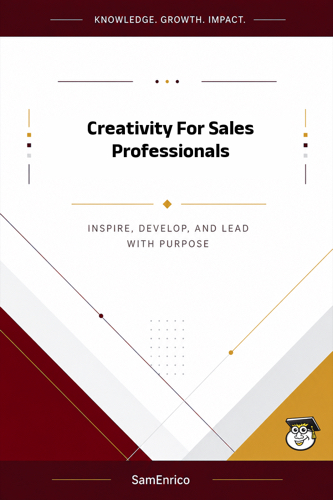
Creativity For Sales Professionals eBook
Generate novel prospecting methods, pitch approach
Generate novel prospecting methods, pitch approaches, and closing techniques.
Formats
Free sample
Chapter 1: The Nexus Paradox--–- Most salespeople believe creativity is a gift you either have or you don't. They think the top performer who closes seven-figure deals with a single email was born with some mysterious "it factor"—a natural ability to say the right thing at the right time. The rest of us, according to this mythology, are left to grind out scripts, follow playbooks, and hope our diligence compensates for our lack of magic.This is a lie. And it is the most expensive lie in the history of professional selling.The truth, revealed by analyzing thousands of sales calls across every industry, is exactly the opposite. Creativity in sales is not a mystical gift.
It is a hypothesis-driven process rooted in data. The most creative sellers are not the ones with the best instincts; they are the ones who know how to find a polarizing insight, state it with confidence, and let the buyer's own curiosity pull them into the conversation. This chapter introduces the single most important framework in this book: the Nexus. Master it, and you will never send a generic prospecting message again. Ignore it, and you will remain indistinguishable from every other seller your buyers ignore every single day.The Myth of the "Natural" Seller Walk into any sales floor and ask the tenured reps who the best creative seller is.
They will point to someone who seems to effortlessly charm prospects, who always knows what to say, who closes deals that everyone else wrote off. That person, they will tell you, "just has it."Now ask that person how they do it. If they are honest, they will describe a process. They will tell you that they research the prospect before every call. They look for a contradiction between what the prospect's industry claims and what the data actually shows.
They open with that contradiction, not with their product. They listen for the moment when the prospect says "That's interesting—tell me more." And only then do they introduce their solution.The difference between the "natural" and the "grinder" is not genetics. It is methodology. The natural has internalized a process so deeply that it appears effortless. The grinder has never been taught that process exists.This chapter dismantles that illusion.
By the time you finish reading, you will have a repeatable, data-driven method for opening every single conversation with a buyer—whether that conversation happens over email, on a cold call, on Linked In, or in a boardroom. You will never again ask "What keeps you up at night?" because you will already know. And you will prove it to them before they say a word.The Fundamental Mistake 99% of Sellers Make Before we build the Nexus framework, we must first understand what most sellers do wrong. Because you cannot fix a problem you refuse to see.The default sales opening follows one of two patterns, both equally ineffective.Pattern One: The Feature Dump. "Hi, I'm Alex from Software Corp.
We help companies reduce operational costs by automating manual workflows. Our platform integrates with Salesforce, Hub Spot, and Netsuite. Can I schedule 15 minutes to show you how it works?"This opening fails because it is about the seller, not the buyer. The buyer thinks: "I don't know you. I don't trust you.
I don't care about your integrations. Delete."Pattern Two: The Generic Discovery Question. "Hi, I'm Alex from Software Corp. What keeps you up at night?"This opening fails because it is lazy. The buyer thinks: "You haven't done any research.
You want me to do your job for you. Why would I invest my time educating a stranger? Delete."Both patterns share the same fatal flaw: they ask the buyer to do work. The feature dump asks the buyer to imagine how generic capabilities might apply to their specific situation. The discovery question asks the buyer to articulate their own pain points.
Buyers are busy, skeptical, and bombarded. They will not do your work for you.The creative seller does the work first. They show up with a hypothesis. They say: "I've been studying companies like yours. Here is what I've noticed.
Does this match your experience?"That is the Nexus. And it changes everything.Defining the Nexus: A Polarizing, Data-Backed Insight The Nexus is a statement that contains three specific elements: a polarizing claim, a data point that supports it, and an implicit invitation for the buyer to correct or confirm. It is called the Nexus because it is the connection point—the place where your research meets their reality, where their problem meets your solution, where their skepticism meets your credibility.Let us break down each element.Element One: The Polarizing Claim. The Nexus must be counter-intuitive. It must challenge a commonly held belief in the buyer's industry or role.
If your opening statement is something everyone already agrees with, it will be ignored. "Efficiency is important" is not polarizing. "The way most companies manage inventory is actually destroying 15% of their margin" is polarizing. The buyer either thinks "That's nonsense, let me explain why" or "Wait, is that true?" Either reaction is engagement.Element Two: The Data Point. Polarizing claims without data are just opinions.
The Nexus must be grounded in a specific, verifiable statistic or trend. "Most companies are losing 15% of margin" is a claim. *"According to a 2025 industry study of 200 mid-market manufacturers, companies using manual inventory tracking lose an average of 15.3% of margin to write-offs, expedited shipping, and stockouts"* is a data point. The specificity signals that you have done homework. It also gives the buyer something to push back on if they disagree—and pushback is engagement.Element Three: The Invitation.
The Nexus must end with an open question that invites correction or confirmation. "Does that match what you're seeing?" or "Has that trend shown up in your data?" or "I'm curious—does that statistic surprise you?" This invitation serves two purposes. First, it lowers the buyer's defensive barrier because you are asking for their expertise, not selling them something. Second, it gives you critical information. If they confirm, you know the problem exists.
If they correct you, you learn even more about their specific situation.Here is a complete Nexus statement built from these three elements:*"Most supply chain directors I speak with believe their inventory accuracy is above 95%. But when we actually audit physical counts against system records, the average is closer to 78%. That 17-point gap translates to about $2.3 million in hidden carrying costs for a company your size. Does that gap exist in your operation?"*This statement works because it is specific, surprising, and humble. It does not claim to know the buyer's situation perfectly.
It offers a hypothesis based on data and asks to be corrected. The buyer is now engaged—not because they want to buy something, but because they want to solve the puzzle.The Neuroscience of the Nexus: Why Pattern Disruption Works To understand why the Nexus is so effective, we must briefly visit the brain. Specifically, the reticular activating system (RAS)—the part of the brain responsible for filtering the massive amount of sensory information we receive every second. The RAS decides what deserves conscious attention and what can…
This is the end of the free sample. Get the eBook to keep going. Buy now
About this book
Details
- Author
- Flowers Charlotte
- Publisher
- SamEnrico
- Language
- English
- Genre
- Non-Fiction, Self-Help, Sales, Prospecting
- Released
- 2026-06-08
- Pages (approx.)
- 150
- Available as
- eBook, Audiobook

Read better in the ZLOADR app
Your eBooks on your phone or tablet. Sign in with your SamEnrico account and start reading.
More by Flowers Charlotte
 The Dry Cleaning Chemical DangersFlowers Charlotte$11.99
 Drug Lord Bodyguard StoriesFlowers Charlotte$11.99
 Stress and Early Aging ConnectionFlowers Charlotte$11.99
 Antwerp Heist Victim StoriesFlowers Charlotte$11.99Antwerp Heist Victim StoriesFlowers Charlotte$11.99
 The Hollow King: A Forensic Odyssey Through the AgesFlowers Charlotte$11.99
 The Viking Voyagers: Norse Explorers of the North Atlantic (793-1066)Flowers Charlotte$11.99
 Strategy Meeting Formulas for Turnaround SituationsFlowers Charlotte$12.99
 Remote Team Conflict GuideFlowers Charlotte$12.99
 Scorzalite MiningFlowers Charlotte$11.99
 Understanding Feigenbaum–bergeron SyndromeFlowers Charlotte$17.99
 How to Start a Hobby in KnottingFlowers Charlotte$11.99
You may also like
 Hong Kong Handover 1997Dunn Johnnie$11.99
 Zumba For Postnatal Recovery CourseNeal Christian$11.99
 Zumba for BeginnersLadner Nikia$11.99
 YouTube Comment Mining GuideHumes Pandora$12.99
 Worry Box MeditationCarlin Rudy$11.99
 Workplace Stress MeditationNguyen Lynn$11.99
 Workplace Stress and Sleep RepairHawley Ivory$11.99
 Workplace Perfectionism CureDelaney Jeffry$11.99
 Workplace Injustice Anger GuideWallen Isabelle$11.99
 Work Addiction and Burnout LinkGreenwood Ester$11.99
 Women in Yoga and WellnessBeattie Galina$11.99
 Women in Stand Up ComedyChun Evangeline$11.99