
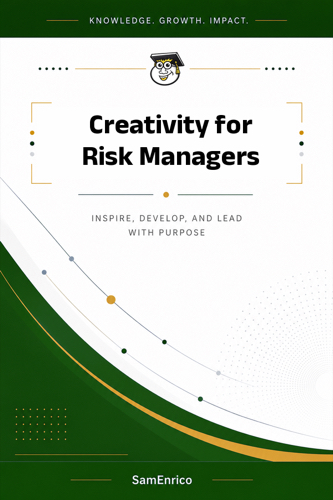
Creativity for Risk Managers Audiobook
Identify non-obvious threats and design inventive
by Goble Melisa
Identify non-obvious threats and design inventive mitigation strategies.
Formats
Free sample
Chapter 1: The Precision Trap--–- In March of 2018, a hedge fund called Neural Capital imploded in seventeen days. They had ninety-seven Ph Ds, three supercomputers, and a risk model so sophisticated that it could predict volatility down to the millisecond. What they did not have was a single person asking a question that seemed, at the time, absurd: What if the model is wrong in a way we have never imagined? The model said their maximum possible one-day loss was $4.2 million. On day eleven, they lost $387 million.
On day seventeen, the fund was closed. The risk manager, a brilliant statistician named Elena, later admitted in a deposition: “We measured everything we could think of. We just didn’t think of the right things.”This is the precision trap. And if you are reading this book, you have already walked into it.The Seduction of the Spreadsheet Let us begin with an uncomfortable truth that most risk management textbooks will never say out loud: the tools that make you feel safe are often the very things that will destroy you. Historical data, normal distributions, Value at Risk models, probability matrices, Monte Carlo simulations—these are not defenses against disaster.
They are rituals that soothe anxiety. And like all rituals, they work best when the world cooperates by following the script of the past. The problem, of course, is that the world has never read the script.Consider the most famous example of the precision trap in modern history: the 2008 financial crisis. In August of 2007, the Chief Risk Officer of one of the world's largest banks stood before his board and presented a slide titled "Worst Case Scenario." The slide showed a projected loss of $2.1 billion. Twelve months later, the actual loss was $58 billion.
The model was not slightly wrong. It was wrong by a factor of twenty-seven. And yet, no one had been negligent. No one had been lazy. Everyone had done exactly what they were trained to do: they had gathered data, built models, calculated probabilities, and presented precise numbers.
The precision was the problem.The psychological mechanism behind the precision trap is well documented, thanks largely to the work of Daniel Kahneman and Amos Tversky, whose research forms the backbone of modern behavioral economics. In Thinking, Fast and Slow, Kahneman describes two systems of thinking: System 1, which is fast, intuitive, and automatic; and System 2, which is slow, deliberate…
This is the end of the free sample. Get the Audiobook to keep going. Buy now
About this book
Details
- Author
- Goble Melisa
- Publisher
- SamEnrico
- Language
- English
- Genre
- Non-Fiction, Self-Help
- Released
- 2026-06-10
- Pages (approx.)
- 153
- Available as
- eBook, Audiobook

Listen in the VoxFlicks app
Audiobooks and audio dramas wherever you go. Sign in with your SamEnrico account and press play.
More by Goble Melisa
 Psychomotor Changes in DepressionGoble Melisa$11.99
 Dysthymia Criteria GuideGoble Melisa$11.99
 Unexpected Pet Death GuideGoble Melisa$11.99
 Justin Rose English RoseGoble Melisa$11.99
 Anger Cognitive Restructuring CBTGoble Melisa$11.99
 Overlearning PreventionGoble Melisa$11.99
 Early Warning SignsGoble Melisa$11.99
 The Ghost of the Kremlin: The MI6 Defector and the Russian Spy Ring (2010)Goble Melisa$11.99
 The Bloodied Silk: Healers of the Yuan ConquestGoble Melisa$11.99
 How to Start a Emery Paper Business (Beginners Guide)Goble Melisa$11.99
 How to Produce Tile and Shingle CuttersGoble Melisa$11.99
 Service Providers Guide to Modular & Mobile Home RemodelingGoble Melisa$11.99
You may also like
 Workplace Stress MeditationNguyen Lynn$11.99
 Volcano Monitoring ScientistCox Alexis$11.99
 The Tech Professional NetAguiar Nevada$11.99
 The Morning Metta RitualCanales Anya$11.99
 The Chunking Memory TechniqueClanton Hyacinth$11.99
 The Beginner Mistake FixAmmons Cassondra$11.99
 Surrendering to What IsGrimm Reatha$11.99
 Self Hypnosis for Fear of FireBillups Eli$11.99
 Road Rage for Professional DriversBrackett Janise$11.99
 Psychiatric Ward Nurse StressDunning Wyatt$11.99
 Observation vs Evaluation NVCTimmons Alda$11.99
 Networking for Nonprofit ProfessionalsPoole Jesse$11.99