
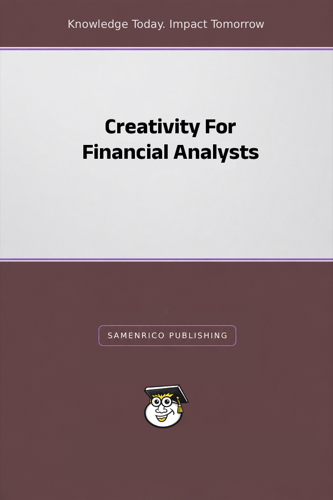
Non-FictionSelf-HelpFinanceModeling
Creativity For Financial Analysts Audiobook
Generate novel financial models, investment theses
Generate novel financial models, investment theses, and risk assessment approaches.
Formats
Free sample
Chapter 1: The $40 Million Mistake--–- The Bloomberg terminal glowed green across four monitors. David Chen, a thirty-one-year-old quantitative analyst at one of New York's most respected hedge funds, watched his model's predicted probability of a volatility collapse flash from 94% to 99.8%. He had spent eighteen months building this system. It had backtested beautifully across seven years of data. His bonus that year was projected at $1.2 million.
Everything was working. Then the market did something that, according to his model, should have been statistically impossible. In the next seventeen minutes, David's fund lost $40 million. Not because his math was wrong. His math was impeccable.
David lost $40 million because he had mistaken precision for truth – a mistake that no spreadsheet, no regression, and no amount of computational horsepower could ever fix.This book is about why that happens and how to stop it. It is about the uncomfortable truth that financial analysts – even the most mathematically sophisticated ones – are not robots. They are pattern-recognizing, bias-ridden, narrative-driven human beings who have been trained to pretend otherwise. And that pretense is costing you money.The Myth We All Believe Walk onto any trading floor or into any investment research department, and you will hear a version of the same story. The story says that financial analysis is a computational exercise.
Gather the data. Clean the data. Run the regression. Optimize the portfolio. Calculate the Sharpe ratio.
The analyst who processes the most information the fastest, using the most sophisticated tools, wins. This is the myth of the quant robot – the belief that creativity belongs in advertising and art school, not in a discounted cash flow model.The myth is seductive because it offers certainty. If analysis is purely computational, then the right model, fed the right data, will produce the right answer. Risk becomes measurable. Outcomes become predictable.
Mistakes become technical errors – a wrong variable, a typo in a formula, a data feed that lags by two seconds. Fix the technical error, and the problem disappears.But David Chen's story reveals the lie. His model was technically flawless. His data was pristine. His execution was instantaneous.
And yet he lost $40 million because his model had never seen a market regime like the one that appeared that Tuesday afternoon. His model was not wrong in the way a typo is wrong. His model was wrong in a deeper, more fundamental sense: it had confused the…
This is the end of the free sample. Get the Audiobook to keep going. Buy now
About this book
Details
- Author
- Richardson Derrick
- Publisher
- SamEnrico
- Language
- English
- Genre
- Non-Fiction, Self-Help, Finance, Modeling
- Released
- 2026-06-10
- Pages (approx.)
- 146
- Available as
- eBook, Audiobook

Listen in the VoxFlicks app
Audiobooks and audio dramas wherever you go. Sign in with your SamEnrico account and press play.
More by Richardson Derrick
 Glyphosate And Gut HealthRichardson Derrick$11.99
 Los Extraditables ManifestoRichardson Derrick$11.99
 Antwerp Heist Trial TranscriptRichardson Derrick$11.99
 Stress and Menstrual Health GuideRichardson Derrick$11.99
 Silicon Bloodlines: The Untold War of the Tech DynastiesRichardson Derrick$11.99
 Frozen Warnings: The Arctic Scientists Racing to Predict Earth's Next Great QuakeRichardson Derrick$11.99
 EU Intrastat Reporting GuideRichardson Derrick$12.99
 Running Strategy Meetings for Project KickoffsRichardson Derrick$12.99
 Understanding Fas DeficiencyRichardson Derrick$17.99
 Salt Spray TestingRichardson Derrick$11.99
 Ultimate Handbook Guide to Saint Petersburg : (Russia) Travel GuideRichardson Derrick$11.99
You may also like
 Hong Kong Handover 1997Dunn Johnnie$11.99
 Zumba For Postnatal Recovery CourseNeal Christian$11.99
 Zumba for BeginnersLadner Nikia$11.99
 YouTube Comment Mining GuideHumes Pandora$12.99
 Worry Box MeditationCarlin Rudy$11.99
 Workplace Stress MeditationNguyen Lynn$11.99
 Workplace Stress and Sleep RepairHawley Ivory$11.99
 Workplace Perfectionism CureDelaney Jeffry$11.99
 Workplace Injustice Anger GuideWallen Isabelle$11.99
 Work Addiction and Burnout LinkGreenwood Ester$11.99
 Women in Yoga and WellnessBeattie Galina$11.99
 Women in Stand Up ComedyChun Evangeline$11.99