
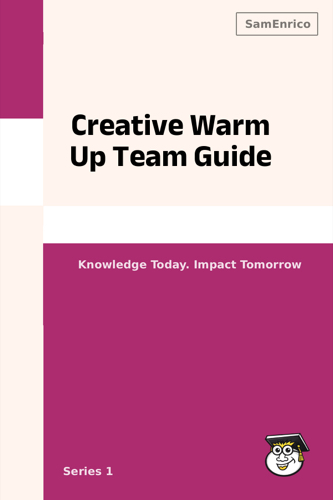
Creative Warm Up Team Guide eBook
Prepares groups for collaborative ideation.
by Worth Oliva
Prepares groups for collaborative ideation.
Formats
Free sample
Chapter 1: The Five-Minute Failure--–- Every creative meeting begins before it begins. The first five minutes of any collaborative session are not a neutral opening—they are the single most predictive moment for everything that follows. Yet most facilitators, managers, and team leaders treat these minutes as administrative overhead: waiting for latecomers to arrive, checking that the projector works, asking people to “grab a seat,” and opening with a perfunctory “Let’s go around the room and say our names.” By the time the real work starts, the creative fate of the session has already been sealed. This chapter reveals why those first 300 seconds matter more than the next three hours, why almost every team gets them wrong, and how a simple five-minute warm-up can transform a room of silent, defensive professionals into a generative, playful, high-trust creative engine.The $10,000 Hour: What Silence Really Costs Imagine a product team at a mid-sized software company. Twelve people gather in a conference room for a four-hour brainstorming session.
They have a hard problem: their user retention has dropped 15% in six months, and no one knows why. The agenda says “9:00 AM – 9:15 AM: Welcome and coffee.” The facilitator, a well-meaning product manager, starts with the standard script: “Thanks everyone for coming. Let’s go around and introduce ourselves. Name, role, and one word about how you’re feeling today.”What follows is predictable. Eleven people say “fine,” “busy,” “tired,” “fine,” “okay,” “fine,” “stressed,” “fine,” “good,” “fine,” “ready to get started.” One person says “excited” and everyone silently judges them.
The introductions take twelve minutes because three people were late. By 9:17 AM, the energy in the room is flat. The facilitator transitions to a slide deck showing the retention data. By 9:45 AM, someone suggests a feature they’ve suggested three times before. By 10:30 AM, two people are on their phones.
By 11:15 AM, the team has generated exactly four ideas, all variations of things they tried last year. By 12:00 PM, they adjourn, exhausted, having solved nothing. The session cost the company approximately $4,800 in team time (twelve people at an average loaded cost of $100 per hour, times four hours). The output: four recycled ideas.Now imagine the same team, the same problem, the same four hours. But this time, the facilitator begins with a five-minute warm-up: the 30 Circles Test from Chapter 9 of this book.
For two minutes, everyone silently draws as many objects as possible inside thirty blank circles. For the next three minutes, they share their most surprising drawings in pairs. That’s it. Five minutes. At 9:05 AM, the energy in the room is completely different.
People are laughing at their own terrible drawings. Someone turned a circle into “a pancake that is also a satellite.” Someone else drew “a clock that only tells you when you’re late.” The facilitator transitions to the same retention data. But now, when someone suggests the same old feature, another person says “Yes, and what if we combined that with the pancake-satellite?” By 11:00 AM, the team has generated forty-seven ideas. Three of them are genuinely novel. Two will become million-dollar product features over the next eighteen months.The difference between these two outcomes was not talent, budget, or problem complexity.
It was five minutes. The first team spent their opening minutes on low-stakes, low-return administrative tasks that drained energy and reinforced hierarchy. The second team spent their opening minutes on a warm-up that activated the creative brain, built psychological safety through shared vulnerability, and established a norm of “anything goes” before judgment entered the room.This is the $10,000 hour in reverse. A five-minute warm-up that costs $100 in team time (twelve people at $100 per hour, for five minutes) can generate returns measured in millions of dollars of novel ideas, not to mention the intangible value of team morale, reduced meeting fatigue, and faster decision-making. The math is simple: warm-ups are not a cost.
They are the highest-ROI five minutes in any creative process.But here is the uncomfortable truth that most leaders refuse to accept. Ninety-three percent of meetings begin with what organizational psychologist Steven Rogelberg calls “dead time”—the first five to ten minutes where nothing productive happens, but everyone pretends it does. Teams do not skip warm-ups because they are lazy or uninformed. They skip warm-ups because they have been trained to believe that “getting down to business” is the professional thing to do. They have internalized the myth that creativity is a switch you can flip on demand.
They believe that smart people in a room with a whiteboard will automatically produce smart ideas. This belief is not just wrong. It is expensively, measurably, demonstrably wrong.The Myth of the Always-On Creative Brain The human brain did not evolve to be creative on command. It evolved to survive. The brain’s default operating mode is not generative ideation but threat detection, pattern recognition, and energy conservation.
These are features, not bugs. Your brain is supposed to notice the rustle in the bushes (threat), recognize that rustling sounds like last week’s rustle (pattern), and avoid wasting energy investigating every single rustle (conservation). The problem is that these same survival mechanisms actively sabotage creative collaboration.Neuroscience distinguishes between two large-scale brain networks that are in constant competition. The first is the executive control network (sometimes called the task-positive network). This network activates when you are focused, analytical, critical, and goal-directed.
It lives primarily in the prefrontal cortex and the anterior cingulate cortex. It is essential for editing, evaluating, and decision-making. It is also the network that says “that won’t work” before the idea is fully formed.The second is the default mode network (DMN). For decades, neuroscientists thought the DMN was simply the brain’s “idle” state—what happens when you are doing nothing. We now know this is incorrect.
The DMN is not a rest network. It is an associative network. It activates when you are daydreaming, remembering, imagining the future, and making remote associations between seemingly unrelated concepts. It is the network of “what if” rather than “what is.” It lives in the medial prefrontal cortex, the posterior cingulate cortex, and the angular gyrus. It is the network that says “what if we combined a pancake and a satellite?”Here is the crucial insight: the executive control network and the default mode network are anticorrelated.
When one is active, the other is suppressed. You cannot be in analytical, critical, judgmental mode and in associative, generative, playful mode at the same time. The brain literally cannot do both. This is not a personality flaw or a lack of discipline. It is the physical architecture of the human brain.Most teams, most of the time, arrive at a creative session with their executive control network blazing.
They have just come from a status meeting where they were asked to report on deadlines, budgets, and deliverables. They have answered forty-seven emails, each requiring a small decision. They have checked their calendar and realized they have back-to-back meetings for the next six hours. Their brain is in full analytical, threat-detection, resource-allocation mode. Then someone says “Let’s brainstorm.” And the brain tries.
It really tries. But the default mode network cannot simply turn on like a light switch. It needs time. It…
This is the end of the free sample. Get the eBook to keep going. Buy now
About this book
Details
- Author
- Worth Oliva
- Publisher
- SamEnrico
- Language
- English
- Genre
- Non-Fiction, Self-Help, Warm Ups
- Released
- 2026-06-10
- Pages (approx.)
- 137
- Available as
- eBook, Audiobook

Read better in the ZLOADR app
Your eBooks on your phone or tablet. Sign in with your SamEnrico account and start reading.
More by Worth Oliva
 NVC for Faith CommunitiesWorth Oliva$11.99
 Risk Reversal Writing TechniquesWorth Oliva$11.99
 Focus Block CalendarWorth Oliva$11.99
 Breaking The Yelling CycleWorth Oliva$11.99
 Lymphoma Survivor MemoirWorth Oliva$11.99
 Intuitive Eating for BingersWorth Oliva$11.99
 Blue Zone Sunlight ExposureWorth Oliva$11.99
 Judy Garland RainbowWorth Oliva$11.99
 The Lost Tapes of the Titanic's Last CallWorth Oliva$11.99
 Codebreaker: The Untold Story of Margaret Hamilton and Apollo 11Worth Oliva$11.99
 The Ballot That Broke the EmpireWorth Oliva$11.99
 The Mineral Guide to NagyagiteWorth Oliva$11.99
You may also like
 Hong Kong Handover 1997Dunn Johnnie$11.99
 Zumba For Postnatal Recovery CourseNeal Christian$11.99
 Zumba for BeginnersLadner Nikia$11.99
 YouTube Comment Mining GuideHumes Pandora$12.99
 Worry Box MeditationCarlin Rudy$11.99
 Workplace Stress MeditationNguyen Lynn$11.99
 Workplace Stress and Sleep RepairHawley Ivory$11.99
 Workplace Perfectionism CureDelaney Jeffry$11.99
 Workplace Injustice Anger GuideWallen Isabelle$11.99
 Work Addiction and Burnout LinkGreenwood Ester$11.99
 Women in Yoga and WellnessBeattie Galina$11.99
 Women in Stand Up ComedyChun Evangeline$11.99