
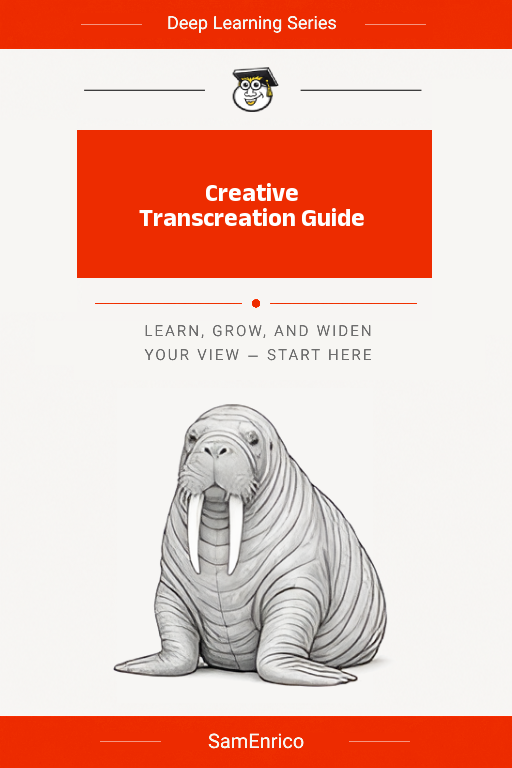
Creative Transcreation Guide eBook
Use AI for poetic translation, slogan adaptation,
by Carlson Dana
Use AI for poetic translation, slogan adaptation, and brand voice transfer. Preserve emotion, wordplay, and cultural resonance across languages.
Formats
Free sample
Chapter 1: The Literal Trap...--–- It was a Tuesday morning when the $62 million mistake arrived via email. The global marketing director of a Fortune 500 beverage company opened the attachment with the kind of casual confidence that comes from a decade of successful campaigns. Her team had just spent six months and eight figures localizing a new slogan for the Japanese market. The English version was a masterpiece of concise branding: "Get your spark back." It was playful, aspirational, and phonetically pleasing—three hard consonants followed by a soft exhale. The Japanese version, produced by a respected translation agency using what they called "industry-best AI-assisted workflows," read as follows: "Modoru, anata no supāku o torimodose."She didn't speak Japanese.
No one on her executive team did. The agency assured them it was perfect. The campaign launched across Tokyo, Osaka, and Yokohama. Billboards went up. Television spots aired during prime time.
Social media influencers posted their "spark return" stories.Within 48 hours, the hashtag became a national joke. Within a week, a competing brand had parodied the slogan in a viral ad. Within a month, the campaign was pulled, the agency was fired, and the marketing director was updating her resume. The literal translation of "Get your spark back" had, in Japanese colloquial context, suggested something closer to "reclaim your lost sexual energy after a disappointing encounter." It wasn't offensive, exactly. It was worse.
It was embarrassing. The brand had spent $62 million to accidentally describe post-coital disappointment.This is not an isolated horror story. It is the rule, not the exception.The Problem That Spans Industries Every year, companies spend more than $50 billion on translation and localization services. And every year, a significant portion of that money produces content that ranges from slightly awkward to brand-damagingly wrong. The problem is not bad technology.
The problem is not lazy translators. The problem is a fundamental misunderstanding of what language does and what AI can and cannot preserve.Language does not transmit meaning like a bucket transfers water. If it did, translation would be a simple substitution code—like replacing every "hello" with "bonjour" and moving on with your day. But language transmits effect. The same words arranged in the same order can produce laughter, tears, confusion, or offense depending entirely on the cultural context, the emotional state of the reader, and the accumulated weight of every previous use of those words in that language.Consider this: the English sentence "That's sick!" can mean extraordinary praise among teenagers, a medical diagnosis among doctors, or moral disgust among religious conservatives.
Now multiply that ambiguity across every word, every idiom, every cultural reference, and every unspoken assumption in every language on earth. That is the challenge of transcreation. And that is why literal translation—the kind that AI does best and fastest—is not merely insufficient for creative content. It is actively destructive.Meet Literal Larry: The Villain of This Book Before we go further, let me introduce you to someone you will come to recognize. His name is Literal Larry.
He does not actually exist as a single person, but he exists in every organization, every workflow, and every well-meaning manager who has ever said, "Can't we just run it through Google Translate and have a native speaker check it?"Literal Larry believes that words have fixed meanings. He believes that a rose is a rose is a rose, and that the German word Rose carries the same romantic weight, the same poetic history, and the same cultural associations as its English counterpart. He is wrong, but he is confidently wrong, and his confidence is what makes him dangerous.Larry is the one who insists on "accuracy" over resonance. He is the one who rejects a creative adaptation because "it's not what the original says." He is the one who, when shown a brilliant transcreation that makes a Japanese audience laugh in exactly the same way the English original made an American audience laugh, will frown and say, "But where is the word 'spark'?"Larry is not a villain because he is stupid. He is a villain because he is rational within a flawed framework.
His framework treats language as a code to be cracked rather than an experience to be recreated. And as AI becomes more powerful, Larry's framework becomes more seductive. Why pay a human transcreator $10,000 when AI can produce 50 versions in 30 seconds? Why spend weeks on cultural research when the model has been trained on billions of pages of text?The answer, which this entire book will demonstrate, is that speed and volume are not the same as resonance. And resonance—the feeling that a message was written for you, in your language, inside your culture—is the only thing that actually moves people.The Core Distinction: Translation vs.
Transcreation Let us establish the foundational distinction that will guide everything that follows.Translation is the transfer of meaning from a source language to a target language. A good translation preserves the factual content of the original. If the original says "the meeting is at 3 PM," a good translation tells you the meeting is at 3 PM. This is valuable. This is necessary for contracts, technical manuals, and legal documents.
AI is exceptionally good at this because meaning, in these contexts, is relatively stable across languages.Transcreation is the recreation of effect. It does not ask "what does this say?" It asks "what does this do?" And then it asks: "how do I make the target audience feel exactly that?" Transcreation is willing to abandon the original words, the original sentence structure, and even the original metaphors if doing so preserves the emotional experience.Here is a simple example. The English slogan "Finger-lickin' good" for KFC is not a statement of fact. It is an invitation to shared transgression—the mild taboo of eating with your hands, made permissible by the deliciousness of the product. A literal translation into Chinese would be nonsensical or, as some early attempts discovered, accidentally grotesque.
The successful transcreation kept nothing of the original words. It became something like "Eat your fingers off" in Chinese—which sounds alarming in English but worked brilliantly in Mandarin because it captured the same feeling of joyful abandon.Translation asks: "What does 'finger-lickin' good' mean?" Transcreation asks: "What feeling does 'finger-lickin' good' create, and how do I create that feeling in Shanghai?"The Literal Trap: Why Accuracy Kills Emotion Now we arrive at the central paradox of this book. AI's greatest strength is literal translation. It can process millions of word pairs, learn statistical patterns of equivalence, and produce outputs that are factually correct with remarkable speed. This is precisely why AI fails at poetry, slogans, and brand voice.The Literal Trap works like this:Step one: You need creative content adapted for a new market.
You have a beautiful slogan, a moving poem, or a witty brand voice that works perfectly in English.Step two: You ask AI to translate it. The AI, doing exactly what it was trained to do, produces a literal or near-literal output.Step three: The output is accurate. Every word corresponds to something in the original. A bilingual speaker would confirm that the AI correctly identified the vocabulary…
This is the end of the free sample. Get the eBook to keep going. Buy now
About this book
Details
- Author
- Carlson Dana
- Publisher
- SamEnrico
- Language
- English
- Genre
- Non-Fiction, AI Operator
- Released
- 2026-05-27
- Pages (approx.)
- 145
- Available as
- eBook, Audiobook

Read better in the ZLOADR app
Your eBooks on your phone or tablet. Sign in with your SamEnrico account and start reading.
More by Carlson Dana
 Emotional Regulation Across Life StagesCarlson Dana$11.99
 Consumer Staples Index FundCarlson Dana$11.99
 Body Scan for Panic DisorderCarlson Dana$11.99
 Stress and Bipolar PartnerCarlson Dana$11.99
 The Labors of Heracles: The Untold Trials of the Hero’s ShadowCarlson Dana$11.99
 How to Produce Body and Hand MoisturizerCarlson Dana$11.99
 Carpet Extraction CleaningCarlson Dana$11.99
You may also like
 Hong Kong Handover 1997Dunn Johnnie$11.99
 Zumba For Postnatal Recovery CourseNeal Christian$11.99
 Zumba for BeginnersLadner Nikia$11.99
 YouTube Comment Mining GuideHumes Pandora$12.99
 Worry Box MeditationCarlin Rudy$11.99
 Workplace Stress MeditationNguyen Lynn$11.99
 Workplace Stress and Sleep RepairHawley Ivory$11.99
 Workplace Perfectionism CureDelaney Jeffry$11.99
 Workplace Injustice Anger GuideWallen Isabelle$11.99
 Work Addiction and Burnout LinkGreenwood Ester$11.99
 Women in Yoga and WellnessBeattie Galina$11.99
 Women in Stand Up ComedyChun Evangeline$11.99