
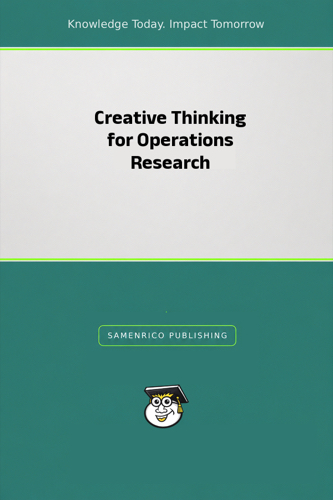
Creative Thinking for Operations Research Audiobook
Find novel optimization algorithms and decision mo
Find novel optimization algorithms and decision models for complex systems.
Formats
Free sample
Chapter 1: The Algorithm Trap...--–- The conference room smelled of stale coffee and exhausted ambition. Dr. Elena Vasquez, a thirty-year veteran of operations research, had just presented her team's solution to a $200 million logistics problem. Her model was elegant: a mixed-integer linear program with seventeen constraints, solved via branch-and-bound with custom heuristics. The client's chief operating officer nodded slowly, then asked a question that would haunt Elena for months: "That's the optimal solution according to your model.
But is it the right solution?"The room fell silent. Elena knew, with the cold certainty of a mathematician, that her solution minimized cost within the given constraints. But something felt wrong. The algorithm had done exactly what it was designed to do. And yet, the COO's question exposed a wound that most OR professionals learn to ignore: the gap between mathematically optimal and genuinely wise.This chapter is about that gap.
It is about why the most dangerous words in operations research are not "we failed" but "we have the optimal solution." And it is about the first and most fundamental creative move you must make before designing any algorithm: recognizing the trap of convergent thinking.The Seduction of Convergence Operations research, as traditionally taught and practiced, is a discipline of convergence. From the first day of introductory courses, students learn algorithms that move steadily toward a single answer: the optimal solution. Gradient descent finds the bottom of a valley. Linear programming travels along edges of feasible polytopes until it reaches a vertex that minimizes cost. Branch-and-bound systematically prunes away branches of a decision tree that cannot contain the optimal solution.
Each of these methods shares a common assumption: the problem is well-defined, the objective function is correct, and the constraints are sacred.This assumption is not merely convenient; it is seductive. It promises certainty in an uncertain world. It allows the analyst to say, with mathematical proof, "This is the best possible answer." It transforms messy human problems into clean mathematical formulations. And therein lies the trap.Consider the story of a major airline's revenue management system. For years, their overbooking algorithm had been carefully optimized using historical no-show rates.
The objective function minimized the sum of lost revenue from empty seats plus compensation for bumped passengers. The algorithm was mathematically elegant, provably optimal given the constraints. And it failed catastrophically during a volcanic ash cloud that shut down European…
This is the end of the free sample. Get the Audiobook to keep going. Buy now
About this book
Details
- Author
- Wooldridge Halina
- Publisher
- SamEnrico
- Language
- English
- Genre
- research, Self-Help
- Released
- 2026-06-10
- Pages (approx.)
- 129
- Available as
- eBook, Audiobook

Listen in the VoxFlicks app
Audiobooks and audio dramas wherever you go. Sign in with your SamEnrico account and press play.
More by Wooldridge Halina
 TMS for Treatment Resistant MDDWooldridge Halina$11.99
 Dog Loss Grief WorkbookWooldridge Halina$11.99
 Cholesterol Pregnancy GuideWooldridge Halina$11.99
 Retief Goosen Ice ManWooldridge Halina$11.99
 Chess Opening CardsWooldridge Halina$11.99
 Verbal Overshadowing Effect on IDWooldridge Halina$11.99
 Fear Of ThunderstormsWooldridge Halina$11.99
 Monte Cassino: The Mountain That Wouldn’t FallWooldridge Halina$11.99
 Iron Storm Over the Coral Sea: The Battle That Saved AustraliaWooldridge Halina$11.99
 Service Providers Guide to Propane Sales & ServicesWooldridge Halina$11.99
 How to Produce Household SundriesWooldridge Halina$11.99
 Equipment Leasing GuideWooldridge Halina$12.99
You may also like
 Scientific Research On TM GuideMartens Nathanial$11.99
 Research Proposal Methodology Section MasteryPauley Debroah$11.99
 Research Proposal Appendix CompilationRaines Tyisha$11.99
 Academic Researcher Distraction GuideFord Virgil$11.99
 TM Research and ScienceCovert Nicki$11.99
 Social Anxiety Research ReviewRoberge Cole$11.99
 Research Proposal Significance Section GuideBock Tory$12.99
 Research Proposal Reviewer PsychologyLugo Tawanda$11.99
 Research Proposal Research Questions DesignLara Robbi$11.99
 Research Proposal References and CitationsPatten Shanice$11.99
 Research Proposal Mixed Methods DesignCameron Omega$11.99
 Research Proposal Data Management PlanAnderson Roberto$12.99