
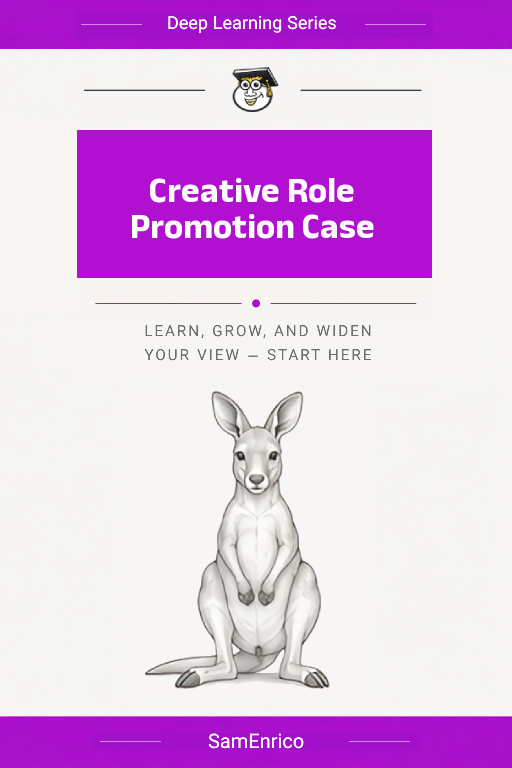
Non-FictionProfessional's Cheat SheetCreative
Creative Role Promotion Case eBook
Documents creative impact using metrics like engag
Documents creative impact using metrics like engagement, brand lift, awards, and revenue attribution for design and content roles.
Formats
Free sample
Chapter 1: The Vanity Trap--–- The email arrived at 9:47 AM on a Tuesday. Senior Graphic Designer Maya Chen had been waiting for this moment for eighteen months. She clicked open the attached report with trembling fingers. The campaign she had poured her soul into—the animated illustrations, the carefully crafted carousel posts, the typography she had kerned by hand—had generated 1.2 million impressions. Fifty-three thousand likes.
Forty-one thousand shares. The engagement rate was 4.8 percent, triple the industry average. Maya smiled.Twenty minutes later, she sat across from the Chief Financial Officer in the quarterly business review. The CFO, a man named Reeves who had never once asked about color theory or font pairing, glanced at her report for exactly four seconds. Then he asked a question that would haunt Maya for the next six months."Great," he said, sliding the report back across the table.
"How much revenue did that generate?"Maya opened her mouth. Nothing came out. She had data on reach, frequency, likes, shares, comments, saves, and even the obscure "engagement rate by follower cohort" that she had taught herself to calculate. She had nothing on revenue. The meeting ended with a polite "we'll circle back" and a promotion that went to someone else—someone whose work had generated half the likes but twice the sales.This book exists because of Maya.
And because of the thousands of designers, content creators, and creative professionals who walk into similar meetings every day, armed with vanity metrics, and leave empty-handed.The Metrics That Lie Let us name the enemy. Vanity metrics are measurements that make you feel good but do not help you make better decisions or prove your value to the people who control budgets and promotions. They include, but are not limited to: impressions, reach, likes, shares, comments, saves, follower counts, page views, downloads, and any variation of "virality" that does not tie directly to a business outcome.These metrics are dangerous for three reasons.First, they are easily manipulated. A $50 bot farm can generate ten thousand likes. A poorly targeted ad buy can generate millions of impressions from users who will never buy anything.
An algorithm change—completely outside your control—can double your reach overnight or cut it in half. When you stake your career on metrics that can be bought, gamed, or arbitrarily altered by a platform update, you are building your promotion case on quicksand.Second, vanity metrics correlate poorly with actual business outcomes. A study of over five hundred thousand Facebook ad campaigns found that the correlation between likes and purchases was effectively zero. The same study found that the correlation between shares and purchases was only marginally higher. People like things for many reasons—the image is pretty, the joke is funny, they feel obligated to support a friend—none of which translate to the CFO's primary concern: dollars.Third, vanity metrics train you to measure output rather than outcome.
Output is the volume of work you produce. Outcome is the business impact of that work. A designer who produces fifty banner ads has high output. A designer who produces five banner ads that generate a million dollars in revenue has high outcome. Which one gets promoted?
The answer is obvious, yet most creatives continue to report output because outcome measurement is harder. It requires different tools, different conversations, and different relationships with stakeholders.Consider the case of a viral post that attracts the wrong audience. A luxury watch brand once created a humorous tweet that generated forty thousand retweets—an extraordinary vanity metric. The problem was that the retweets came primarily from teenagers who found the joke funny but would never purchase a five-thousand-dollar watch. The brand's actual target audience, wealthy professionals in their forties, saw the tweet and perceived the brand as unserious.
Sales dropped 12 percent during the campaign. The social media manager had reported the retweets as a success. She was fired three months later.This is the vanity trap. You measure what is easy rather than what matters. You celebrate what looks good rather than what drives results.
And then you sit across from the CFO with a beautiful report and no promotion.What the Best-Sellers Won't Teach You You have likely read the classic marketing and psychology texts that explain why things spread. Robert Cialdini's Influence teaches you the principles of persuasion—reciprocity, scarcity, authority, consistency, liking, social proof. Jonah Berger's Contagious teaches you the STEPPS framework—Social currency, Triggers, Emotion, Public, Practical value, Stories. These are brilliant books. They will make you better at your craft.
They will not get you promoted.Here is what these books do not teach you: how to prove to a skeptical CFO that you caused the spread. How to isolate your creative contribution from seasonality, media spend, brand reputation, and luck. How to translate a beautiful animation into a specific dollar amount of retained revenue. How to walk into a promotion meeting with a single page of paper that makes denial irrational.The gap in the literature is stark. The existing best-sellers fall into two camps.
The first camp focuses on operational efficiency—how to make things faster, cheaper, and at higher volume. These books teach you to optimize workflows, build design systems, and reduce revision cycles. They are useful for junior creatives but do not help you argue for a senior title. The second camp focuses on high-level brand strategy—how to build emotional connections, define brand voice, and create distinctive assets. These books are useful for creative directors but offer little to the individual contributor trying to prove their worth.What does not exist is a tactical, data-backed playbook specifically for designers, content creators, and creative leads to prove their worth and get promoted.
A book that teaches you exactly which metrics to track, how to track them, how to present them, and how to handle the objections that will inevitably come. A book that transforms creativity from a soft skill judged subjectively into a growth lever measured rigorously.This book is that playbook.The Core Problem: Output Versus Outcome Let us go deeper into the distinction that will determine your career trajectory.Output metrics measure activity. How many assets did you create? How many hours did you work? How many revisions did you complete?
How many meetings did you attend? These metrics are easy to collect. They are also meaningless to anyone who cares about business results. No CFO has ever asked, "How many hours did the design team work this quarter?" They ask, "What did those hours produce in terms of revenue, retention, or cost savings?"Outcome metrics measure impact. How much revenue did your work generate?
How many customers did your content retain? How much cost did your design system save? How much did your campaign lift brand consideration? These metrics are harder to collect. They require integration with analytics platforms, coordination with finance and marketing operations, and a willingness to run controlled experiments.
But they are the only metrics that lead to promotion.Consider two content creators at the same company over the same quarter.Creator A produces forty social media posts. She tracks impressions (2 million), likes (80,000), and shares (15,000). She reports these numbers…
This is the end of the free sample. Get the eBook to keep going. Buy now
About this book
Details
- Author
- Weyand Crystal
- Publisher
- SamEnrico
- Language
- English
- Genre
- Non-Fiction, Professional's Cheat Sheet, Creative
- Released
- 2026-05-30
- Pages (approx.)
- 146
- Available as
- eBook, Audiobook

Read better in the ZLOADR app
Your eBooks on your phone or tablet. Sign in with your SamEnrico account and start reading.
More by Weyand Crystal
 Anger At Partner SpouseWeyand Crystal$11.99
 The Weather Report ClueWeyand Crystal$11.99
 Homework Hassle Reduction PlanWeyand Crystal$11.99
 Hungarian Business GuideWeyand Crystal$11.99
 The Nap and Creativity GuideWeyand Crystal$11.99
 The Siege of La Modelo: Colombia's Deadliest Prison UprisingWeyand Crystal$11.99
 Legal AdministratorWeyand Crystal$11.99
 Bubble Email NotificationsWeyand Crystal$12.99
 Ultimate Handbook Guide to Boston : (United States) Travel GuideWeyand Crystal$11.99
 Understanding Vascular Malformations of The BrainWeyand Crystal$17.99
You may also like
 Hong Kong Handover 1997Dunn Johnnie$11.99
 Zumba For Postnatal Recovery CourseNeal Christian$11.99
 Zumba for BeginnersLadner Nikia$11.99
 YouTube Comment Mining GuideHumes Pandora$12.99
 Worry Box MeditationCarlin Rudy$11.99
 Workplace Stress MeditationNguyen Lynn$11.99
 Workplace Stress and Sleep RepairHawley Ivory$11.99
 Workplace Perfectionism CureDelaney Jeffry$11.99
 Workplace Injustice Anger GuideWallen Isabelle$11.99
 Work Addiction and Burnout LinkGreenwood Ester$11.99
 Women in Yoga and WellnessBeattie Galina$11.99
 Women in Stand Up ComedyChun Evangeline$11.99