
Non-FictionSelf-HelpRiskEngineering
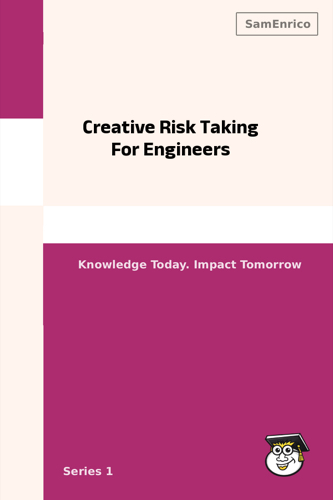
Creative Risk Taking For Engineers eBook
Calculate and take smart creative risks that lead
Calculate and take smart creative risks that lead to breakthrough innovations.
Formats
Free sample
Chapter 1: The Two Engineers--–- Every engineer carries two voices inside their head. You know this because you’ve felt them arguing. One voice says: Verify. Validate. Margin of safety.
What if it breaks? The other voice whispers: What if it works? What if no one has ever tried this before? What if this is the thing you were meant to build?The first voice is The Safety Engineer. The second is The Creative Risk-Taker.They are both you.
And for most of your career, you have probably let The Safety Engineer win every single argument. Not because you lack imagination. Not because you are cowardly. But because your training, your performance reviews, your industry’s entire incentive structure, and your deep fear of looking foolish have all conspired to put The Safety Engineer in the driver’s seat.This chapter is about recognizing those two voices for what they are. It is about understanding why The Safety Engineer is essential—and why keeping him in charge of every decision is slowly making you and your work obsolete.The Argument You Have Every Week Let me describe a scene you know by heart.You are in a design review.
A junior engineer proposes something unconventional. Maybe it is a new material that costs less but has less historical data. Maybe it is a novel architecture that could cut power consumption in half but requires an unproven manufacturing step. Maybe it is a radical simplification that removes three redundant subsystems because the junior engineer believes the primary system is actually more reliable than the models show.The Safety Engineer in you immediately activates. You think: Where are the failure mode analyses?
What about the edge cases? Who will sign off on this? What happens when it fails in production?These are good questions. They are necessary questions. The Safety Engineer exists for a reason.
Without him, bridges would collapse, airplanes would fall, and medical devices would kill people. Engineering is, at its core, a profession of responsibility. The public trusts us because we are the people who say “stop” when something is not ready.But here is the problem. In most engineering organizations, The Safety Engineer does not just have a vote. He has veto power.
And he has learned to exercise that veto not only against genuine recklessness but also against novelty—against anything that has not been done before, against any uncertainty, against any creative risk that might fail and make someone look bad.The junior engineer’s idea dies. Not because it was wrong. Not because the analysis showed it would fail. But because it was different. And difference, in a culture dominated by The Safety Engineer, feels like danger.The Hidden Cost of Winning Every Argument Here is what The Safety Engineer never calculates: the cost of not taking a creative risk.When you reject the junior engineer’s novel material, you save the team from a potential recall.
But what do you lose? You lose the chance to be the first team with a 30% cost advantage. You lose the learning that would have come from testing that material on a small scale. You lose the junior engineer’s motivation—she will not propose another idea for months, maybe years. You lose the optionality of having a second supply chain.The Safety Engineer does not see these losses because they are not in the risk register.
The risk register only tracks things that can go wrong. It does not track opportunities that die unborn.This is the hidden cost of zero-risk engineering. It is slow, silent, and cumulative. A company that makes the safe choice every time does not fail catastrophically. It just becomes less relevant, quarter by quarter, until one day it wakes up and discovers that a competitor took the risks it was afraid to take and now owns the market.Consider the history of digital photography.
Kodak invented the first digital camera in 1975. The Safety Engineer looked at it and saw everything that could go wrong: low resolution, no distribution, cannibalization of film profits. The Creative Risk-Taker saw the future. The Safety Engineer won every argument for two decades. Kodak filed for bankruptcy in 2012.
Not because they made a wrong bet. Because they refused to make any bet at all.Meet The Safety Engineer (He Means Well, But He Lies)Let us personify these two voices so you can recognize them in your own thinking.The Safety Engineer speaks in absolutes. His favorite words are: always, never, must, cannot, guaranteed, proven, certified. He believes that any uncertainty is a flaw to be eliminated. He trusts historical data more than new hypotheses.
He sleeps better at night knowing that every component has been tested to failure and every process has been signed off by three reviewers.The Safety Engineer is not stupid. He is not lazy. He is protective. He has seen projects fail. He has seen engineers blamed, demoted, or fired for taking risks that did not pan out.
He has internalized a simple equation: If I say no, nothing bad happens to me. If I say yes and it fails, I suffer.The problem is that The Safety Engineer lies to you—not maliciously, but systematically. He tells you that you can predict the future from the past. He tells you that all failures are equally bad. He tells you that your reputation is built on never being wrong.
These are not truths. They are cognitive biases dressed up as professional judgment.Loss aversion is the first lie. Psychologists Daniel Kahneman and Amos Tversky proved that human beings feel the pain of a loss about twice as intensely as they feel the pleasure of an equivalent gain. The Safety Engineer exploits this. He makes a $100,000 potential loss feel like a disaster while making a $200,000 potential gain feel like a nice-to-have.
The math says take the risk. The emotion says hide.The planning fallacy is the second lie. The Safety Engineer tells you that your project will take exactly as long as your timeline says, cost exactly as much as your budget predicts, and encounter exactly the problems you have anticipated. This is almost never true. But The Safety Engineer uses the illusion of control to argue against anything that introduces “unnecessary” uncertainty—even when the uncertainty is already there, whether you acknowledge it or not.Status quo bias is the third lie.
The Safety Engineer insists that the existing design, process, or material is the “safe” choice. But existing systems have their own hidden risks. They have unknown failure modes, accumulated technical debt, and suppliers that might go bankrupt. The Safety Engineer ignores these because they are not novel. He fears the new while being blind to the dangers of the old.Meet The Creative Risk-Taker (She Is Braver Than You Think)Now let us meet the other voice.The Creative Risk-Taker speaks in possibilities.
Her favorite words are: what if, maybe, imagine, suppose, let’s try, we could learn. She is comfortable with uncertainty because she knows that uncertainty is where breakthroughs live. She does not need a guarantee; she needs a bounded bet.The Creative Risk-Taker is not reckless. She does not ignore…
This is the end of the free sample. Get the eBook to keep going. Buy now
About this book
Details
- Author
- Rosenthal Cherrie
- Publisher
- SamEnrico
- Language
- English
- Genre
- Non-Fiction, Self-Help, Risk, Engineering
- Released
- 2026-06-09
- Pages (approx.)
- 143
- Available as
- eBook, Audiobook

Read better in the ZLOADR app
Your eBooks on your phone or tablet. Sign in with your SamEnrico account and start reading.
More by Rosenthal Cherrie
 Phthalates And Fertility GuideRosenthal Cherrie$11.99
 Pablo Escobar Medellin SlumsRosenthal Cherrie$11.99
 Stress and Pregnancy ComplicationsRosenthal Cherrie$11.99
 Antwerp Heist Informant SecretsRosenthal Cherrie$11.99
 Whispers from the Forgotten: The Last Queen of ShebaRosenthal Cherrie$11.99
 The Nile's Hidden Veins: Piri Reis and the Quest for the River's HeartRosenthal Cherrie$11.99
 Nigeria Sugar Tax GuideRosenthal Cherrie$12.99
 Strategy Meeting Grading Rubric for QualityRosenthal Cherrie$12.99
 How to Start a Power-driven Impact Wrenches Business (Beginners Guide)Rosenthal Cherrie$11.99
 Understanding Fatal Familial InsomniaRosenthal Cherrie$17.99
 San Clemente Goat BreedingRosenthal Cherrie$11.99
You may also like
 Hong Kong Handover 1997Dunn Johnnie$11.99
 Zumba For Postnatal Recovery CourseNeal Christian$11.99
 Zumba for BeginnersLadner Nikia$11.99
 YouTube Comment Mining GuideHumes Pandora$12.99
 Worry Box MeditationCarlin Rudy$11.99
 Workplace Stress MeditationNguyen Lynn$11.99
 Workplace Stress and Sleep RepairHawley Ivory$11.99
 Workplace Perfectionism CureDelaney Jeffry$11.99
 Workplace Injustice Anger GuideWallen Isabelle$11.99
 Work Addiction and Burnout LinkGreenwood Ester$11.99
 Women in Yoga and WellnessBeattie Galina$11.99
 Women in Stand Up ComedyChun Evangeline$11.99