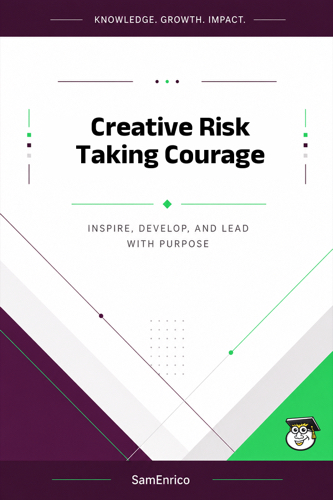
Creative Risk Taking Courage eBook
Take artistic leaps without guaranteeing success o
by Conn Tien
Take artistic leaps without guaranteeing success or safety.
Formats
Free sample
Chapter 1: The False Safety Trap--–- In 2014, I spent eighteen months on a novel that I believed would change my life. My agent called it “powerful.” My writing group wept at the ending. I sent it to five major publishers, and all five said no. But it was the sixth sentence of the fifth rejection letter that shattered me. An editor I admired wrote: “This is beautifully written.
But it feels like something you already knew how to make.” Not bad. Not good. Just… familiar. I had not failed because I took a risk. I had failed because I had been playing it safe inside a risky disguise.
That editor did me the greatest favor anyone has ever done for a writer. She told me the truth that this entire book is built upon: the most dangerous thing you can do with your creative life is to play it safe.The Most Dangerous Word in the Creative Vocabulary Let me say something that will sound like a contradiction, and then I will prove it is true. Safety is not the opposite of risk. Safety is the most common form of risk there is. Every time you choose to repeat what worked before, every time you reach for the technique that earned you praise, every time you make the art that people already understand, you are not protecting yourself.
You are slowly, politely, invisibly making yourself obsolete.I want you to think about the last time you saw a band play the exact same set they played five years ago. Or a painter working in a style that was innovative a decade ago. Or a writer producing the same kind of story that first got them published. Did you feel admiration for their consistency? Or did you feel something closer to pity?
Audiences, critics, and markets are not hungry for the familiar. They are hungry for the tension of something that might not work. They want to watch someone walk a tightrope without a net. They want to see what happens when an artist reaches for something they cannot yet reach.This is the first and most important distinction this book will give you. There are two kinds of safety in creative work.
The first is what I call false safety. False safety is the belief that repetition protects you. It is the voice that says: “Do what you know. Stick to the formula. Don’t embarrass yourself.” False safety feels responsible.
It feels mature. It is actually the fastest route to creative death. The second is structural safety, which we will explore in Chapter 7. Structural safety is the container—the routines, the workspace, the boundaries—that actually enables risk. For now, we are focused on false safety, because false safety is the liar that has convinced most creatives that they are being brave when they are actually being cowardly.The Decay of Safety Here is a law of creative work that no one tells you when you are starting out: every creative success has a shelf life.
What was innovative five years ago is invisible today. What was daring last year is expected this year. What made people uncomfortable a decade ago is now a cliché. I call this the decay of safety—the relentless process by which anything that once protected you becomes the very thing that exposes you.Consider the film industry. When the first Iron Man movie came out in 2008, a connected superhero universe was a genuine risk.
No one had ever done it before. It could have failed spectacularly. Instead, it succeeded beyond anyone’s imagination. And then something predictable happened. Other studios tried to copy the formula.
For the next decade, we were flooded with connected universes, shared mythologies, and post-credits teases. What was once a risk became a template. What was once daring became boring. By 2020, audiences groaned at the announcement of another cinematic universe. The safe choice—making another connected franchise—had become the most dangerous choice of all.The same pattern appears in every creative field.
In music, the band that invents a new sound is celebrated. The band that perfects that sound for the next four albums is forgotten. In painting, the artist who breaks the rules becomes famous. The artist who repeats the same breakthrough for thirty years becomes a footnote. In entrepreneurship, the startup that disrupts an industry is a legend.
The startup that copies a successful disruptor is a statistic.False safety does not kill you quickly. It kills you slowly. You will not wake up one day to find that your audience has abandoned you. Instead, you will notice that the invitations stop coming. The reviews get shorter.
The applause gets quieter. And you will tell yourself that you are still making good work—because you are. That is the horror of it. You are making good work. But good is not enough.
Good is the enemy of great, yes, but more importantly, good is the enemy of alive. And false safety produces work that is technically good and spiritually dead.The Audience is Not Looking for Comfort One of the most persistent and damaging myths in creative work is that audiences want to be comforted. They do not. What they want is to be moved. And movement requires tension.
Tension requires the possibility of failure.I want you to think about the last time you saw a live performance that genuinely thrilled you. Was it the performer who executed everything flawlessly, never missing a note, never deviating from the script? Or was it the performer who took a risk—who reached for a high note that might crack, who told a story that might not land, who stood on stage with nothing to hide behind? The answer is obvious. Flawless is forgettable.
Vulnerable is memorable.There is a reason that reality television has dominated popular culture for two decades. It is not because it is high art. It is because it carries the genuine risk of humiliation. When someone sings on a talent show and their voice cracks, that is real. When someone pitches a business idea and the investors say no, that is real.
When someone attempts a cooking challenge and burns the dish, that is real. Audiences are desperate for authenticity, and authenticity is simply the willingness to risk failure in public.This is not a new phenomenon. The ancient Greeks understood it. Their tragedies were not about perfect heroes succeeding. They were about flawed humans failing.
The audience did not leave the theater feeling comforted. They left feeling catharsis—a word that literally means purification through pity and terror. They paid money to watch people make mistakes. They paid money to watch people lose everything. And they came back for more, because there is something in the human soul that recognizes truth not in success but in struggle.If you are reading this book, you are almost certainly someone who has been told to play it safe.
Your teachers told you to master the fundamentals before you experimented. Your parents told you to have a backup plan. Your colleagues told you to stick with what works. Everyone around you has been trying to…
This is the end of the free sample. Get the eBook to keep going. Buy now
About this book
Details
- Author
- Conn Tien
- Publisher
- SamEnrico
- Language
- English
- Genre
- Non-Fiction, Self-Help, Risk Taking
- Released
- 2026-06-06
- Pages (approx.)
- 134
- Available as
- eBook, Audiobook

Read better in the ZLOADR app
Your eBooks on your phone or tablet. Sign in with your SamEnrico account and start reading.
More by Conn Tien
 Blue Zone Spouse Support PlanConn Tien$11.99
 Indian BPO Cost AnalysisConn Tien$11.99
 Flow For SurgeonsConn Tien$11.99
 Love Letters from the Arctic: The Secret Correspondence of a WWII Nurse and a Lost PilotConn Tien$11.99
 How to Start a Armoured Doors Business (Beginners Guide)Conn Tien$11.99
 How to Produce Caller IDSConn Tien$11.99
 New Hire Reporting for Child SupportConn Tien$12.99
 Home Theater InstallerConn Tien$11.99