
Non-FictionMental WealthCreative Wellness
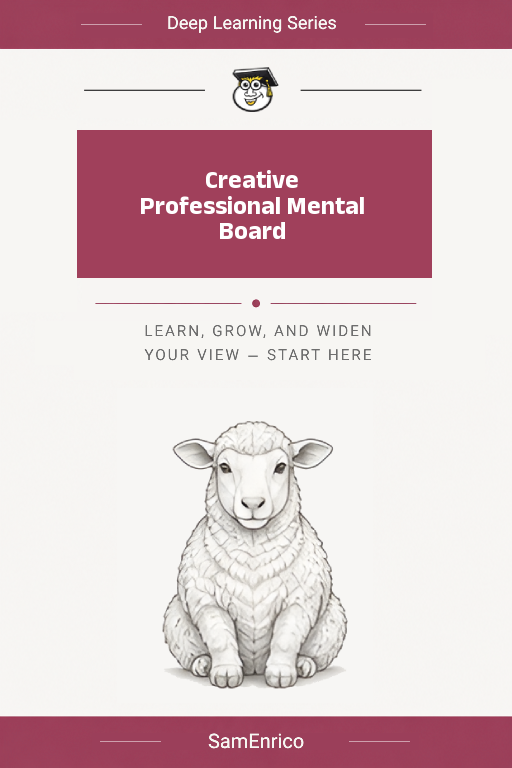
Creative Professional Mental Board eBook
Build support team for artists, writers, and perfo
by Blue Romeo
Build support team for artists, writers, and performers including creativity coaches and performance anxiety specialists.
Formats
Free sample
Chapter 1: The Suffering Tax--–- Every artist knows the mythology by heart. The painter who cuts off his ear. The poet who drowns in whiskey. The novelist who burns through three marriages and two breakdowns before producing the masterpiece that kills him. We have been told, explicitly and implicitly, that suffering is not merely the price of great art but the very engine of it.
That without the torment, the anxiety, the sleepless nights and the gnawing fear of inadequacy, what emerges on the canvas, the page, or the stage will be shallow. Safe. Forgettable.This chapter dismantles that mythology. Not because suffering is avoidable—it is not, and any book that promises a pain-free creative life is selling lies—but because the belief that suffering is necessary has become a self-fulfilling prophecy that destroys more careers than it ennobles. The data from thirty years of creativity research, drawn from the underground classic Art & Fear and the clinical work of performance psychologists, tells a different story.
Suffering does not cause great art. Great art happens despite suffering, and often at tremendous cost. The artists who sustain long, generative careers are not the ones who suffered most heroically. They are the ones who built support systems. They are the ones who rejected the identity of the tortured genius and embraced the identity of the creative professional.This chapter introduces the concept that will run like a spine through this entire book: the lone wolf model of creativity is a cultural fiction that has outlived its usefulness.
Isolation amplifies anxiety. It kills accountability. It turns manageable creative struggles into career-ending catastrophes. And the first step toward building a Mental Board—the support system of coaches, specialists, partners, and professionals that this book will teach you to assemble—is to name the cost of the myth you have been living inside. By the end of this chapter, you will be asked to calculate your own Suffering Tax: the price you have paid, in abandoned projects, eroded confidence, and lost years, for believing that you had to suffer alone.Let us begin with a story.The Cost of the Myth: A Case Study in Unnecessary Collapse Sarah was a novelist.
A good one. She had published two books to respectable reviews, earned enough to quit her day job, and was halfway through her third manuscript when something broke. Not her plot. Not her characters. Her belief in herself.She had been raised on the mythology.
Her favorite writers—Plath, Hemingway, Woolf—had all died by their own hands or their own habits. Her MFA professors spoke in reverent tones about the "price of vision." Her own mother, a painter who had given up her career at thirty, told Sarah that "real artists are never happy." So when the anxiety showed up—the tight chest before opening her laptop, the three hours of staring at a blinking cursor, the voice that whispered "this is garbage and everyone will know it"—Sarah did what the mythology prescribed. She suffered.She drank more coffee and less water. She stopped seeing friends because "real writing requires solitude." She told herself that the panic attacks were a sign of depth. She cancelled dinner with her partner, then stopped answering texts, then stopped leaving the house except for groceries.
The manuscript stalled at page 117. The voice got louder. She started to believe that she had already written her two good books and was now exposed as a fraud.Six months later, Sarah was in a therapist's office, diagnosed with generalized anxiety disorder and moderate depression. The therapist asked a simple question: "When did you last ask anyone for help?"Sarah could not remember.The mythology had taught her that asking for help was cheating. That suffering was the furnace in which authentic art was forged.
That a creativity coach was for corporate drones, not serious novelists. That performance anxiety specialists were for athletes, not artists. That an accountability partner was just a crutch for the weak-willed.By the time Sarah found her way to a creativity coach—a woman named Diana who specialized in writers' block—she had lost eighteen months of productive work, nearly lost her book contract, and spent thousands of dollars on therapy that, while necessary, could not solve the structural problem: Sarah had no support system. She had no one to call when the cursor blinked. No one to check in on her deadlines.
No one to say, "That voice is lying, and here is the evidence."This book is the story of how Sarah—and hundreds of other artists, writers, and performers—built their Mental Boards. But before we get to the building, we have to clear the land. And the land is thick with the wreckage of a beautiful, romantic, ruinous lie.The Three Pillars of the Tortured Genius Myth The mythology of the suffering artist rests on three foundational beliefs. Each one contains a grain of truth, which is why the myth is so durable. Each one also contains a catastrophic distortion.Pillar One: Suffering produces authenticity.The grain of truth: lived experience, including difficult experience, deepens art.
A writer who has never known loss may struggle to write convincingly about grief. A performer who has never faced rejection may lack the vulnerability that moves an audience.The distortion: suffering is not the only source of depth, and it is certainly not the most reliable one. Empathy, observation, craft, and imagination are equally valid and far less destructive pathways to authentic expression. Toni Morrison wrote the depths of human cruelty and resilience without living through them herself. She used research, imagination, and discipline—not self-destruction.
The belief that you must personally suffer to create meaningfully is a form of narcissism dressed up as artistic integrity.Pillar Two: Isolation is necessary for concentration.The grain of truth: distraction kills deep work. The social obligations of daily life—emails, meetings, small talk—can fracture attention and prevent the sustained focus that complex creative projects require.The distortion: isolation is not the same as solitude. Solitude is a chosen, bounded, time-limited state of focused work. Isolation is a chronic condition of relational starvation. The mythology confuses the two.
It tells the artist that closing the door to the study for four hours is the same as closing the door to all human contact for four months. It conflates the necessary boundary with the unnecessary wall. The result is not deeper work but a brittle psyche that cracks under the first real pressure.Pillar Three: Anxiety is a sign of depth.The grain of truth: creative work is risky. Risk produces anxiety. A certain level of nervous activation—what performance psychologists call "optimal arousal"—can sharpen focus, increase energy, and produce better outcomes.The distortion: not all anxiety is created equal.
The low-grade hum of productive nerves is very different from the crushing weight of panic, the paralysis of perfectionism, or the slow erosion of generalized dread. The mythology tells the artist that any anxiety is a sign of caring, and that caring deeply is the mark of the true artist. This is like saying any fever is a sign of a strong immune system. Some fevers…
This is the end of the free sample. Get the eBook to keep going. Buy now
About this book
Details
- Author
- Blue Romeo
- Publisher
- SamEnrico
- Language
- English
- Genre
- Non-Fiction, Mental Wealth, Creative Wellness
- Released
- 2026-05-30
- Pages (approx.)
- 143
- Available as
- eBook, Audiobook

Read better in the ZLOADR app
Your eBooks on your phone or tablet. Sign in with your SamEnrico account and start reading.
More by Blue Romeo
 Navigating Work From Home IssuesBlue Romeo$11.99
 Remote Retreats for EnterprisesBlue Romeo$11.99
 Medicare Housing Transition GuideBlue Romeo$11.99
 Etsy Digital Planner Product ResearchBlue Romeo$11.99
 Deep Work for Sales ProfessionalsBlue Romeo$11.99
 The Phantom of Route 66: The Unsolved Mystery of the Vanishing TravelersBlue Romeo$11.99
 The Last Mile: The Miracle of the 1998 Jamaican Bobsled TeamBlue Romeo$11.99
 Understanding Chondrodysplasia Punctata, Sheffield TypeBlue Romeo$17.99
 Rolling Forecast Department GuideBlue Romeo$12.99
 Mortgage BrokeringBlue Romeo$11.99
 Ultimate Handbook Guide to Pago Pago : (American Samoa) Travel GuideBlue Romeo$11.99
You may also like
 Hong Kong Handover 1997Dunn Johnnie$11.99
 Zumba For Postnatal Recovery CourseNeal Christian$11.99
 Zumba for BeginnersLadner Nikia$11.99
 YouTube Comment Mining GuideHumes Pandora$12.99
 Worry Box MeditationCarlin Rudy$11.99
 Workplace Stress MeditationNguyen Lynn$11.99
 Workplace Stress and Sleep RepairHawley Ivory$11.99
 Workplace Perfectionism CureDelaney Jeffry$11.99
 Workplace Injustice Anger GuideWallen Isabelle$11.99
 Work Addiction and Burnout LinkGreenwood Ester$11.99
 Women in Yoga and WellnessBeattie Galina$11.99
 Women in Stand Up ComedyChun Evangeline$11.99