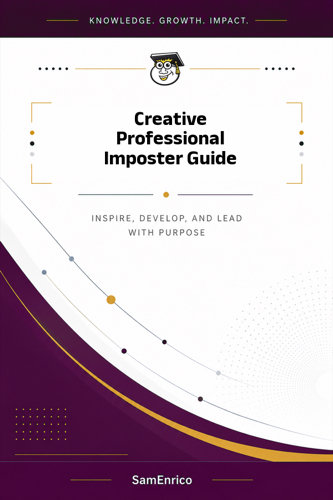
Creative Professional Imposter Guide eBook
Artists, writers, and designers overcoming the fea
Artists, writers, and designers overcoming the fear that their work isn't good enough.
Formats
Free sample
Chapter 1: The Three Masks--If you are holding this book, there is a good chance you have done something unforgivable. You have looked at your own work—a painting, a logo, a paragraph, a wireframe, a photograph—and felt a specific kind of nausea. The kind that says: They are going to find out.Not that you made a mistake. Mistakes are fixable. No, the fear is deeper.
The fear is that you are the mistake. That you have been sneaking into rooms where you do not belong, wearing clothes that do not fit, using words you do not understand, and any moment now someone is going to tap you on the shoulder and escort you out. Not because you did something wrong. Because you are something wrong.This is not a personality flaw. This is not low self-esteem.
This is not humility, and it is certainly not helpful. This is the Creative Imposter Complex, and it has a specific texture that generic anxiety does not. A corporate manager might worry about being exposed as incompetent. But a painter, a writer, a designer—you worry about being exposed as empty. As if the work you make is not merely bad but fraudulent.
As if the real creative person is somewhere else, and you are just the person who stole their desk.Here is the first and most important thing you will read in this book: The people you admire feel this way too.Maya Angelou, after eleven books and a Presidential Medal of Freedom, said: "I have written eleven books, but each time I think, 'Uh oh, they're going to find out now. I've run a game on everybody.'" David Bowie described himself as "a fraudulent artist" even as he sold out stadiums. The writer Neil Gaiman once received an email from a fan asking for advice, and he realized he was still waiting for the "real" Neil Gaiman to show up and do the work. The actor Jodie Foster admitted she still expects someone to tap her on the shoulder and say, "I'm sorry, there's been a mistake. You're actually not supposed to be here."They are not being modest.
They are being honest. And their honesty reveals something crucial: the feeling of being a fraud is not correlated with actual fraudulence. The real imposters do not feel like imposters. They feel certain. Certainty is the hallmark of the amateur.
Doubt is the price of entry.So let us name what we are dealing with. This chapter is the diagnosis. It will not cure you. It will not make you feel better. It will, however, give you a map of the terrain.
You cannot defeat an enemy you cannot name.The Visibility Paradox Why does creative work produce such a specific flavor of imposter syndrome? Because it is visible in a way that most work is not.Consider a middle manager at a pharmaceutical company. Their output is abstract: reports, meetings, spreadsheets, strategy documents. When someone criticizes their work, the criticism is about the content—the numbers, the projections, the timeline. It is rarely about the person.
The manager can say, "The Q3 forecast was off," without saying, "I am a fraud."Now consider a graphic designer. Their output is not abstract. It is a logo, a website, a poster, a brand identity. When someone criticizes their work, the criticism lands on something that feels like an extension of the designer's soul. "This logo is ugly" translates directly to "You have bad taste." "This spacing is wrong" translates to "You don't see what I see." The work is not a report.
The work is a specimen of the self, pinned to a board for inspection.This is the Visibility Paradox: creative work is judged as if it reveals the creator's essential worth, while non-creative work is judged as if it reveals the creator's competence. The difference is everything.A bad spreadsheet means you need to check your formulas. A bad painting means, to the painter, that you are a bad painter. Full stop.This is not rational. But it is real.
And it is the first thing you need to understand about the Creative Imposter Complex: your brain is not malfunctioning. It is responding rationally to an irrational environment. The problem is not your feelings. The problem is the logic your feelings are based on.The Three Masks of the Fake Artist If imposter syndrome were a single experience, this book would be much shorter. But it is not.
It is a family of experiences that wear different masks. Over a decade of working with creative professionals—writers, painters, UX designers, illustrators, art directors, poets, architects, and even a few tattoo artists—I have observed three distinct patterns. I call them the Three Masks.You will likely recognize yourself in one. Possibly two. Rarely all three, though some overachievers manage it.Mask One: The Prodigy The Prodigy believes that mastery should not require effort.
If you need more than one draft, you are not talented. If you need to practice, you are not a natural. If you struggle, you are faking it.The Prodigy Mask whispers: Real artists don't try this hard.This mask is particularly common among people who were told they were "gifted" as children. They learned early that praise came easily, without visible struggle. They were the kid who could draw better than anyone else in third grade, the teenager whose essays were read aloud in class, the young designer who won a student award.
The praise felt good. But it came with a hidden contract: You are special because you don't have to work.Then something happened. They grew up. The problems got harder. The third-grade drawing skills did not translate to professional illustration.
The high school essays did not become a novel. The student award did not guarantee a career. And suddenly, they had to try. Trying felt like failure. If they were truly talented, the Prodigy Mask argued, they would not need to struggle.The Prodigy does not finish projects.
They start them with excitement and abandon them when the first challenge appears. They have dozens of half-written screenplays, folders of unfinished illustrations, a hard drive full of abandoned websites. Each abandoned project becomes evidence for the mask: "See? You couldn't finish. You're not a real artist."The Prodigy also struggles with revision.
To revise is to admit that the first version was not perfect. The Prodigy Mask cannot tolerate this. So the Prodigy submits first drafts, ships unpolished work, and then feels like a fraud when someone inevitably points out the flaws. The flaws were always there. The Prodigy just refused to see them.If you are wearing the Prodigy Mask, you will recognize these symptoms:You abandon projects at the first sign of difficulty.You have a graveyard of "almost finished" work.You believe that needing multiple drafts means you lack talent.You were told you were "gifted" as a child, and you are still trying to live up to it.You equate speed with skill.
Fast = good. Slow = bad.You have never submitted a second draft of anything.Mask Two: The Hermit The Hermit believes that asking for help reveals…
This is the end of the free sample. Get the eBook to keep going. Buy now
About this book
Details
- Author
- Mcmanus Jenifer
- Publisher
- SamEnrico
- Language
- English
- Genre
- Non-Fiction, Self-Help, Creative Psychology
- Released
- 2026-06-07
- Pages (approx.)
- 143
- Available as
- eBook, Audiobook

Read better in the ZLOADR app
Your eBooks on your phone or tablet. Sign in with your SamEnrico account and start reading.
More by Mcmanus Jenifer
 Incubating Solutions For Eating Disorders WorkbookMcmanus Jenifer$11.99
 Anger at Child’s Risk-Taking BehaviorMcmanus Jenifer$11.99
 The IBS and IBD GuideMcmanus Jenifer$11.99
 The Relapse Prevention for GamblingMcmanus Jenifer$11.99
 Chariots of the Heart: The Secret Love That Fueled Rome’s Greatest VictoryMcmanus Jenifer$11.99
 Understanding Thymic Epithelial TumorMcmanus Jenifer$17.99
 Quora Question ValidationMcmanus Jenifer$12.99
 Nigeria Invoice Factoring GuideMcmanus Jenifer$12.99
 Sales AnalystMcmanus Jenifer$11.99
 How to Become a Leather CutterMcmanus Jenifer$11.99