
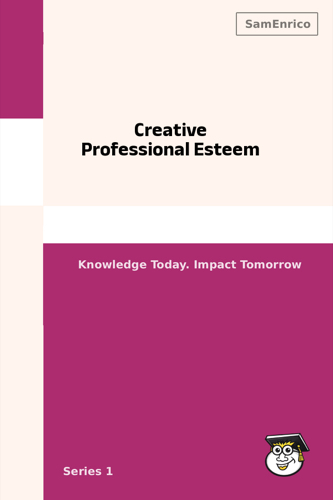
Creative Professional Esteem eBook
Build confidence in subjective creative fields des
by Fife Andree
Build confidence in subjective creative fields despite rejection and criticism.
Formats
Free sample
Chapter 1: The Vulnerability Hangover--For three days after submitting her manuscript, the novelist could not open her laptop. She checked email on her phone, each notification sending a spike of cortisol through her chest. She replayed every sentence she had written, now convinced they were amateurish. She told her partner, “I think I just embarrassed myself in front of my editor.” When the acceptance finally arrived, she felt only a brief flicker of relief before the dread reset for the next project.This is not weakness. This is not insecurity as a character flaw.
This is a biological survival response, and once you understand how it works, you can stop fighting yourself and start working with your own nervous system.The Hidden Architecture of Creative Fear The term “vulnerability hangover” was popularized by researcher and author Brené Brown to describe the physical and emotional aftermath of exposing something you have created. But what most creative professionals do not realize is that this hangover has a precise neurobiological signature. When you share your work and await judgment, your brain’s insula and anterior cingulate cortex—regions that process physical pain—activate in the same way they would if you had touched a hot stove.This is not a metaphor. Functional MRI studies have shown that social rejection and harsh criticism trigger the same neural pathways as physical injury. For creative professionals, whose work is often intertwined with identity, this response is amplified.
You are not being dramatic when you say a bad review “hurts.” Your brain agrees.The evolutionary logic is straightforward. For early humans, social exclusion meant death. Being rejected by the tribe meant no access to food, shelter, or protection. Your nervous system evolved to treat any potential rejection as a life-threatening event. The problem is that your nervous system cannot distinguish between being exiled from the tribe and receiving a two-star review on a creative platform.
Both register as danger.This chapter begins where every book on creative confidence should begin: not with positive thinking, but with accurate self-assessment. You cannot build esteem on a foundation of denial. You have to understand what you are actually feeling, why you are feeling it, and most importantly, how to tell the difference between the fear that protects you and the fear that paralyzes you.Productive Discomfort versus Debilitating Fear One of the most common mistakes creative professionals make is treating all fear as the same substance. They are not. There is a vast difference between the nervous excitement before a presentation and the hollow dread that prevents you from showing up at all.
Learning to distinguish these two states is the single most important skill you will develop in this book.Productive discomfort feels like butterflies in the stomach, a slightly elevated heart rate, and a sense of alertness. It says, “This matters to me, and I am ready to try.” It is the sensation before a first date, a job interview, or a gallery opening. Your hands might sweat, but you can still move. You can still speak. You are present.Debilitating fear feels like a weight on your chest, a urge to hide or escape, and a loop of catastrophic thinking.
It says, “Do not do this. You will be hurt. Stay small.” It is the sensation that causes you to miss deadlines, delete files, or ghost a client. You are not present. You are in survival mode.The Body Check tool helps you distinguish between these two states in under thirty seconds.
Sit quietly. Place one hand on your chest and one on your stomach. Ask yourself three questions:First, where do I feel this fear in my body? Productive discomfort tends to live in the chest and throat—energetic, fluttery. Debilitating fear tends to live in the gut and shoulders—heavy, constricting.Second, what is the quality of my thoughts?
Productive discomfort produces focused, specific concerns: “What if I forget my talking points?” Debilitating fear produces vague, global catastrophes: “What if I am a fraud and everyone finds out?”Third, do I have the urge to move forward or to hide? Productive discomfort coexists with a desire to act. You are nervous, but you still want to walk toward the stage. Debilitating fear produces an urge to retreat, to close the laptop, to cancel the meeting.If you identify debilitating fear, do not push through it. That is not courage; that is dissociation.
Instead, use the tools in this chapter to lower the threat response before acting. If you identify productive discomfort, recognize it as a sign that you care. Welcome it. It means you are alive.Name It to Tame It: The First Intervention The late neurologist and psychiatrist Daniel Siegel coined the phrase “name it to tame it” to describe the process by which labeling an emotion reduces its intensity. When you put words to a feeling, you activate the prefrontal cortex—the logical, planning part of your brain.
This engagement down-regulates the amygdala, the ancient threat-detection center that triggers fight-or-flight responses.Here is why this matters for creative professionals. Most of us do not name our fears. We marinate in them. We say things like, “I feel terrible about this portfolio,” which is not a name. It is a fog.
A fog cannot be addressed. It can only be fled or endured.Naming requires specificity. Instead of “I feel terrible,” you say, “I am afraid that if this pitch is rejected, I will be seen as inexperienced, and that will harm my chances of future work.” Instead of “I am anxious about posting this art,” you say, “I am afraid that the response will be silence, which I will interpret as evidence that my work has no value.”The difference is not merely semantic. When you articulate the specific fear, two things happen. First, you realize that many of your fears are actually predictions about the future—predictions that may or may not come true.
Second, you give your prefrontal cortex a job to do. It can now examine the fear for evidence, probability, and proportion. It can ask: How likely is this outcome? What is the worst that could actually happen? What is the most likely outcome?The chapter provides a structured worksheet called the Vulnerability Inventory, which guides you through mapping past creative exposures, their outcomes, and the actual consequences versus the imagined ones.
Most creatives discover that their imagined catastrophes—humiliation, financial ruin, permanent ostracism—almost never materialize. What actually happens is usually mundane: a polite rejection, a brief period of disappointment, and then the next opportunity.The Myth of Thick Skin Creative professionals often hear the advice to “develop thick skin” or “stop taking things personally.” This advice is worse than useless; it is actively harmful. It implies that your sensitivity to rejection is a flaw to be eradicated rather than a feature to be managed.You do not want thick skin. Thick skin is dead tissue. What you want is a responsive nervous system that can distinguish between genuine threats and false alarms.
You want to feel the sting of rejection—because that sting carries information—without spiraling into a week of paralysis.The goal of this chapter, and this book, is…
This is the end of the free sample. Get the eBook to keep going. Buy now
About this book
Details
- Author
- Fife Andree
- Publisher
- SamEnrico
- Language
- English
- Genre
- Non-Fiction, Self-Help, Creative Careers
- Released
- 2026-06-06
- Pages (approx.)
- 116
- Available as
- eBook, Audiobook

Read better in the ZLOADR app
Your eBooks on your phone or tablet. Sign in with your SamEnrico account and start reading.
More by Fife Andree
 Driving Phobia GuideFife Andree$11.99
 Sexist Workplace Anger GuideFife Andree$11.99
 The Body Language for Law EnforcementFife Andree$11.99
 WeChat Moments Social PressureFife Andree$11.99
 Silk and Steel: The Unseen Trade Wars of the Han DynastyFife Andree$11.99
 Understanding Microphthalmia Microtia Fetal AkinesiaFife Andree$17.99
 Marketing Image Prompt GuideFife Andree$12.99
 Clean Energy Capital AllocationFife Andree$12.99
 How to Start a Bunk Beds Made of Metal Business (Beginners Guide)Fife Andree$11.99
 Alligator TrapperFife Andree$11.99
You may also like
 The Creative Professional ConfidenceVanburen Sharyn$11.99
 Creative Professional Stress SolutionTapia Kathe$11.99
 Creative Professional Self EsteemHale Shaun$11.99
 The Self Esteem for Creatives CourseCarroll Enrique$11.99
 Assertiveness for Artists GuideRedmon Annita$11.99
 Creative Professional Energy GuideMead Chloe$11.99
 ABCDE for Creative Professionals GuideLeonard Eva$11.99