
Non-FictionSelf-HelpCreative Fields
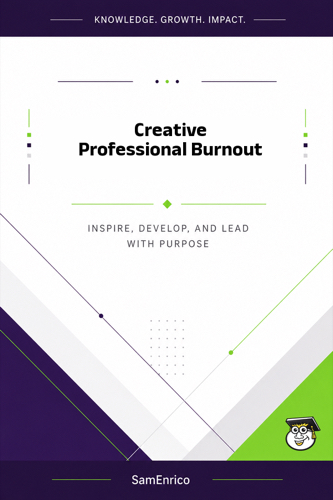
Creative Professional Burnout eBook
Protect artistic energy from commercial demands.
Protect artistic energy from commercial demands.
Formats
Free sample
Chapter 1: The Passion Tax--Most people will tell you that loving your work is the ultimate prize. They are wrong.Not slightly wrong. Not well-intentionedly wrong. Catastrophically, dangerously, career-endingly wrong. Because when you love what you do, you don't just tolerate the bad parts—you celebrate them as proof of your devotion.
You wear your exhaustion like a medal. You answer emails at midnight and call it dedication. You accept "exposure" as payment and call it paying your dues. You watch your savings account dwindle and call it the price of authenticity.And then one day—usually on a Tuesday, because burnout never has the courtesy to arrive on a Friday—you find yourself staring at a blank screen, feeling absolutely nothing. Not frustration.
Not creative block. Not even anger. Just a vast, hollow emptiness where your passion used to live. The thing you loved has become the thing you dread. And you have no idea how you got here.This book is about how you got here.
And more importantly, how to get out.But before we can build a solution, we have to name the disease. And the disease has a name: The Passion Tax.The Hidden Cost of Doing What You Love In 2025, media scholar Mark Deuze published Well-Being and Creative Careers, a comprehensive study that confirmed what many creatives had long suspected but couldn't prove. Deuze's research found that creative professionals—writers, designers, musicians, photographers, architects, filmmakers, and visual artists—report significantly higher rates of anxiety, depression, and emotional exhaustion than any other professional sector. Higher than healthcare workers. Higher than emergency responders.
Higher than corporate lawyers working eighty-hour weeks.Think about that for a moment. An emergency room doctor watches people die. A firefighter runs into burning buildings. And yet, according to the data, a freelance graphic designer dealing with a difficult client is statistically more likely to report severe burnout than either of them.Why?The answer, Deuze discovered, lies in what he calls the passion paradox: the counterintuitive reality that loving your work makes you more vulnerable to exploitation, not less. When you see your job as a calling rather than a transaction, you tolerate conditions that would send a corporate employee straight to HR.
You accept lower pay because "it's about the art." You work longer hours because "this is what I was born to do." You internalize every failure as a personal indictment because your work isn't just something you do—it's who you are.This is the Passion Tax: the hidden psychological cost of monetizing your identity. Every time you blur the line between your creative work and your sense of self, you pay a little more. Every time you say yes to a project you should have rejected, the tax compounds. Every time you check your email at 11 PM and feel a spike of anxiety, the tax comes due.And eventually, the tax collector shows up. Her name is burnout.
And she doesn't accept excuses.The Passion Paradox: Why Love Makes You Vulnerable Let me tell you about a writer I'll call Sarah. (Her real name isn't Sarah, but she asked me not to use it. She's still recovering.)Sarah was a successful freelance journalist. She wrote long-form features for respected magazines. She had a byline she was proud of.
She loved her work—genuinely, deeply loved it. When she told people what she did for a living, she felt lucky. And that feeling of luckiness was exactly the trap.Because Sarah loved her work, she said yes to every assignment that came her way. Even the low-paying ones. Even the ones with impossible deadlines.
Even the ones where the editor was clearly difficult. "I should be grateful," she told herself. "Other people would kill for this." She worked through weekends. She answered emails on vacation. She told herself that the anxiety she felt before every interview was just "performance adrenaline."After three years of this, Sarah stopped being able to write.
Not "writer's block"—she had experienced that before and knew how to work through it. This was different. She would sit down at her computer, open a blank document, and feel a wave of nausea. The thought of typing a single word filled her with dread. The thing she had once loved now felt like a punishment.Sarah had paid the Passion Tax.
And she had paid it in full.Here's what Sarah didn't understand until it was almost too late: the very love that made her a good writer also made her a bad businessperson. She treated every project as a creative opportunity rather than a commercial transaction. She confused "being grateful for work" with "accepting unfair terms." She believed that if she just worked hard enough, the universe would eventually reward her.The universe does not work that way. The universe is not keeping score. The universe will let you work yourself into the ground and then ask why you stopped.The Two Selves: Maker and Seller To understand the Passion Tax, you have to understand that you are not one person.
You are two.There is The Maker. This is the part of you that finds joy in the act of creation itself. The Maker doesn't care about money or recognition or whether anyone ever sees the work. The Maker just wants to make. When you spend three hours on a sketch that will never leave your notebook, that's The Maker.
When you write a poem for no one but yourself, that's The Maker. When you learn a new software just because it looks fun, that's The Maker. The Maker's energy is renewable, intrinsic, and non-transactional. The Maker asks one question: Did I enjoy making this?Then there is The Seller. This is the part of you that needs external approval to feel worthy.
The Seller cares about sales numbers, likes, retweets, reviews, repeat clients, and the silent judgment of your peers. When you check your email seventeen times in an hour waiting for a response, that's The Seller. When you obsess over why someone didn't like your post, that's The Seller. When you measure your worth by your bank account balance, that's The Seller. The Seller's energy is finite, anxiety-driven, and deeply addictive.
The Seller asks one question: Did anyone like this?Here's the problem: in a healthy creative life, The Maker and The Seller work together. The Maker creates. The Seller sells. The Maker doesn't worry about the market. The Seller doesn't try to control the art.
Each stays in their lane.But when you monetize your passion, the lanes blur. The Seller starts to believe that it is The Maker. You begin to think that your commercial value is the same thing as your creative worth. You start measuring your art by its market performance. You stop asking "Did I enjoy this?" and start asking only "Did anyone buy this?"This is the Passion Tax in action.
Every time The Seller eats The Maker's lunch, you pay a little more. And eventually, The Maker stops showing up to work. Why would they? The Maker only gets paid in joy, and joy has been replaced by anxiety.The Over-Identification Trap There's a reason the…
This is the end of the free sample. Get the eBook to keep going. Buy now
About this book
Details
- Author
- Sherwood Reanna
- Publisher
- SamEnrico
- Language
- English
- Genre
- Non-Fiction, Self-Help, Creative Fields
- Released
- 2026-06-07
- Pages (approx.)
- 127
- Available as
- eBook, Audiobook

Read better in the ZLOADR app
Your eBooks on your phone or tablet. Sign in with your SamEnrico account and start reading.
More by Sherwood Reanna
 Mindful Sobriety: An Alcoholism Recovery CourseSherwood Reanna$11.99
 Equity Waterfall AnalysisSherwood Reanna$11.99
 Workaholism and ADHDSherwood Reanna$11.99
 Neural Dawn: The Unseen Architect of the First AI UprisingSherwood Reanna$11.99
 How to Produce Airsoft EquipmentSherwood Reanna$11.99
 Cross Border Payment Insurance GuideSherwood Reanna$12.99
 How to Start a Ferrosilicon Chromium Business (Beginners Guide)Sherwood Reanna$11.99
 Sound DesignerSherwood Reanna$11.99
You may also like
 Hong Kong Handover 1997Dunn Johnnie$11.99
 Zumba For Postnatal Recovery CourseNeal Christian$11.99
 Zumba for BeginnersLadner Nikia$11.99
 YouTube Comment Mining GuideHumes Pandora$12.99
 Worry Box MeditationCarlin Rudy$11.99
 Workplace Stress MeditationNguyen Lynn$11.99
 Workplace Stress and Sleep RepairHawley Ivory$11.99
 Workplace Perfectionism CureDelaney Jeffry$11.99
 Workplace Injustice Anger GuideWallen Isabelle$11.99
 Work Addiction and Burnout LinkGreenwood Ester$11.99
 Women in Yoga and WellnessBeattie Galina$11.99
 Women in Stand Up ComedyChun Evangeline$11.99