
Non-FictionSelf-HelpCreativity
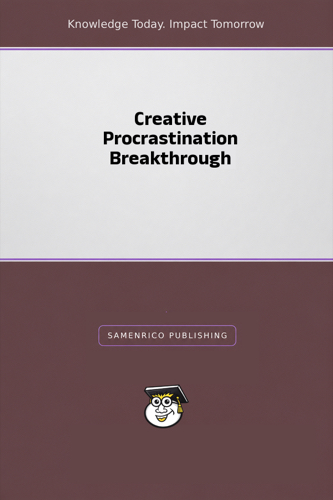
Creative Procrastination Breakthrough eBook
Start artistic projects despite fear of bad output
Start artistic projects despite fear of bad output.
Formats
Free sample
Chapter 1: The Vomit Draft...--–- Most artists don’t fail because they lack talent. They never start because they secretly believe their first attempt must be good. This is the lie that has kept your best work trapped inside your head for years, and it ends now.You are reading this book for one of three reasons. First, you have a project you have been postponing for months or years—a novel, a painting, a album, a business, a screenplay—and the blank page has become a source of quiet shame. Second, you have started many projects but abandoned them the moment they stopped looking like the masterpiece you imagined.
Third, you are tired of the loop: you feel inspired, you sit down to work, fear arrives, you clean your desk or scroll your phone or reorganize your bookshelf, and then you hate yourself for wasting another evening. You are not lazy. You are not undisciplined. You are afraid. And the specific shape of your fear is this: What if what I make is bad?This chapter dismantles that fear.
It does not ask you to overcome it with willpower or positive thinking—those strategies have already failed you. Instead, it offers a single, radical permission slip: you are allowed to make bad art. Not just allowed. Encouraged. Required.
The first step of the Creative Procrastination Breakthrough is learning to vomit onto the page, the canvas, the studio floor, and call it progress.The Myth of the Firstborn Masterpiece Every creative person carries a secret image in their mind: the artist who sits down, possessed by genius, and produces a masterpiece in one perfect flow. This image appears in movies about painters, in biographies of writers, in the origin stories of musicians. The myth says that real artists don’t struggle. Real artists don’t make ugly things. Real artists are touched by something the rest of us lack.This myth is a lie, and it is the single greatest destroyer of creative lives.David Bayles and Ted Orland, in their classic book Art & Fear, call this the fantasy of the “firstborn masterpiece.” We imagine that Michelangelo carved David directly from the marble without any false strokes.
We imagine that Hemingway wrote The Old Man and the Sea in a fever of genius and typed “The End” on a perfect manuscript. We imagine that the paintings in museums arrived there directly from the artist’s hands, already framed and glowing.None of this is true.Michelangelo’s archives contain dozens of rejected studies for David—arms that looked wrong, torsos that collapsed anatomically, poses that felt stiff. Hemingway rewrote the ending to A Farewell to Arms thirty-nine times. The great cellist Pablo Casals was asked at age ninety why he still practiced four hours a day. He replied, “Because I think I am making progress.” The master does not stop being a beginner.
The master simply learns to make better ugly things, faster, and with less self-hatred.The research backs this up. Psychologist Dean Simonton, who has studied creative genius for decades, analyzed the careers of hundreds of prolific creators—from Mozart to Edison to Picasso. His finding was consistent across every domain: quantity predicts quality. The creators who produced the most work also produced the most masterpieces. But they also produced the most failures.
For every great symphony, Mozart left behind dozens of forgettable pieces. For every patent that changed the world, Edison filed hundreds that went nowhere. Picasso created over fifty thousand works of art in his lifetime. Most of them are not in museums. Most of them are mediocre, strange, or outright bad.
But the masterpieces emerged from the pile of failures.This is not a coincidence. You cannot select the best unless you have a large sample to select from. You cannot refine a bad draft unless you have a draft to refine. And you cannot have a draft at all unless you start.The Gap: Why Your Taste Hates Your Hands There is a second reason the fear of bad output feels so unbearable, and it has nothing to do with objective quality. It has to do with the structure of your own artistic development.Every creative person experiences what Ira Glass, the host of This American Life, famously called “the gap.” When you start making art, you have excellent taste.
You have spent years consuming the best work in your field—the novels that broke your heart, the songs that made you weep, the films that rearranged your understanding of what is possible. You know what good looks like. You know what great looks like. Your taste is sophisticated, demanding, and exacting.Your hands, however, are beginners.There is a gap between your taste and your skill. And the gap feels like failure.
You make something, you look at it, your excellent taste immediately spots every flaw, and you conclude that you are not an artist. But this is a category error. The gap is not evidence of your inadequacy. It is evidence that you are paying attention. The gap is where every artist begins.
The only way out of the gap is through it—by making things that fall short of your taste, over and over, until your hands slowly catch up to your eyes.Here is the cruel irony: if you had terrible taste, you would be perfectly happy with everything you made. You would never experience the agony of the gap. But you would also never improve. The gap is the price of having excellent taste. It is the engine of your artistic growth.
And it feels exactly like failure, which is why so many people quit in the first year.Do not quit in the first year. Or the first decade. The gap does not close quickly. But it does close, one ugly drawing at a time, one terrible sentence at a time, one out-of-tune practice session at a time.The Three Perfectionist Lies Perfectionism is not a commitment to excellence. Perfectionism is a sophisticated avoidance strategy dressed in formal wear.
It sounds responsible. It sounds like high standards. But perfectionism is fear in a blazer, and it tells you three specific lies that keep you from starting.Lie Number One: “If I wait until I am ready, the work will be better.”This is the lie of preparation. It says that you are not ready yet, but someday soon—after you read one more book, take one more class, buy the right equipment, find the right studio, wait for the right mood—you will be ready, and then the work will flow easily and well.This is false because readiness is not a state you arrive at. Readiness is a decision you make.
The best time to start was ten years ago. The second best time is now. The third best time is also now, because “now” is always the only time you have. Every day you wait, your skills are not improving. They are rusting.
You do not become a runner by reading about running. You become a runner by running badly, slowly, awkwardly, and then running again tomorrow.Lie Number Two: “Bad output reveals who I really…
This is the end of the free sample. Get the eBook to keep going. Buy now
About this book
Details
- Author
- Andersen Elenora
- Publisher
- SamEnrico
- Language
- English
- Genre
- Non-Fiction, Self-Help, Creativity
- Released
- 2026-06-06
- Pages (approx.)
- 108
- Available as
- eBook, Audiobook

Read better in the ZLOADR app
Your eBooks on your phone or tablet. Sign in with your SamEnrico account and start reading.
More by Andersen Elenora
 Outbreak Shareholder Letter KitAndersen Elenora$11.99
 Mindfulness for ChildrenAndersen Elenora$11.99
 The Foster Care PregnancyAndersen Elenora$11.99
 International Dividend InvestingAndersen Elenora$11.99
 Maquis French Rural FightersAndersen Elenora$11.99
 Chronic Stress Vs BurnoutAndersen Elenora$11.99
 Child Illness Death GriefAndersen Elenora$11.99
 Zama's Last Stand: Hannibal's Final Gambit Against Rome (202 BC)Andersen Elenora$11.99
 The Ballad of the Maya Ballcourt: How Ancient Marketing Won the GameAndersen Elenora$11.99
 How to Produce Mattress PadsAndersen Elenora$11.99
 How to Produce a WindshieldAndersen Elenora$11.99
 OKR Quarterly Planning TemplateAndersen Elenora$12.99
You may also like
 Hong Kong Handover 1997Dunn Johnnie$11.99
 Zumba For Postnatal Recovery CourseNeal Christian$11.99
 Zumba for BeginnersLadner Nikia$11.99
 YouTube Comment Mining GuideHumes Pandora$12.99
 Worry Box MeditationCarlin Rudy$11.99
 Workplace Stress MeditationNguyen Lynn$11.99
 Workplace Stress and Sleep RepairHawley Ivory$11.99
 Workplace Perfectionism CureDelaney Jeffry$11.99
 Workplace Injustice Anger GuideWallen Isabelle$11.99
 Work Addiction and Burnout LinkGreenwood Ester$11.99
 Women in Yoga and WellnessBeattie Galina$11.99
 Women in Stand Up ComedyChun Evangeline$11.99