
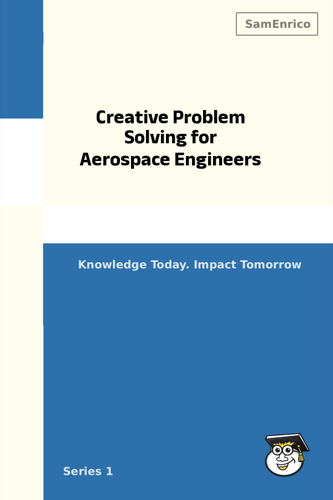
Creative Problem Solving for Aerospace Engineers eBook
Solve weight, stress, and safety challenges with u
Solve weight, stress, and safety challenges with unconventional materials and designs.
Formats
Free sample
Chapter 1: The Kilogram Funeral–- Every aerospace engineer has attended a kilogram funeral. The room is a windowless conference room at 7:45 PM. Pizza boxes overflow the trash. Someone has drawn a massive weight budget table on the whiteboard, and the numbers are bleeding red. The program manager stands at the front, exhausted, holding a laser pointer like a weapon.
“We are 47 kilograms over,” she says. “The rocket can’t take another gram. Find it by Friday.”The silence that follows is the sound of 12 engineers realizing they will not see their families this weekend.You know this scene because you have lived it. Maybe the number was 47 kilograms, maybe 470, maybe 4.7. But the shape was the same: a hard mass limit, a looming deadline, and the sinking feeling that you have already optimized everything you know how to optimize.
So you start cutting. You shave millimeters off bracket thicknesses. You replace steel fasteners with titanium. You drill lightening holes in non-critical fittings. You argue with manufacturing about tolerances.
You call suppliers to ask if they can make the same part 5% thinner. After three sleepless nights, you find 48 kilograms. The program manager thanks you. The rocket launches on time. Everyone celebrates.But here is the question that haunts me: Why were those 47 kilograms there in the first place?This chapter is an autopsy of that question.
I want to walk you through the hidden assumptions that put those kilograms on the spacecraft—and then show you how to stop them from ever appearing again. Because the 47-kilogram funeral is not inevitable. It is not physics. It is the result of a century-old habit of thought that has outlived its usefulness. That habit has a name: the weight-stress-safety triangle.
And it is wrong.I do not mean it is slightly inaccurate. I mean it is a lie that has cost billions of dollars, delayed hundreds of missions, and killed the careers of engineers who believed it was a law of nature. The triangle says you cannot reduce weight without sacrificing strength or safety. It says the three corners are locked in eternal conflict. But that is only true if you design the way your grandfather designed—machining solid blocks of metal into shapes that a cutting tool can reach.
Change the design philosophy, and the triangle shatters.This chapter will show you how. You will learn why classical alloys like 6061 aluminum and 304 steel have hit a performance wall—not because they are bad materials, but because we have been asking them to do the wrong job. You will understand the crushing economics of the Cargo Constraint, where every kilogram launched into orbit costs more than a month of your salary. You will discover the strange and beautiful truth that a structure which sags under its own weight on Earth may be perfectly rigid in space. And you will make the most important mental shift of your career: moving from subtractive engineering—starting with a block and cutting away—to constructive engineering—starting with nothing and adding material only where geometry demands it.By the end of this chapter, you will never look at a bracket the same way again.
You will see the 47 kilograms not as a tragedy but as a gift—because they were teaching you that the old rules are dead. Welcome to the end of heavier is stronger.The 1950s Called. They Want Their Safety Factors Back.Let me tell you a story about a diagram. It is 1952. A young engineer at Boeing named Ed Wells is working on the B-52 Stratofortress, a bomber so large that no one knows how to build its wings.
The problem is weight. The Air Force wants the plane to fly 8,000 miles without refueling, which means it needs an enormous fuel load, which means the structure has to be incredibly light. But the structure also has to survive turbulence, hard landings, and combat damage. The engineers are stuck.Wells draws a triangle on a napkin. Three corners: Weight.
Stress. Safety. Arrows connect them, pointing in opposite directions. To reduce weight, he writes, you must increase stress or reduce safety. To increase safety, you must add weight or reduce stress.
The triangle is a cage. The B-52 team spends months fighting inside it, shaving grams here, adding reinforcements there. In the end, they build a magnificent airplane that serves for 70 years—but only because they accepted the triangle as a fixed constraint.That napkin drawing became gospel. Every aerospace textbook for the next 50 years reproduced a version of the weight-stress-safety triangle. Young engineers memorized it.
Professors lectured on it. Program managers used it to argue that mass growth was inevitable. The triangle was not just a diagram. It was an ideology.Here is what the textbooks did not tell you: Ed Wells was describing machined metal structures. In 1952, every aerospace component was made by taking a solid block of aluminum or steel and milling away the material that was not needed.
The triangle was an accurate description of that process. If you start with a solid block and you want it to be stronger, you must leave more material—more weight. If you want it lighter, you must remove material—weaker and less safe. The triangle was a statement about manufacturing, not about the universe.But manufacturing has changed. We can now build structures atom by atom, layer by layer, with geometries that were unimaginable in 1952.
We can print hollow struts that are stronger than solid rods because removing interior material eliminates the microscopic flaws where cracks start. We can create lattices that are dense where stress is high and sparse where stress is low. We can grade material composition across a part so that it transitions smoothly from one alloy to another. None of these things fit inside the triangle.The triangle is not a law of physics. It is a historical artifact.
And it is time to throw it away.The Periodic Table Is Exhausted Let me show you a chart. On the horizontal axis, year. On the vertical axis, specific strength—that is, strength divided by density, the true measure of lightweight performance. Start in 1900. Steel: specific strength around 100 k N·m/kg.
Then aluminum arrives in the 1920s: 150. Titanium in the 1950s: 200. Composites in the 1970s: 300 to 400. The line goes up, sometimes steeply, as metallurgists discover new alloys and heat treatments.Now look at the last 20 years. The line is flat.
6061 aluminum today is barely better than 6061 aluminum from 1995. 304 stainless steel has not improved in 30 years. Ti-6Al-4V, the workhorse titanium alloy, was developed in 1954. We have tweaked it, heat-treated it, and textured it, but the fundamental specific strength has changed less than 10% in 70 years. Why?
Because we have run out of room in the periodic table.Think about it this way. The strength of a metal comes from its crystal structure, its grain boundaries, and the way atoms fit together. Metallurgists have tried every combination of elements. They have tried every heat treatment. They have tried every deformation process.
They have pushed aluminum, steel, titanium, magnesium, and nickel to the theoretical limits of their crystal lattices. There are no more knobs to turn. The low-hanging fruit is gone. The…
This is the end of the free sample. Get the eBook to keep going. Buy now
About this book
Details
- Author
- Merritt Thalia
- Publisher
- SamEnrico
- Language
- English
- Genre
- Non-Fiction, Self-Help
- Released
- 2026-06-10
- Pages (approx.)
- 160
- Available as
- eBook, Audiobook

Read better in the ZLOADR app
Your eBooks on your phone or tablet. Sign in with your SamEnrico account and start reading.
More by Merritt Thalia
 Solo Drinking RecoveryMerritt Thalia$11.99
 Steve Elkington Swing ArchitectMerritt Thalia$11.99
 MDD and Inflammation LinkMerritt Thalia$11.99
 Geography Capital CardsMerritt Thalia$11.99
 Inattentional Blindness in Crime ScenesMerritt Thalia$11.99
 Dental Phobia GuideMerritt Thalia$11.99
 Aspirin for Heart PreventionMerritt Thalia$11.99
 The Poisoned Bottle: Australia's Prohibition-Era Undercover WarMerritt Thalia$11.99
 The Man Who Shaped British Music: Walter Legge and the Birth of EMI ClassicsMerritt Thalia$11.99
 Service Providers Guide to Plumbing Drain CleaningMerritt Thalia$11.99
 How to Produce Household Storage CaddiesMerritt Thalia$11.99
 How to Become a Precision AssemblerMerritt Thalia$11.99
You may also like
 Workplace Stress MeditationNguyen Lynn$11.99
 Volcano Monitoring ScientistCox Alexis$11.99
 The Tech Professional NetAguiar Nevada$11.99
 The Morning Metta RitualCanales Anya$11.99
 The Chunking Memory TechniqueClanton Hyacinth$11.99
 The Beginner Mistake FixAmmons Cassondra$11.99
 Surrendering to What IsGrimm Reatha$11.99
 Self Hypnosis for Fear of FireBillups Eli$11.99
 Road Rage for Professional DriversBrackett Janise$11.99
 Psychiatric Ward Nurse StressDunning Wyatt$11.99
 Observation vs Evaluation NVCTimmons Alda$11.99
 Networking for Nonprofit ProfessionalsPoole Jesse$11.99