
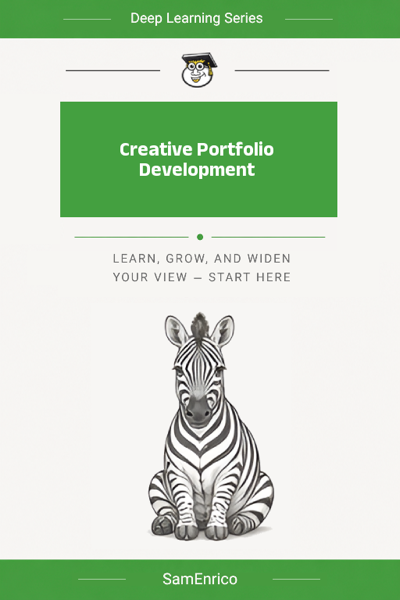
Creative Portfolio Development eBook
A Coursebook on Creative Portfolio Development
A Coursebook on Creative Portfolio Development
Formats
Free sample
Chapter 1: The Hidden Truth…--Most creative professionals believe their portfolio is a mirror. They think it should reflect who they are as an artist—their style, their passions, their unique creative voice. They spend months agonizing over which pieces feel most “them,” which projects showcase their personality, which layouts best express their soul.This belief is precisely what keeps them unemployed.Here is the hidden truth that the top 1% of creatives understand, and that the other 99% learn only after years of rejection: a portfolio is not a mirror. It is a window. A hiring manager does not look at your portfolio to discover who you are.
They look through your portfolio to see if you can solve a problem they currently have, for a client they currently serve, within a budget they currently manage.This single distinction—mirror versus window—separates the portfolios that get ignored from the portfolios that generate job offers within weeks.If you have ever submitted what you believed was your strongest work, only to receive silence or a generic rejection email, you have likely been building a mirror when you needed to build a window. This chapter will dismantle everything you thought you knew about creative portfolios and rebuild your understanding from the ground up. By the end, you will never look at your work the same way again.The 60-Second Blink Test Let us begin with an uncomfortable reality. The average hiring manager spends between 45 and 60 seconds reviewing a creative portfolio before making an initial decision. That decision is rarely “hire immediately.” More often, it is a binary classification: “continue reviewing” or “move to the reject pile.”I have watched this happen in real time.
Over the course of researching this book, I sat beside eleven creative directors, four UX hiring managers, and three art school admissions officers as they reviewed portfolios. I timed every glance, every scroll, every click. The results were brutal.Within the first eight seconds, the reviewer had formed an impression of the candidate’s professionalism. Within twenty seconds, they had decided whether the work was “relevant” to their open role. Within forty-five seconds, they had either committed to reading further or closed the tab entirely.Not one reviewer read a single word of an “Artist Statement” in the first minute.
Not one clicked on an “About Me” page before looking at the work. And every single reviewer made a mental note—conscious or not—about whether the portfolio felt like a collection of personal expression or a set of solutions to real problems.This is the 60-Second Blink Test. Named deliberately to distinguish it from technical audits later in this book, the Blink Test measures one thing only: does your portfolio, in the time it takes to brew a cup of coffee, communicate that you are a professional who solves problems?If the answer is no, nothing else matters. Your beautiful typography, your innovative interaction design, your award-winning illustrations—all of it becomes invisible because the reviewer has already moved on.The Mirror Fallacy: Why Self-Expression Backfires To understand why most portfolios fail, we must first understand the psychological trap that creatives fall into. I call it the Mirror Fallacy.The Mirror Fallacy is the intuitive but错误的 belief that a portfolio should primarily express the creator’s identity.
It feels natural. You have spent years developing your style, your voice, your visual language. Of course you want to show that off. Of course you want to be recognized for who you are as an artist.Here is the problem: hiring managers are not looking for artists. They are looking for problem-solvers.Consider two hypothetical portfolios.
The first belongs to a graphic designer who has filled their site with seven personal projects: a poster for a band they love, a logo for a fictional coffee shop, a zine about their favorite movie, a series of abstract illustrations, a branding concept for a friend’s startup, a typographic experiment, and a photograph of their desk setup.The second portfolio belongs to a different designer. This portfolio contains only four projects. Each project begins with a two-sentence description of a business problem: a nonprofit that needed to increase donor engagement, a retail brand that struggled with wayfinding in their physical stores, a software company whose users could not complete a key onboarding flow, a local restaurant whose menu was confusing to first-time visitors. Each project then shows the work, followed by a single sentence of measurable outcome.Which portfolio do you think gets more callbacks?The first portfolio is a mirror. It tells the reviewer: “Here is who I am.
Here is what I like. Here is my aesthetic. Figure out how I might fit into your organization.” The second portfolio is a window. It tells the reviewer: “Here are problems I have solved. Here is how I think.
Here is proof that my solutions work. I can do the same for you.”The Mirror Fallacy is seductive because it feels authentic. But authenticity, in the context of a job application, is not about expressing your innermost self. It is about being genuinely useful to someone who has a problem to solve.The Recruiter’s Actual Question Behind every job posting, every freelance inquiry, every creative brief, there is a single question that the hiring manager is asking themselves as they review your portfolio. They rarely say it out loud.
They may not even consciously articulate it. But it drives every decision they make.That question is: “Can this person make my life easier?”Let that sink in. A hiring manager does not wake up excited to review portfolios. They wake up overwhelmed by deadlines, stressed about a project that is behind schedule, anxious about a client who is unhappy, or worried about a skill gap on their team. They are not looking for a creative genius to admire.
They are looking for a competent professional who can lighten their load.This reframes everything. When you understand that the hiring manager’s primary emotion is not curiosity but anxiety, you realize that your portfolio must do more than impress. It must reassure. Every image, every caption, every project selection must answer the unspoken question: “Will this person reduce my stress or add to it?”A portfolio that triggers the Mirror Fallacy adds stress. The reviewer must infer your skills.
They must imagine how your band poster might translate to a corporate brochure. They must guess whether you can work within brand guidelines when all they see is personal expression. That guessing takes mental energy—energy the reviewer does not have.A portfolio built as a window reduces stress. The reviewer sees exactly what you can do, for whom, with what results. They do not need to guess.
They do not need to extrapolate. They see a problem you solved, and they recognize that same problem on their own to-do list. The decision becomes obvious.ROI: The Framework You Were Never Taught In business school, there is a concept called Return on Investment, or ROI. It is a simple calculation: what value do you get back relative to what you put in? Every business decision is evaluated through this lens.
Every dollar spent must justify itself.Your portfolio is no different. A hiring manager, consciously or not, performs an ROI calculation…
This is the end of the free sample. Get the eBook to keep going. Buy now
About this book
Details
- Author
- Quinones Maurine
- Publisher
- SamEnrico
- Language
- English
- Genre
- Non-Fiction, Informative, Educational
- Released
- 2026-06-02
- Pages (approx.)
- 159
- Available as
- eBook, Audiobook

Read better in the ZLOADR app
Your eBooks on your phone or tablet. Sign in with your SamEnrico account and start reading.
More by Quinones Maurine
 Addressing Infidelity DiscoveryQuinones Maurine$11.99
 Facebook Social Comparison TrapQuinones Maurine$11.99
 Carson Ecofeminism PioneerQuinones Maurine$11.99
 Rewiring Childhood MessagesQuinones Maurine$11.99
 Customer Effort Score ValidationQuinones Maurine$11.99
 Pro Bowl Leadership PresenceQuinones Maurine$11.99
 Imposter Syndrome Energy DrainQuinones Maurine$11.99
 Evening Habit RoutineQuinones Maurine$11.99
 Congress Master GuideQuinones Maurine$11.99
 Echoes of the Lost Colony: Roanoke's Vanishing ActQuinones Maurine$11.99
 Enki’s Great Deception: The Trickster God of the AbzuQuinones Maurine$11.99
 Plastic Fantastic: The Rise and Fall of the Furby CrazeQuinones Maurine$11.99