
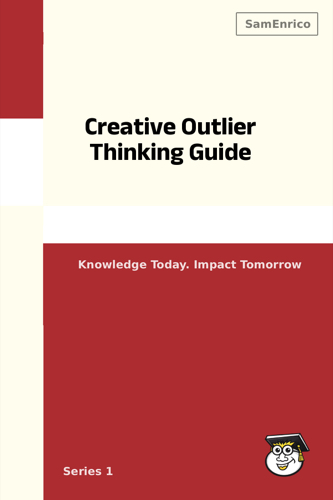
Non-FictionSelf-HelpOutliersCase Study
Creative Outlier Thinking Guide eBook
Study and apply strategies from highly creative ou
Study and apply strategies from highly creative outliers to business challenges.
Formats
Free sample
Chapter 1: Killing Certainty...–- Every organization is built on a foundation of unspoken assumptions—beliefs so deeply embedded that no one questions them. These are the "sacred cows": ideas that were once true (or at least plausible) but have long since calcified into unquestionable rules. Creative outliers don't just question these assumptions—they actively hunt them down, flip them upside down, and build entirely new business models from the wreckage. This chapter reveals how to identify your own sacred cows, why certainty is the enemy of breakthrough thinking, and how a simple act of reversal can unlock opportunities hiding in plain sight.The Invisible Prison of Unquestioned Beliefs Every industry has its commandments. They are rarely written down, never voted on, and almost never challenged.
Yet they shape every decision, every investment, every product roadmap, and every hire.In retail: "Customers need to touch products before buying."In software: "Annual subscriptions are more profitable than monthly."In consulting: "We bill by the hour."In hospitality: "Hotels need physical lobbies."In education: "Learning happens best in classrooms."These statements feel like facts. They are not. They are agreements—temporary, contingent, and waiting to be broken by someone willing to ask the question that makes everyone else uncomfortable: What if the opposite were true?This chapter is about becoming that someone.The Anatomy of a Sacred Cow A sacred cow is any assumption that has become immune to criticism through prolonged acceptance. The term originates from the Hindu tradition, in which cattle are considered sacred and therefore cannot be harmed. In business, sacred cows are ideas that cannot be criticized—not because they are provably true, but because criticizing them feels disrespectful, naive, or simply exhausting.The Three Characteristics of a Sacred Cow:1.
Universality without evidence. Everyone believes it, but no one can point to the original proof. Ask "Why do we do it this way?" and you'll hear "Because that's how it's always been done" or "Everyone does it that way."2. Immunity from questioning. When someone challenges a sacred cow, the response is rarely logical.
It is emotional: "That would never work" or "You don't understand this industry" or "We tried something like that years ago."3. Opportunity cost. Sacred cows are not harmless. Every hour spent optimizing within the wrong assumption is an hour not spent discovering the right model. Every dollar invested in a fading paradigm is a dollar not invested in the future.The most dangerous sacred cows are not the ones everyone debates.
They are the ones no one even notices.The Certainty Trap: Why Smart People Believe Dumb Things Why do intelligent, experienced, highly compensated professionals continue to operate on assumptions that are demonstrably false? The answer lies in what psychologists call the certainty trap.Cognitive Closure. The human brain craves certainty. Uncertainty is uncomfortable—it triggers the same neural circuits as physical pain. Once we have an answer that seems to work, the brain rewards us for stopping the search.
Questioning that answer means reopening uncertainty, which the brain actively avoids.Social Proof. If everyone in your industry believes something, challenging it makes you look foolish. The safest career move is to nod along. The most dangerous is to say "I think we might all be wrong." Creative outliers are willing to look foolish in the short term because they know that conventional wisdom is usually wrong at the edges—and the edges are where opportunity lives.Experience as a Liability. The longer you have worked in an industry, the more sacred cows you have internalized.
Experience teaches you "how things work." But it also teaches you to stop seeing possibilities. This is why disruptive innovations almost never come from industry incumbents. The incumbents don't just miss the disruption—they actively fight it because it violates assumptions they have spent decades perfecting.The Certainty Trap in Action: When Netflix announced its shift from DVD-by-mail to streaming, the company's own DVD division fought the transition. They had data. They had profitability.
They had happy customers. What they didn't have was the willingness to see that the future would make their success irrelevant. Reed Hastings had to fire his own executives to force the pivot.The Outlier Strategy: How Steve Jobs and Reed Hastings Broke the Rules Creative outliers are not smarter than everyone else. They are simply more willing to question what everyone else accepts.Steve Jobs and the Calligraphy Lesson In 1991, every computer company believed that fonts were a technical detail—something engineers handled, not something customers cared about. The assumption was simple: computers are for work.
Aesthetics are for graphic designers. The two shall not meet.Steve Jobs had dropped out of Reed College, but he had stayed around to audit a calligraphy class. He learned about serif and sans-serif typefaces, about varying the space between letter combinations, about what makes typography beautiful.Ten years later, when he was designing the Macintosh, that calligraphy class came back. He insisted that the Mac have beautiful typography—proportional fonts, multiple typefaces, the ability to kern and lead. The engineers thought he was wasting time.
Customers didn't care about fonts. It would slow down the machine. It would cost too much.Jobs didn't argue about the engineering trade-offs. He simply refused to ship a computer without beautiful typography.The result? The Mac became the computer for people who cared about how things looked.
It attracted designers, writers, publishers—a creative class that would never have touched a command-line machine. The assumption that "computers are for work" was wrong. They were also for expression, for beauty, for identity.Every beautiful interface you have ever used—every smartphone, every website, every application with thoughtful typography—traces its lineage back to a college dropout who refused to accept that fonts didn't matter.Reed Hastings and the Late Fee Heresy In 1997, the video rental industry had a sacred cow: late fees. Blockbuster, the market leader, generated nearly $800 million annually from customers who returned movies after their due date. The assumption was ironclad: customers are irresponsible.
Late fees incentivize prompt returns. Without late fees, the business collapses.Reed Hastings had a different experience. He returned a copy of Apollo 13 to his local Blockbuster and was charged a $40 late fee. He was furious—not because the fee was unfair, but because he had forgotten to return the movie. His frustration was not with the company; it was with himself.
But then he had a thought: Why does this business model exist at all? What if there were no late fees?Every expert told him it was impossible. Without late fees, people would keep movies for months. Inventory would dry up. Revenue would collapse.
The math didn't work.Hastings didn't argue about the math. He changed the premise. Instead of renting movies one at a time, Netflix offered a subscription: pay a flat monthly fee, keep as many movies as you want, keep them as long as you want. No due dates. No late fees.
No per-movie transaction.The industry said he was insane. Blockbuster had a hundred times his revenue, thousands of stores, decades of brand recognition. Hastings had a website and a dream.Twenty years later, Blockbuster is bankrupt. Netflix is worth more than Disney.The…
This is the end of the free sample. Get the eBook to keep going. Buy now
About this book
Details
- Author
- Norris Bessie
- Publisher
- SamEnrico
- Language
- English
- Genre
- Non-Fiction, Self-Help, Outliers, Case Study
- Released
- 2026-06-11
- Pages (approx.)
- 154
- Available as
- eBook, Audiobook

Read better in the ZLOADR app
Your eBooks on your phone or tablet. Sign in with your SamEnrico account and start reading.
More by Norris Bessie
 Mold Illness Prevention GuideNorris Bessie$11.99
 Social Entrepreneur Speaking GuideNorris Bessie$11.99
 Pablo Escobar VS AmericaNorris Bessie$11.99
 Stress and Autoimmune Disease ConnectionNorris Bessie$11.99
 The Last Empress: A Century of Forbidden Love and PowerNorris Bessie$11.99
 The Last Whisper of the Silk RoadNorris Bessie$11.99
 Understanding Fanconi Like SyndromeNorris Bessie$17.99
 Ultimate Handbook Guide to Sagamihara : (Japan) Travel GuideNorris Bessie$11.99
 Route SupervisorNorris Bessie$11.99
 UAE VAT for Non ResidentsNorris Bessie$12.99
 Strategy Meeting Tool Kit for FacilitatorsNorris Bessie$12.99
You may also like
 Hong Kong Handover 1997Dunn Johnnie$11.99
 Zumba For Postnatal Recovery CourseNeal Christian$11.99
 Zumba for BeginnersLadner Nikia$11.99
 YouTube Comment Mining GuideHumes Pandora$12.99
 Worry Box MeditationCarlin Rudy$11.99
 Workplace Stress MeditationNguyen Lynn$11.99
 Workplace Stress and Sleep RepairHawley Ivory$11.99
 Workplace Perfectionism CureDelaney Jeffry$11.99
 Workplace Injustice Anger GuideWallen Isabelle$11.99
 Work Addiction and Burnout LinkGreenwood Ester$11.99
 Women in Yoga and WellnessBeattie Galina$11.99
 Women in Stand Up ComedyChun Evangeline$11.99