
Non-FictionSelf-HelpCreativity
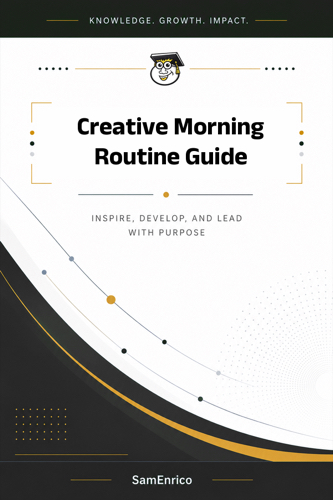
Creative Morning Routine Guide eBook
How artists, writers, and musicians start their da
How artists, writers, and musicians start their day.
Formats
Free sample
Chapter 1: The Morning Lie...--We have been told a beautiful lie. It whispers that creativity cannot be tamed, that inspiration strikes like lightning from a clear sky, and that the artist’s life is one of glorious chaos—late nights, wine-soaked conversations, and sudden bursts of genius at 2 AM. This myth is seductive because it absolves us of responsibility. If creativity is magic, we cannot be blamed for its absence. We simply wait.
We suffer. We hope.But here is the truth that every working artist eventually discovers: the lightning does not strike. It is summoned.Over the past thirty years, a quiet body of evidence has accumulated—not in laboratories, but in the daily schedules of the world’s most prolific creators. Mason Currey’s Daily Rituals examined the habits of 161 artists, from Beethoven to Picasso to Maya Angelou. Twyla Tharp’s The Creative Habit documented her own four-decade career as a choreographer.
Julia Cameron’s The Artist’s Way has guided millions through a structured twelve-week program. And across all of these works, a single pattern emerges with staggering consistency: the vast majority of successful artists do not create at midnight. They create at dawn.This chapter dismantles the mythology of the tortured artist and replaces it with something far more useful: the physics of creative energy, the neuroscience of decision fatigue, and the practical architecture of a morning that sets you up not for productivity in the corporate sense, but for flow in the artistic sense. By the end of this chapter, you will understand why structure does not kill spontaneity—it enables it. You will have completed an audit of your current morning that reveals exactly where your creative energy is leaking.
And you will be ready to build, chapter by chapter, a morning routine that works for your art, your chronotype, and your life.The Myth of Midnight Genius Let us begin with a funeral. We need to bury the romantic image of the artist as a tortured night creature, because as long as this image lives in our imagination, we will keep waiting for inspiration that never arrives at a reasonable hour.Consider the actual schedules of history’s most celebrated creators. Mason Currey’s research is relentless in its demolition of the midnight myth. Beethoven woke at dawn, immediately walked to his study, and sat at his desk from 6:30 AM until 2:30 PM. Before writing a single note, he prepared his own coffee—exactly sixty beans per cup, counted one by one.
This ritual was not eccentric. It was strategic. By automating the trivial decision of coffee preparation, Beethoven preserved his cognitive capacity for the symphony.Maya Angelou rented a local hotel room and arrived by 6 AM. She wrote standing up at a podium, using a dictionary, a thesaurus, and a Bible. She worked until 2 PM, then went home to edit.
She did this for decades. When asked about inspiration, she reportedly said, “I write only when I am inspired. Fortunately, I am inspired every morning at 6 AM.”Twyla Tharp wakes at 5:30 AM, hails a cab to the gym, works out for two hours, then returns to her studio. She has done this for over forty years. In The Creative Habit, she writes: “I begin each day of my life with a ritual.
I wake up, put on my workout clothes, and leave my apartment before my brain has time to argue with me about it.”Haruki Murakami wakes at 4 AM, writes for five to six hours, then runs ten kilometers or swims. He has maintained this schedule for decades while producing some of the most imaginative fiction of our time.Patricia Highsmith ate bacon and eggs every morning before writing The Talented Mr. Ripley. Proust took two café au laits and a croissant, in the same order, in bed. Frank Lloyd Wright woke at 4 AM, worked for three hours, then had breakfast and napped.The pattern is undeniable.
These artists did not wait for lightning. They built a structure that invited lightning to strike at the same time every day.But what about the exceptions? What about night owls like Franz Kafka, who wrote The Metamorphosis in the late hours after his insurance job? The chapter acknowledges Kafka, but with an important nuance: even Kafka eventually shifted to morning work when facing serious projects. And more importantly, the definition of “morning” that we will use throughout this book is not tied to a clock.
It is tied to you. As we will establish in Chapter 5, “morning” means the first three hours after you wake, regardless of whether that is 5 AM or 11 AM. A jazz musician who plays gigs until 2 AM still has a creative morning—it simply begins at 11 AM. The science of the hypnagogic state, decision fatigue, and cognitive priming applies to time since waking, not the position of the sun.The Finite Battery: Why Your Brain Cannot Make Unlimited Choices To understand why morning routines matter, we need to understand a concept that cognitive psychologists call decision fatigue. The discovery of decision fatigue is counterintuitive.
We tend to think that making choices is a sign of freedom and agency. But research shows that each decision we make—no matter how small—depletes a finite reservoir of mental energy.Consider the famous study of Israeli parole judges published in the Proceedings of the National Academy of Sciences. Researchers analyzed over 1,100 judicial rulings and discovered a disturbing pattern: prisoners who appeared before the judge in the morning received parole about 70% of the time. Those who appeared later in the day received parole less than 10% of the time. The same judge, the same legal criteria, the same cases.
The only variable was the judge’s mental fatigue. By afternoon, after hours of listening to arguments and making decisions, the judge’s brain defaulted to the easiest choice: deny parole, change nothing, stay safe.The same phenomenon occurs in your creative life. Every trivial decision you make in the morning—what to wear, what to eat, whether to check email, whether to respond, what to listen to, what order to do things in—consumes a small unit of your decision-making capacity. By the time you finally sit down to create, you may have nothing left.This is not a failure of willpower. It is physics.
The prefrontal cortex, the part of your brain responsible for executive function and self-control, operates like a muscle. It fatigues with use. And unlike a muscle, it does not recover quickly. Once depleted, it stays depleted for hours.The solution is not to try harder. The solution is to design your morning so that decisions are removed entirely.This is what Beethoven understood when he counted his sixty coffee beans.
This is what Steve Jobs understood when he wore the same black turtleneck every day. This is what Barack Obama understood when he limited his wardrobe to gray or blue suits so he could “focus on the big decisions.” These are not eccentricities. They are strategies for preserving cognitive capacity for the work that actually matters.For the artist, the “work that actually matters” is not email, not social media, not scheduling, not errands. The work that matters is the canvas…
This is the end of the free sample. Get the eBook to keep going. Buy now
About this book
Details
- Author
- Betancourt Jacquelynn
- Publisher
- SamEnrico
- Language
- English
- Genre
- Non-Fiction, Self-Help, Creativity
- Released
- 2026-06-10
- Pages (approx.)
- 157
- Available as
- eBook, Audiobook

Read better in the ZLOADR app
Your eBooks on your phone or tablet. Sign in with your SamEnrico account and start reading.
More by Betancourt Jacquelynn
 The Ben Nighthorse CampbellBetancourt Jacquelynn$11.99
 Alcohol Withdrawal Home Detox RisksBetancourt Jacquelynn$11.99
 Worst Case Scenario ThinkingBetancourt Jacquelynn$11.99
 Caregiver Identity Loss GuideBetancourt Jacquelynn$11.99
 Self Talk For Social SituationsBetancourt Jacquelynn$11.99
 Prebiotics For CognitionBetancourt Jacquelynn$11.99
 Glaucoma GuideBetancourt Jacquelynn$11.99
 The Ballad of the Blackbird: The Untold Story of Bessie ColemanBetancourt Jacquelynn$11.99
 The Shadow Fleet: Spain's Secret Maritime DominanceBetancourt Jacquelynn$11.99
 How to Become a Abrasive-grader HelperBetancourt Jacquelynn$11.99
 The Essential Guide to Jam BandsBetancourt Jacquelynn$11.99
 A Collector's Handbook to the AC PetiteBetancourt Jacquelynn$11.99
You may also like
 Hong Kong Handover 1997Dunn Johnnie$11.99
 Zumba For Postnatal Recovery CourseNeal Christian$11.99
 Zumba for BeginnersLadner Nikia$11.99
 YouTube Comment Mining GuideHumes Pandora$12.99
 Worry Box MeditationCarlin Rudy$11.99
 Workplace Stress MeditationNguyen Lynn$11.99
 Workplace Stress and Sleep RepairHawley Ivory$11.99
 Workplace Perfectionism CureDelaney Jeffry$11.99
 Workplace Injustice Anger GuideWallen Isabelle$11.99
 Work Addiction and Burnout LinkGreenwood Ester$11.99
 Women in Yoga and WellnessBeattie Galina$11.99
 Women in Stand Up ComedyChun Evangeline$11.99