
Non-FictionSelf-HelpMentorship
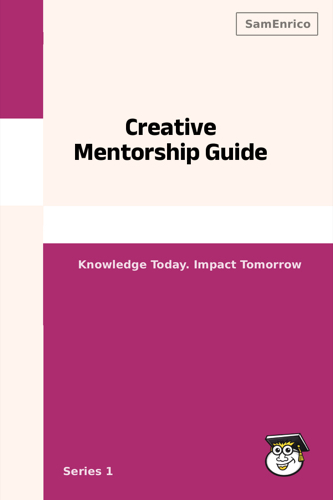
Creative Mentorship Guide eBook
Find and learn from experienced creators to build
Find and learn from experienced creators to build your confidence.
Formats
Free sample
Chapter 1: The Waiting Trap...–- Most people spend years waiting for a permission that was never required. They wait to feel ready, to have more skill, to be further along, to have a portfolio that doesn't embarrass them. They wait for a mythical figure—a mentor, a guide, a Yoda—to descend from the clouds and anoint them as worthy. And while they wait, their creative work withers from neglect, their confidence erodes from disuse, and their window of opportunity narrows with each passing season. This book exists because that waiting is a lie.
And this chapter exists to show you the door you've been standing in front of, afraid to knock.The Morning Everything Changed Three years ago, a graphic designer named Maya sat in her Brooklyn apartment staring at an email she had been drafting for six weeks. The email was addressed to a creative director she admired—a woman whose work had defined an entire aesthetic movement in independent publishing. Maya had written and rewritten the message forty-seven times. She had asked three friends to review it. She had changed the subject line eleven times.
She had moved the cursor over the send button and then away from it so many times that she had worn a small divot into her trackpad.The email was one hundred and forty-two words. It asked for fifteen minutes of the creative director's time to review a three-page portfolio. That was all. Fifteen minutes. One hundred and forty-two words.
Six weeks of paralysis.What Maya didn't know—couldn't know—was that on the other side of that email, the creative director was sitting in her own apartment, feeling lonely and irrelevant. She had just turned forty-eight. Her last three projects had been commercially successful but creatively hollow. She had spent the morning scrolling through Instagram, watching younger designers get accolades for work that borrowed heavily from her own early experiments. No one asked her opinion anymore.
No one seemed to need her. She had begun to wonder if her best work was behind her.When Maya's email arrived, the creative director read it twice. Then she replied within eleven minutes: "Yes. Tuesday at 2pm. Send the portfolio now so I can look before we talk."That fifteen-minute conversation turned into a monthly standing call.
That monthly call turned into a mentorship that lasted two years. That mentorship turned into a professional relationship in which Maya eventually became the creative director's collaborator, then her peer, then the person the older designer called when she needed fresh eyes on her own work.Six weeks of waiting. Eleven minutes of reply. Two years of transformation.The only difference between Maya and the thousands of designers who never sent that email was simple: she stopped waiting.The Anatomy of Creative Waiting If you are reading this book, you are almost certainly a waiter. Not in the literal sense—you are not standing in a restaurant holding a tray.
You are waiting in the more insidious sense: you are postponing action until some external condition is met.Let me name the most common forms of creative waiting, because naming something is the first step to dismantling it:The Portfolio Wait. "I'll reach out to potential mentors once my portfolio is stronger." This is the most seductive form of waiting because it feels responsible. It feels like you're being respectful of the mentor's time. But here is the truth that no one tells you: your portfolio will never feel finished. Creative work is not a destination; it is an endless series of horizons.
The moment you finish one piece, you will immediately see its flaws. The moment you publish it, you will think of three things you should have done differently. If you wait until your portfolio is "ready," you will die waiting.The Skill Wait. "I need to take one more course, read one more book, master one more technique before I'm qualified to seek mentorship." This form of waiting is driven by imposter syndrome dressed up as diligence. It confuses expertise with permission.
The truth is that the best mentors are not looking for finished products; they are looking for raw material and genuine curiosity. A beginner who asks a brilliant question is infinitely more interesting to most mentors than an intermediate practitioner who asks nothing at all.The Connection Wait. "I don't know anyone who can introduce me, so I can't reach out." This is waiting that mistakes networking for nepotism. It assumes that access requires a golden ticket—a mutual friend, a warm introduction, a conference where you can accidentally bump into someone in the hallway. But as you will learn throughout this book, cold outreach is not a consolation prize.
It is the primary mechanism by which most creative relationships actually begin. The "warm introduction" is a luxury; the cold email is a skill. And skills can be learned.The Confidence Wait. "I'll seek mentorship once I feel more confident." This is the granddaddy of all creative waiting because it inverts causality. Confidence is not the prerequisite for action; it is the result of action.
You do not become confident and then seek mentorship. You seek mentorship, survive the vulnerability of being seen, receive feedback, integrate it, improve, and then confidence arrives as a byproduct. Waiting for confidence before seeking help is like waiting to be dry before stepping into the shower.The Right Mentor Wait. "I'm waiting for the perfect mentor—someone who understands exactly what I need, has the exact skills I lack, and is available exactly when I need them." This is waiting that fetishizes the "one true mentor" model—a model this book will systematically dismantle. The perfect mentor does not exist.
What exists are good-enough mentors, improbable mentors, tangential mentors, and the Virtual Personal Board of Directors you will build in Chapter 3. Waiting for perfection is waiting for nothing.The Psychological Cost of Waiting Waiting is not neutral. It is not a holding pattern in which nothing happens. Waiting is an active psychological state that erodes your creative capacity in measurable ways.Research in behavioral psychology has identified a phenomenon called "anticipatory anxiety"—the distress we feel while waiting for an uncertain outcome. Anticipatory anxiety is often worse than the outcome itself.
People waiting for medical test results report higher stress than people who have received bad news. Students waiting for exam scores report more distress than students who have already failed. The waiting itself is the torture.Creative waiting follows the same pattern. The six weeks Maya spent drafting her email were not six weeks of peaceful preparation. They were six weeks of low-grade dread, self-criticism, and imaginative catastrophizing.
She imagined the creative director ignoring her (most likely). She imagined the creative director laughing at her portfolio (unlikely, but possible). She imagined being humiliated in a public forum (irrational, but compelling). Each of these imagined scenarios was a small trauma. By the time she finally sent the email, she had already suffered dozens of psychic injuries—none of which came from the mentor herself.This is the hidden math of waiting: the cost of inaction is almost always higher than the cost of action.
Action produces either success (good) or failure (educational). Inaction produces only one thing: the slow erosion of self-trust. Every time…
This is the end of the free sample. Get the eBook to keep going. Buy now
About this book
Details
- Author
- Barrett Gerardo
- Publisher
- SamEnrico
- Language
- English
- Genre
- Non-Fiction, Self-Help, Mentorship
- Released
- 2026-06-06
- Pages (approx.)
- 122
- Available as
- eBook, Audiobook

Read better in the ZLOADR app
Your eBooks on your phone or tablet. Sign in with your SamEnrico account and start reading.
More by Barrett Gerardo
 Body Scan With Limited MobilityBarrett Gerardo$11.99
 Self Esteem For People With Stretch Marks GuideBarrett Gerardo$11.99
 Astronaut Mission Stress GuideBarrett Gerardo$11.99
 Betrayal Anger GuideBarrett Gerardo$11.99
 Key Employee Retention AlertBarrett Gerardo$11.99
 Timor Island CircumnavigationBarrett Gerardo$11.99
 Coping with Exam Pressure GuideBarrett Gerardo$11.99
 The Shirabyoshi's Last Dance: Japan's Cursed CourtesansBarrett Gerardo$11.99
 Loki’s Deception: The God Who Outwitted ZeusBarrett Gerardo$11.99
 The Mineral Guide to AnorthiteBarrett Gerardo$11.99
 Growing CupheaBarrett Gerardo$11.99
 AI Prompts for Tokenomics EvaluationBarrett Gerardo$11.99
You may also like
 Hong Kong Handover 1997Dunn Johnnie$11.99
 Zumba For Postnatal Recovery CourseNeal Christian$11.99
 Zumba for BeginnersLadner Nikia$11.99
 YouTube Comment Mining GuideHumes Pandora$12.99
 Worry Box MeditationCarlin Rudy$11.99
 Workplace Stress MeditationNguyen Lynn$11.99
 Workplace Stress and Sleep RepairHawley Ivory$11.99
 Workplace Perfectionism CureDelaney Jeffry$11.99
 Workplace Injustice Anger GuideWallen Isabelle$11.99
 Work Addiction and Burnout LinkGreenwood Ester$11.99
 Women in Yoga and WellnessBeattie Galina$11.99
 Women in Stand Up ComedyChun Evangeline$11.99