
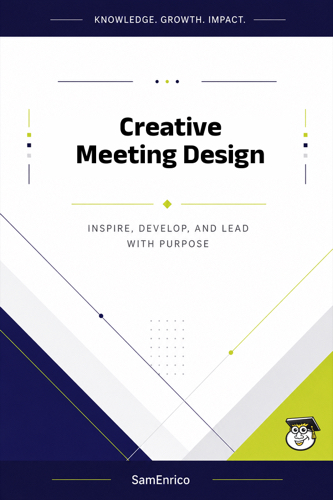
Non-FictionSelf-HelpMeeting Design
Creative Meeting Design eBook
Structure sessions for maximum idea flow.
Structure sessions for maximum idea flow.
Formats
Free sample
Chapter 1: The Zombie Audit--–- The meeting was scheduled for one hour. Forty-seven minutes in, Sarah realized she had not had a single thought worth remembering. She had nodded at appropriate moments, laughed when others laughed, and even contributed a sentence that she immediately forgot. Around the table, eight other humans sat in various states of cognitive collapse—one scrolling, one doodling, one practicing the thousand-yard stare of a person who had mentally checked out fourteen minutes ago and was never coming back.This meeting had a name on the calendar. It had an agenda, though no one had read it.
It had twelve attendees, though only three spoke. It had a recurring invitation that had been on everyone's calendar for eighteen months. And it had, as far as anyone could remember, never produced a single decision that stuck.Sarah's company called this "alignment." Her team called it Tuesday.This chapter is about that meeting. More specifically, this chapter is about why that meeting exists, why it is slowly killing your team's creativity, and how to perform the one act that will do more for idea flow than any facilitation technique you will ever learn: the ruthless, compassionate, systematic elimination of meetings that should never have existed in the first place.The $1.9 Trillion Lie Let us begin with a number that sounds fake but is tragically real. In 2023, researchers estimated that US companies spent approximately $1.9 trillion on meetings.
Not on work done in meetings. On the meetings themselves—the collective salary hours burned in conference rooms, Zoom squares, and poorly lit hybrid huddles.Trillion. With a T.To put that number in perspective, $1.9 trillion is roughly the GDP of Canada. It is more than the entire global box office revenue of every movie ever made, adjusted for inflation. It is approximately the amount of money required to send a human to Mars, build a colony, and bring them back for lunch.And what do we get for this investment?
According to a 2024 meta-analysis of workplace productivity studies, roughly 67 percent of meetings are rated by attendees as "not worth the time they consumed." More than half of all meeting time is spent on updates that could have been emails. And here is the kicker: creativity-focused meetings—the ones explicitly designed to generate new ideas—are rated as the least effective of all meeting types.The meetings meant to make us more creative are, statistically, the ones most likely to kill creativity.This is not because people are lazy or stupid. It is because meetings were never designed for creativity in the first place. They were designed for something else entirely, and we have been trying to retrofit them for decades with mixed results at best.The Medieval Origins of Your 10 AM Standup To understand why meetings fail at idea flow, we must first understand what meetings were originally built to do.The modern meeting descends from two distinct historical traditions, neither of which had anything to do with collaborative creativity.The first tradition is the court assembly. In medieval Europe, kings and lords gathered their advisors in rooms designed for a single purpose: the reinforcement of hierarchy.
The king sat at the head of a long table—a literal "head" of the table. His most senior advisors sat closest to him. Junior advisors sat farther away. The physical arrangement of the room encoded the status of every person in it. You spoke when the king asked you a question.
You never interrupted. You never disagreed with someone more senior than you. And you certainly never suggested that the king's idea was anything less than inspired.This was not a meeting designed for idea flow. It was a meeting designed for control. And it worked beautifully for that purpose.The second tradition is the military briefing.
In armies across history, officers gathered to receive orders from their commanders. The structure was rigid: the commander spoke, the subordinates listened, and the subordinates then executed. Briefings were not discussions. They were information cascades. Questions were permitted only for clarification, never for critique.
The goal was alignment, not exploration.These two traditions—the hierarchical court and the commanding briefing—merged in the twentieth century to create the default meeting structure that most organizations still use today. A leader at the head. A table that encodes status. A linear agenda of updates. A norm that senior people speak first and most often.
A bias toward reporting over reasoning.This structure is excellent for maintaining control. It is terrible for generating ideas.And yet, when we need creativity, we take this control-oriented container and simply ... hope. We add a whiteboard. We say "no bad ideas." We put a bowl of candy on the table.
But the container itself—the status-coded, hierarchy-reinforcing, speaker-dominating structure—remains untouched.You cannot grow a garden in a prison yard just by planting better seeds. The container is the problem.Introducing Meeting Debt Rebecca Hinds, whose 2026 book Your Best Meeting Ever provides the strategic backbone for much of what follows, introduces a concept that every leader needs to internalize: Meeting Debt.Meeting debt is the hidden cost of recurring, under-designed meetings. Like technical debt in software development, meeting debt accumulates slowly, invisibly, until it cripples your team's ability to function.Technical debt works like this: a software team takes a shortcut to ship a feature faster. The code works, but it is messy. Over time, the mess compounds.
New features take longer to add. Bugs become harder to fix. Eventually, the team spends 80 percent of its time maintaining the messy code and 20 percent actually building new things. The debt has come due.Meeting debt works exactly the same way. A recurring meeting is scheduled for "alignment." It has no clear agenda, but everyone attends because "that's what we do." Over time, the meeting becomes a ritual without a purpose.
People stop preparing. Attendance drifts. Decisions made in the meeting are reversed in email threads. New meetings are added to discuss what happened in the old meetings. The debt compounds.The terrifying thing about meeting debt is that it is invisible.
No one wakes up and says, "I am going to add $10,000 of meeting debt to my team today." They just accept an invitation. They just keep a recurring slot on the calendar. They just assume that if the meeting is on the calendar, it must be important.By the time the debt becomes visible—when your team is spending twenty hours a week in meetings and producing less creative work than ever—it is almost impossible to unwind. The meetings have become part of the organizational furniture. Canceling one feels like canceling a holiday.This book will give you the tools to unwind that debt.
But the first tool is the simplest and hardest: you must admit that most of your meetings are not working.The Two Kinds of Broken Meetings Before we go any further, we need to make a critical distinction that will shape everything that follows. Not all broken meetings are broken in the same way. Some are chronically broken—zombies that cannot be saved. Others are mostly good meetings that simply need iteration.This distinction is essential because later in this book…
This is the end of the free sample. Get the eBook to keep going. Buy now
About this book
Details
- Author
- Whitehead Lashaun
- Publisher
- SamEnrico
- Language
- English
- Genre
- Non-Fiction, Self-Help, Meeting Design
- Released
- 2026-06-07
- Pages (approx.)
- 125
- Available as
- eBook, Audiobook

Read better in the ZLOADR app
Your eBooks on your phone or tablet. Sign in with your SamEnrico account and start reading.
More by Whitehead Lashaun
 Senior Family Respect GuideWhitehead Lashaun$11.99
 Shift Work Diabetes RiskWhitehead Lashaun$11.99
 Metabolic Adaptation ExerciseWhitehead Lashaun$11.99
 Eisenhower For New ManagersWhitehead Lashaun$11.99
 Gamblers Anonymous ExplainedWhitehead Lashaun$11.99
 Weight Gain Prevention After QuittingWhitehead Lashaun$11.99
 Diabetes ManagementWhitehead Lashaun$11.99
 The Whale Who Remembered War: A Cetacean’s SecretWhitehead Lashaun$11.99
 Love and Gunpowder in the Sudan: The Mahdist War's Forgotten RomanceWhitehead Lashaun$11.99
 How to Produce Inflatable Bouncer AccessoriesWhitehead Lashaun$11.99
 A Collector's Handbook to the Horch 930Whitehead Lashaun$11.99
 How to Produce a Touch-up MarkerWhitehead Lashaun$11.99
You may also like
 Hong Kong Handover 1997Dunn Johnnie$11.99
 Zumba For Postnatal Recovery CourseNeal Christian$11.99
 Zumba for BeginnersLadner Nikia$11.99
 YouTube Comment Mining GuideHumes Pandora$12.99
 Worry Box MeditationCarlin Rudy$11.99
 Workplace Stress MeditationNguyen Lynn$11.99
 Workplace Stress and Sleep RepairHawley Ivory$11.99
 Workplace Perfectionism CureDelaney Jeffry$11.99
 Workplace Injustice Anger GuideWallen Isabelle$11.99
 Work Addiction and Burnout LinkGreenwood Ester$11.99
 Women in Yoga and WellnessBeattie Galina$11.99
 Women in Stand Up ComedyChun Evangeline$11.99