
Non-FictionSelf-HelpCreative Legacy
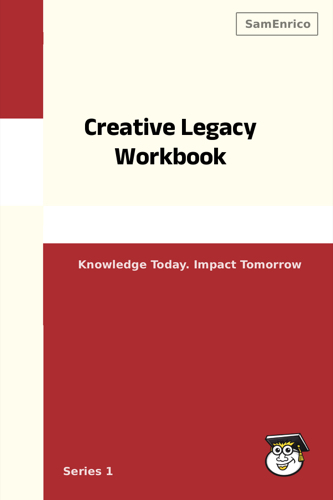
Creative Legacy Workbook eBook
Leave behind art, writing, or music that outlasts
Leave behind art, writing, or music that outlasts you using this thoughtful guide.
Formats
Free sample
Chapter 1: The Permission Slip...--It is a Tuesday afternoon, twenty or thirty or fifty years from now. Someone you love — or someone who never knew you at all — stands in a dusty room. They have a trash bag in one hand and a box of your life in the other. They do not know which pile to put it in. They do not know which canvas you stayed up all night perfecting and which one you painted in an hour while hungover.
They do not know that the napkin with the scribbled melody was your best idea, or that the leather journal with the expensive binding contains nothing but grocery lists and spite. They are holding a hard drive. It has not been opened in a decade. They do not know the password. They do not know if there is anything inside worth saving.This is not a hypothetical.
This is the fate of nearly every creative person who has ever lived. The attics of the world are filled with the unrecognized, unlabeled, unloved remnants of lives that mattered deeply to someone. Your attic — whether it is a literal storage unit, a closet, a studio, a laptop, or a cloud account that stops being paid the month after you die — will one day be opened by a stranger. That stranger is not you. That stranger does not know what you meant.
And unless you do something about it now, that stranger will throw away the thing that would have meant everything to your great-grandchild.I am going to ask you to do something uncomfortable in this book. I am going to ask you to look directly at your own mortality. I am going to ask you to make decisions about what deserves to survive and what should be burned. I am going to ask you to write down passwords, label boxes, and have difficult conversations with the people you love.But before I ask you to do any of that, I am going to give you something first. I am going to give you permission.Permission to start small.
Permission to do it badly. Permission to change your mind. Permission to throw things away. Permission to keep things that embarrass you. Permission to be the sole judge of what matters.
Permission to leave instructions that your executor might ignore. Permission to fail. Permission to finish. Permission to stop.This chapter is called The Permission Slip because that is what it is. A get-out-of-jail-free card for every anxiety that has kept you from planning your creative legacy.
By the time you finish reading, you will have done one concrete thing — not a big thing, but a real thing — and you will feel something unexpected. Relief.Let us begin.The Three Lies That Keep Your Attic Full Before we can build anything, we have to clear away the debris. Not the physical debris — the boxes and hard drives will wait. The mental debris. The lies you have been telling yourself that have kept you from starting.I have heard these lies from thousands of creative people.
Maybe you have told yourself a version of them.Lie #1: "I'll deal with this later."Later is a myth. Later never comes. There is always another project, another deadline, another reason to push legacy planning to the bottom of the list. The cruel irony is that the people who most need to plan their creative legacy — the ones with decades of work, the ones whose children will have no idea what to keep — are the ones who have the least time left. But even young creators tell themselves this lie.
"I am only thirty. I have plenty of time." You do have plenty of time. But plenty of time has a funny way of turning into no time at all, one procrastinated afternoon at a time.The truth is that legacy planning does not require a retirement or a terminal diagnosis. It requires a Tuesday afternoon and the willingness to open one box. That is it.
One box. One folder. One hard drive. The hardest part is starting, and starting only takes five minutes.Lie #2: "Everything matters."This is the lie that hoarders tell themselves. Every sketch matters.
Every draft matters. Every embarrassing poem from high school matters. If everything matters, nothing can be thrown away. And if nothing can be thrown away, the task of organizing is infinite. And if the task is infinite, you are justified in never starting.But here is the truth that will set you free: most of what you have made does not matter.
Not to you, not to your heirs, not to posterity. Most of your work was practice. Practice is valuable — it made you who you are — but practice does not need to be preserved. Your child does not need your failed experiments. The world does not need your juvenilia.
Your legacy is not everything you ever did. It is the best of what you did, framed by the story of who you were.Letting go of the idea that everything matters is the single most liberating step in this entire book. Once you accept that you are allowed to throw things away, the attic becomes manageable.Lie #3: "Someone will figure it out."This is the cruelest lie of all. It is the lie that tells you that your spouse, your child, your best friend, or your lawyer will somehow know what to keep and what to burn. It is the lie that lets you off the hook.
You do not have to make hard decisions because someone else will do it for you after you are gone.The truth is that no one will figure it out. Your spouse does not know which sketch you actually loved and which one you abandoned in frustration. Your child does not know the difference between a finished manuscript and a false start. Your lawyer does not know that the folder labeled "Taxes 2015" contains the only copy of the song your late partner loved.When you leave no instructions, you are not leaving freedom. You are leaving a burden.
You are transferring your anxiety to someone who is already grieving. That is not kindness. That is abandonment.These three lies have kept you stuck. Not because you are lazy or disorganized or afraid of death. Because you are human.
Because no one ever taught you a different way. Because the task felt too big and you did not have permission to make it small.You have permission now.The Stranger Test: Looking at Your Work Through Future Eyes Every chapter in this book includes a workbook element. These are not optional add-ons or afterthoughts. They are the heart of the book. Reading without doing is like reading about swimming without getting in the water.
You will learn nothing that sticks.The workbook element for this chapter is called The Stranger Test. It is simple. It is uncomfortable. It will change how you see your own work.Here is what you are going to do. Find a piece of your own creative work.
It can be anything — a painting, a poem, a song demo, a photograph, a short story, a quilt, a…
This is the end of the free sample. Get the eBook to keep going. Buy now
About this book
Details
- Author
- Chesser Ashlea
- Publisher
- SamEnrico
- Language
- English
- Genre
- Non-Fiction, Self-Help, Creative Legacy
- Released
- 2026-06-08
- Pages (approx.)
- 135
- Available as
- eBook, Audiobook

Read better in the ZLOADR app
Your eBooks on your phone or tablet. Sign in with your SamEnrico account and start reading.
More by Chesser Ashlea
 The Senior Worthiness PodcastChesser Ashlea$11.99
 Radar Anti Submarine GuideChesser Ashlea$11.99
 The Gambling Streaming AddictionChesser Ashlea$11.99
 The Snapchat Story Comparison GuideChesser Ashlea$11.99
 The Sky Bear and the First Fire: A Cree Cosmic OriginChesser Ashlea$11.99
 How to Start a Civil Engineering Constructions for Long-distance Communication Business (BeginnersChesser Ashlea$11.99
 Property Insurance ClimateChesser Ashlea$12.99
 Partnership Succession RulesChesser Ashlea$12.99
 Understanding Spielmeyer–vogt DiseaseChesser Ashlea$17.99
 Value Proposition Canvas CreatorChesser Ashlea$11.99
You may also like
 Hong Kong Handover 1997Dunn Johnnie$11.99
 Zumba For Postnatal Recovery CourseNeal Christian$11.99
 Zumba for BeginnersLadner Nikia$11.99
 YouTube Comment Mining GuideHumes Pandora$12.99
 Worry Box MeditationCarlin Rudy$11.99
 Workplace Stress MeditationNguyen Lynn$11.99
 Workplace Stress and Sleep RepairHawley Ivory$11.99
 Workplace Perfectionism CureDelaney Jeffry$11.99
 Workplace Injustice Anger GuideWallen Isabelle$11.99
 Work Addiction and Burnout LinkGreenwood Ester$11.99
 Women in Yoga and WellnessBeattie Galina$11.99
 Women in Stand Up ComedyChun Evangeline$11.99