
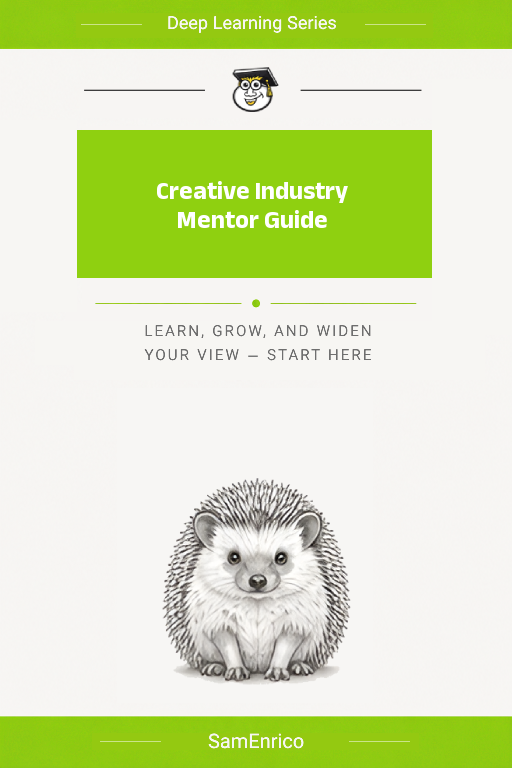
Non-FictionFirst 30 DaysCreative
Creative Industry Mentor Guide eBook
Find mentors in design, writing, and arts. Focus o
Find mentors in design, writing, and arts. Focus on portfolios, award winners, and agency experience.
Formats
Free sample
Chapter 1: The Genius Trap--–- Every creative professional has heard the myth. It whispers in art school hallways, echoes through design forums, and decorates the Linked In profiles of self-taught “visionaries.” The myth says: Great work comes from great alone-ness. The lone genius, the solitary artist, the writer locked in a cabin, the designer who needs no one. It is a beautiful story. It is also completely wrong.This chapter dismantles that myth not to disappoint you, but to free you.
Because if genius is something you are born with, you cannot do much about it. But if creative success comes from who you know and how you learn from them—that you can control. The difference between struggling for years and breaking into the agency world in months is almost never talent. It is navigation. And navigation requires mentors.Let us begin with a story about the most successful design studio you have never heard of.The Crown Did Not Write Itself In 2016, the television series The Crown began production.
It would go on to win dozens of awards, including Emmys and Golden Globes, and be hailed as a masterclass in writing, acting, and direction. But here is what the credits do not show: the showrunner, Peter Morgan, did not write the first episode alone in a room. He assembled a writers’ room of seven people. Each brought different strengths—one knew royal history, one excelled at dialogue, one specialized in political subtext. They shared drafts, killed each other’s darlings, and rebuilt scenes from scratch based on collective feedback.
Every single episode of The Crown passed through multiple pairs of eyes before it reached the screen.Now consider the alternative. Imagine one writer locking herself in a cabin for six months and emerging with a finished script. Would it be better? Almost certainly not. It would be lonelier, but not better.
The creative industry has known this for decades, yet young designers, writers, and artists continue to believe that asking for help is a sign of weakness.The evidence says the opposite. A 2018 study of advertising agencies in New York and London found that creative teams who had at least two formal mentors produced work that was 43% more likely to win industry awards than teams with no mentorship structure. Another study of graphic design graduates tracked over five years found that the single strongest predictor of full-time agency employment was not portfolio quality (though that mattered) but the number of professional relationships the graduate maintained after school.You are not a genius. That is good news.The Three Mentors You Actually Need Most people misunderstand what a mentor is. They imagine a Yoda-like figure—wiser, older, somehow possessing all the answers.
They wait for this perfect person to appear. And they wait. And they wait. And nothing happens.The problem is not that mentors do not exist. The problem is that you have been looking for one person to fill three completely different roles.
No single human can do all of these things well. But three different humans? Absolutely.Let us break down the Mentor Map—a framework that will change how you think about every creative relationship you build from this day forward.Operational Mentors These are the people who teach you how. How to use Figma. How to write a creative brief.
How to present a deck. How to mask a layer in Photoshop. How to structure a case study. Operational mentors are typically one to three years ahead of you in their careers. They are senior enough to have mastered the tools and processes you are struggling with, but junior enough to remember exactly how it felt to be confused.Operational mentors have a short shelf life.
You will usually outgrow them within six to twelve months. That is not failure. That is the point. When you stop learning new operational skills from someone, you thank them and find the next person.Examples of operational mentors: a senior designer who walks you through their file organization system, a copywriter who shows you their headline-generation process, an art director who records a Loom video explaining how they approach a brief.Strategic Mentors These are the people who teach you where and why. Where should your career go in the next two years?
Why does agency politics work the way it does? Which clients build portfolios and which ones burn time? Strategic mentors are usually five to ten years ahead of you. They have made mistakes you have not made yet, and they can see patterns in your career that you cannot see yourself.Strategic mentors have a longer shelf life—typically two to three years. They help you navigate promotions, job changes, and major creative decisions.
Unlike operational mentors, you do not meet with strategic mentors weekly. Monthly or quarterly check-ins are sufficient.Examples of strategic mentors: a creative director who advises you on whether to take a freelance gig or hold out for a full-time role, an executive who explains why your agency is restructuring and what it means for you, a former professor who helps you decide between two job offers.Psychological Mentors These are the people who teach you who you are. They provide resilience, validation, and crisis support. They are the ones you call when you get fired, when a client destroys your favorite piece of work, or when you are convinced you have no talent. Psychological mentors can be peers, former teachers, therapists, or trusted colleagues.
They do not need to be ahead of you in their careers. They just need to be stable, kind, and honest.Unlike the other two types, psychological mentors can last indefinitely. Some of mine have been in my life for over a decade. They do not teach me software or career strategy. They teach me that I am not alone.Examples of psychological mentors: a fellow junior designer who talks you off the ledge after a bad review, a former manager who still answers your late-night texts, a trusted peer who tells you when you are being unreasonable.The Personal Board of Directors Here is the insight that changes everything: you do not need one perfect mentor.
You need a Personal Board of Directors—five to seven people who collectively cover your operational, strategic, and psychological gaps.Think of it like a company board. No company has one advisor who handles finance, marketing, legal, and operations. They have multiple experts. Your career is no different.A healthy Personal Board of Directors might look like this:One operational mentor who is a senior designer at your agency (teaches you craft)One operational mentor who is a copywriter at a different agency (teaches you writing craft)One strategic mentor who is a creative director (guides your career moves)One strategic mentor who is an executive creative director (helps you see the big picture)One psychological mentor who is a trusted peer (provides daily support)One psychological mentor who is a former professor (provides perspective and stability)That is six people. None of them has to be perfect.
Together, they cover everything.The Three Cs of Connection Knowing what you need is not the same as knowing how to…
This is the end of the free sample. Get the eBook to keep going. Buy now
About this book
Details
- Author
- Gamble Madelyn
- Publisher
- SamEnrico
- Language
- English
- Genre
- Non-Fiction, First 30 Days, Creative
- Released
- 2026-05-30
- Pages (approx.)
- 109
- Available as
- eBook, Audiobook

Read better in the ZLOADR app
Your eBooks on your phone or tablet. Sign in with your SamEnrico account and start reading.
More by Gamble Madelyn
 Sales Nonverbal Persuasion GuideGamble Madelyn$11.99
 Remote Review for Product ManagersGamble Madelyn$11.99
 Affirmations For Motivation HandbookGamble Madelyn$11.99
 Abortion Trauma TriggersGamble Madelyn$11.99
 Telemedicine Investment ForecastGamble Madelyn$11.99
 The Puppet King: How a Child Ruler Shaped Ancient EgyptGamble Madelyn$11.99
 Forensic PathologistGamble Madelyn$11.99
 Emerging Markets ESG PerformanceGamble Madelyn$12.99
 How to Become a Set-up WorkerGamble Madelyn$11.99
 Understanding ParasitophobiaGamble Madelyn$17.99
You may also like
 Hong Kong Handover 1997Dunn Johnnie$11.99
 Zumba For Postnatal Recovery CourseNeal Christian$11.99
 Zumba for BeginnersLadner Nikia$11.99
 YouTube Comment Mining GuideHumes Pandora$12.99
 Worry Box MeditationCarlin Rudy$11.99
 Workplace Stress MeditationNguyen Lynn$11.99
 Workplace Stress and Sleep RepairHawley Ivory$11.99
 Workplace Perfectionism CureDelaney Jeffry$11.99
 Workplace Injustice Anger GuideWallen Isabelle$11.99
 Work Addiction and Burnout LinkGreenwood Ester$11.99
 Women in Yoga and WellnessBeattie Galina$11.99
 Women in Stand Up ComedyChun Evangeline$11.99