
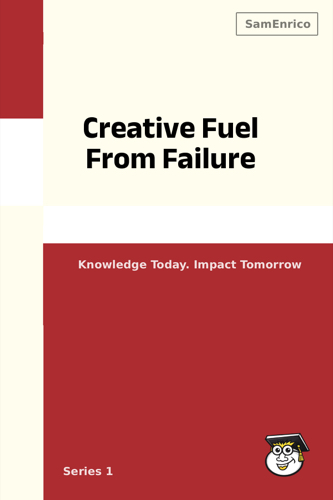
Creative Fuel From Failure eBook
Turning past mistakes and closed doors into creati
Turning past mistakes and closed doors into creative catalysts.
Formats
Free sample
Chapter 1: The Crash Curve--The moment you realize you have failed—truly failed, not just stumbled—arrives like a punch to the sternum. The air leaves your body. Your phone glows with the rejection email. The gallery director's polite "not this time" lands like a slammed door. The manuscript you poured eighteen months into comes back with a form letter.
Or worse: silence. That silence after you hit "send" on something you believed in, followed by days of nothing, followed by the quiet understanding that nothing will ever come.You are not alone in this feeling. But you are also not yet equipped to use it.Most books about failure skip past the ugly part. They leap from "I failed" to "and here's what I learned" so quickly that the reader feels ashamed for still being stuck in the mud. This chapter does the opposite.
We are going to sit in the wreckage long enough to name every sharp edge. Because you cannot turn failure into creative fuel if you do not know what kind of failure you are holding, what stage of the crash you are in, and whether this particular failure is even capable of becoming fuel in the first place.Let us begin with a story. Not a famous one. Yours.Think of the last creative failure that still stings when you remember it late at night. Maybe it was a project you abandoned halfway through, overcome by the certainty that it was garbage.
Maybe it was a pitch you delivered that landed with an audible thud. Maybe it was a piece of art, a song, a business idea, a design, a performance that you knew—you knew—was not your best, but you sent it out anyway because the rent was due, and the rejection came back so fast you wondered if they even read it. Hold that failure in your mind. We will return to it.First, you need a map of the territory.The Four Faces of Creative Failure Not all failures are the same. This seems obvious, but watch how quickly we lump them together.
"I failed" becomes a single, heavy blanket we throw over everything from a minor typo to a career-ending catastrophe. When you cannot distinguish between different species of failure, you cannot design different responses. So let us draw lines.Type One: Rejection Rejection is an external no. Someone else closed the door. A publisher passed.
A gallery declined. A client canceled. A funding committee said "insufficient impact." A festival selection committee sent the form letter that begins "Thank you for your submission, but…"Rejection is the most common failure type, and also the most deceptive. Because rejection feels personal—someone looked at your work and said no—but it is rarely only about you. Publishers reject manuscripts that later become bestsellers.
Investors reject companies that later become unicorns. Galleries reject artists who later become museum fixtures. The rejection letter does not come with a detailed rubric. It just says no.This does not mean rejection is meaningless. It means rejection is noisy data.
Your job is to extract the signal from the noise. One rejection tells you almost nothing. Twelve rejections for the same project might tell you something about fit, timing, or quality. But we will get to that in Chapter Two.Type Two: Missed Targets You set a goal. You missed it.
You wanted to finish the novel by June. You finished in October. You wanted to sell fifty units at the craft fair. You sold twelve. You wanted to gain a thousand newsletter subscribers in three months.
You gained two hundred.Missed targets feel different from rejection because there is no external villain. You cannot blame a gatekeeper. You set the bar, you jumped, you fell short. This failure type produces a specific flavor of shame: the sense that you let yourself down. It is clean, in a way.
No one else is responsible. But that cleanliness can also make it more brutal, because there is no one to argue with except the person in the mirror.The danger of missed targets is that they tempt you to lower the bar permanently. "I guess I am not a thousand-subscriber person. I am a two-hundred-subscriber person." That is not learning. That is shrinking.
A better response is to ask: was the target realistic? If yes, what specific skill or system was missing? If no, adjust the target upward or downward based on data, not shame.Type Three: Flawed Execution You had a good idea. You delivered it poorly. The concept was strong—a gallery show about urban loneliness, a software feature that solved a real user problem, a short story with a brilliant twist—but the execution wobbled.
The paintings felt rushed. The code had bugs. The story's pacing collapsed in the third act.Flawed execution is the most useful failure type because it points directly at a skill gap. You do not have to wonder what went wrong. You already know.
You bit off more than you could chew technically. You ran out of time and submitted a draft instead of a polish. You understood the theory but lacked the craft.This failure type responds to practice. Not more inspiration. Not more confidence.
Practice. Deliberate, repetitive, boring practice. The painter who fails at anatomy needs to draw a hundred hands. The writer whose endings collapse needs to write fifty endings for the same story and pick the best one. Flawed execution is not a judgment of your potential.
It is a diagnosis of your current proficiency.Type Four: Abandoned Ideas You stopped caring. The project is not finished. It will never be finished. You walked away not because someone rejected it, not because you missed a target, not because you executed poorly, but because the fire went out.Abandoned ideas produce a strange grief. You cannot point to a failure event—no rejection email, no missed deadline, no critical review.
There was just a day when you did not open the file, and then another day, and then a month, and then you realized you were never going back. This failure type is quiet. It is also, in some ways, the most honest. It tells you that your interests, values, or energy have shifted. The person who started the project is not exactly the same as the person who would have to finish it.The danger of abandoned ideas is the story you tell about yourself afterward.
"I am a quitter." "I lack follow-through." "I can never commit." Those stories are usually false. More often, abandonment means the project served its purpose—it taught you something, or it led you somewhere else, or it was simply the wrong container for the idea. We will return to this in Chapter Five, where we mine abandoned projects for salvageable fragments.The Emotional Crash Curve Knowing the type of failure is not enough. You also need to know where you are on the emotional arc. Because you cannot make good decisions about a failure while you are still in shock.
And you cannot learn from a failure while you are still rationalizing it away.The crash curve has four stages. They…
This is the end of the free sample. Get the eBook to keep going. Buy now
About this book
Details
- Author
- Newman Hattie
- Publisher
- SamEnrico
- Language
- English
- Genre
- Non-Fiction, Self-Help, Failure
- Released
- 2026-06-09
- Pages (approx.)
- 127
- Available as
- eBook, Audiobook

Read better in the ZLOADR app
Your eBooks on your phone or tablet. Sign in with your SamEnrico account and start reading.
More by Newman Hattie
 Weighted Blanket AwarenessNewman Hattie$11.99
 The Shift Work Memory Recovery GuideNewman Hattie$11.99
 Divorce After Long MarriageNewman Hattie$11.99
 Rhetorical Analysis Essay GuideNewman Hattie$11.99
 The Phantom Kidnappers of Lagos: When Nigeria’s Elite Became TargetsNewman Hattie$11.99
 Understanding Pipecolic AcidemiaNewman Hattie$17.99
 Expense Tracking Wave GuideNewman Hattie$12.99
 JEE Post IIT Life and CareersNewman Hattie$12.99
 Assistant Video EditorNewman Hattie$11.99
You may also like
 Hong Kong Handover 1997Dunn Johnnie$11.99
 Zumba For Postnatal Recovery CourseNeal Christian$11.99
 Zumba for BeginnersLadner Nikia$11.99
 YouTube Comment Mining GuideHumes Pandora$12.99
 Worry Box MeditationCarlin Rudy$11.99
 Workplace Stress MeditationNguyen Lynn$11.99
 Workplace Stress and Sleep RepairHawley Ivory$11.99
 Workplace Perfectionism CureDelaney Jeffry$11.99
 Workplace Injustice Anger GuideWallen Isabelle$11.99
 Work Addiction and Burnout LinkGreenwood Ester$11.99
 Women in Yoga and WellnessBeattie Galina$11.99
 Women in Stand Up ComedyChun Evangeline$11.99