
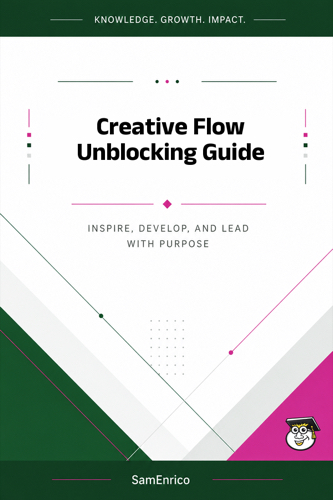
Non-FictionSelf-HelpCreativity
Creative Flow Unblocking Guide eBook
Overcome writer's block and creative resistance to
by Ali Booker
Overcome writer's block and creative resistance to enter artistic flow.
Formats
Free sample
Chapter 1: The Spice Rack Lie--–- I once spent three hours organizing my spice rack alphabetically. Then by color. Then by frequency of use. I do not cook. I have never cooked.
At the time, I owned six spices, three of which had expired during the Obama administration. This was not about organization. This was not about cleanliness. This was not even about spices. This was about a blank page in my office that had been staring at me for forty-seven days.
I had a book contract. I had a deadline. I had a mortgage. And I had just spent a Tuesday morning arranging oregano, paprika, and something called "sumac" that I had bought for a recipe I never made. In that moment, standing in my kitchen surrounded by alphabetized herbs, I had an uncomfortable realization: my brain was not lazy.
My brain was trying to save my life.This is the single most important thing you will read in this book, so I want you to pause and let it land. Whatever you believe about your creative blocks—that you lack discipline, that you don't have enough talent, that you're secretly a fraud who has fooled everyone so far—I am telling you with the full weight of neuroscience behind me: you are wrong. The problem is not your character. The problem is not your work ethic. The problem is not that you don't want it badly enough.
The problem is that your brain has mistaken the vulnerable act of creating for a physical threat, and it is doing exactly what evolution designed it to do. It is trying to keep you safe. The tragedy is that what keeps you safe also keeps you silent.The Shame Spiral That Keeps You Stuck Before we go any further, I want you to do something uncomfortable. I want you to remember the last time you sat down to write and produced nothing. Not the time you wrote badly—producing bad work is a sign that you actually showed up.
I want the time you sat there, cursor blinking, and wrote zero words. Or the time you opened the document, stared at it for ten minutes, and found yourself suddenly, urgently needing to check your email. Or the time you told yourself you would write "first thing in the morning" and then spent the morning researching something completely irrelevant to your project. Remember that moment. Now, what did you tell yourself afterward?If you are like ninety-seven percent of the writers I have worked with, the voice in your head said something like this: "You are so lazy.
You have no discipline. Who do you think you are, calling yourself a writer? Real writers write. You just made an excuse. You don't want it badly enough.
You should probably just give up." That voice, my friend, is the Shame Spiral, and it is the single most destructive force in the creative life. Not because it is accurate—it is not. But because it attaches a moral judgment to a neurological event. You did not fail because you are bad. You failed because your amygdala, the ancient part of your brain designed to detect threats, decided that writing was dangerous.
And then your prefrontal cortex, the rational part of your brain, invented a story to explain why you couldn't write. The story it invented was about your character. The truth is about your biology.Let me say this again because it is the foundation of everything that follows: creative block is not a moral failure. It is a biological response to perceived threat. Once you understand this, the shame begins to dissolve.
And once the shame dissolves, you can actually address the real problem.The Limbic System: Your Overprotective Bodyguard To understand why writing feels so terrifying to your brain, you need to meet your limbic system. The limbic system is a set of brain structures—including the amygdala, the hippocampus, and the hypothalamus—that evolved hundreds of millions of years ago to keep you alive in a world full of predators, famines, and tribal warfare. Your limbic system does not know about book contracts, deadlines, or Amazon reviews. It does not know that you are sitting in a comfortable chair in a heated room with a cup of coffee. As far as your limbic system is concerned, you are still a cavalier on the savanna, and anything that raises your heart rate is probably a saber-toothed tiger.Here is the critical insight from neuroscientists like Anne Janzer and Rosanne Bane: your brain cannot reliably distinguish between physical danger and social-emotional danger.
When you face a physical threat—a tiger, a falling tree, a slippery staircase—your amygdala triggers the fight/flight/freeze response. Cortisol and adrenaline flood your system. Your heart rate increases. Your digestion slows. Your peripheral vision narrows.
Your body prepares to survive.Now, consider what happens when you sit down to write. You are about to produce something that could be judged. You are about to reveal your inner world to unknown readers. You are about to risk rejection, criticism, and the terrifying possibility that you are not as talented as you hoped. To your limbic system, this looks like danger.
Not a tiger, perhaps, but danger nonetheless. And so it does what it was designed to do: it triggers the same fight/flight/freeze response. The cortisol flows. The heart races. And suddenly, the blank page feels terrifying.This is not a metaphor.
This is measurable biology. Researchers have found that cortisol levels in creative professionals spike before public presentations, before deadline reviews, and crucially, before the first sentence of a difficult writing session. Your body is not being dramatic. Your body is being protective. The problem is that the protection is preventing the work.The Crucial Distinction: Block vs.
Resistance Before we go any further, I need to introduce a distinction that will structure this entire book. This distinction comes from Steven Pressfield's essential work The War of Art, and if you remember nothing else from this chapter, remember this:Writer's block is the symptom. Resistance is the cause.Writer's block is what you feel: the blank page, the frozen cursor, the hours of staring at a screen without producing a single sentence. Writer's block is the experience of being stuck. Resistance is the active force that makes you clean your refrigerator instead of writing.
Resistance is the voice that tells you to check email "just one more time." Resistance is the sudden, urgent need to reorganize your bookshelf. Resistance is the force that creates the block.Here is why this distinction matters: you cannot fight what you cannot name. If you believe you have "writer's block," you have named a static condition, something that has happened to you. You are a victim of a block. But if you recognize Resistance, you have named an active enemy, something you can fight.
Resistance is not a condition; it is a behavior. And behaviors can be changed.Throughout this book, we will maintain this distinction rigorously. When you feel stuck, we will not say "I have writer's block." We will say "Resistance is active right now." This small linguistic shift…
This is the end of the free sample. Get the eBook to keep going. Buy now
About this book
Details
- Author
- Ali Booker
- Publisher
- SamEnrico
- Language
- English
- Genre
- Non-Fiction, Self-Help, Creativity
- Released
- 2026-06-06
- Pages (approx.)
- 142
- Available as
- eBook, Audiobook

Read better in the ZLOADR app
Your eBooks on your phone or tablet. Sign in with your SamEnrico account and start reading.
More by Ali Booker
 Gambling Addiction for College StudentsAli Booker$11.99
 Remote Work Time Budgeting GuideAli Booker$11.99
 Deadweight Loss PreventionAli Booker$11.99
 Whispers in the Empty Market: The Djinn of the Vanished BazaarAli Booker$11.99
 Mortgage Specialist AssociateAli Booker$11.99
 How to Start a Box Furnace Business (Beginners Guide)Ali Booker$11.99
 GDPR CCPA Nigeria DPR GuideAli Booker$12.99
 Learn to Play the OudAli Booker$11.99
You may also like
 Hong Kong Handover 1997Dunn Johnnie$11.99
 Zumba For Postnatal Recovery CourseNeal Christian$11.99
 Zumba for BeginnersLadner Nikia$11.99
 YouTube Comment Mining GuideHumes Pandora$12.99
 Worry Box MeditationCarlin Rudy$11.99
 Workplace Stress MeditationNguyen Lynn$11.99
 Workplace Stress and Sleep RepairHawley Ivory$11.99
 Workplace Perfectionism CureDelaney Jeffry$11.99
 Workplace Injustice Anger GuideWallen Isabelle$11.99
 Work Addiction and Burnout LinkGreenwood Ester$11.99
 Women in Yoga and WellnessBeattie Galina$11.99
 Women in Stand Up ComedyChun Evangeline$11.99