
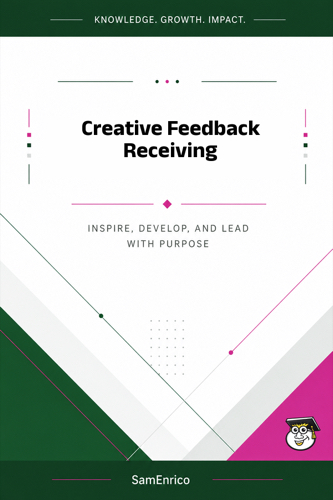
Non-FictionSelf-HelpFeedback Skills
Creative Feedback Receiving eBook
Accept critique without losing confidence using th
Accept critique without losing confidence using this practical guide.
Formats
Free sample
Chapter 1: The Hidden Wound...--–- The email arrived at 2:47 PM on a Tuesday. Maya, a graphic designer with seven years of experience and a portfolio that had won two industry awards, read it once. Then twice. Then a third time, her vision blurring slightly around the edges. The message was from her creative director, and it contained exactly three sentences: "Maya, can we talk about the Hawthorne campaign?
Some elements aren't landing. Let's meet at 4 PM."That was it. No accusations. No raised voices. No threats.
Just a request for a conversation about a project that, until that moment, Maya had been quietly proud of. But by 3:15 PM, she had already spiraled through a mental checklist of catastrophes: she was going to be fired, she had lost her talent, everyone had secretly known she was a fraud, and the last seven years of her career had been a lucky streak that was about to end. Her heart pounded. Her palms sweated. She considered calling in sick.
She considered quitting first.By 4 PM, when she walked into the meeting, her face was flushed, her voice was tight, and her brain had effectively left the building. The creative director spent ten minutes offering specific, actionable feedback about color contrast and typography hierarchy. Maya heard none of it. She was too busy fighting back tears and rehearsing her defense. Afterward, she drove home in silence, replayed the conversation on a loop for six hours, and didn't sleep.The feedback was mild.
The reaction was extreme. And Maya is not weak, broken, or unusually sensitive. She is human. So are you.This chapter is about why a few words—even well-intentioned words—can feel like a physical assault. It is about the neurobiology of rejection, the difference between feedback about your work and feedback about your worth, and the single most important shift you can make to stop confusing pain with truth.
By the end of this chapter, you will understand why your brain treats criticism like a punch, why that reaction is not a character flaw, and how to start separating the signal from the suffering before you even say a word.The Punch That Isn't Physical Let us begin with a question that seems simple but is actually profound: Why does a comment hurt more than a cut? If you slice your finger with a kitchen knife, you feel pain, you bandage the wound, and within a few days, the body does what bodies do—it heals. The memory of that cut fades quickly. You do not lie awake at 3 AM replaying the moment the knife made contact. You do not construct elaborate narratives about what the knife thinks of you.
You do not wonder if the cut means you are fundamentally flawed as a human being.But a comment? A comment can linger for years. A single sentence from a boss, a teacher, a parent, or a peer can echo in your head for decades. It can shape your career choices, your relationships, and your sense of what you deserve. It can keep you up at night, drain your confidence, and make you question whether you belong in rooms you have already earned the right to sit in.Why?
What is happening inside the brain that makes words more potent than wounds?The answer lies in a small, almond-shaped cluster of neurons deep within your skull called the anterior cingulate cortex. Neuroscientists have known for decades that this region processes physical pain. But in the early 2000s, a series of f MRI studies revealed something startling: the same region also activates during social rejection, exclusion, and criticism. In one landmark study, participants played a virtual ball-tossing game while inside an f MRI scanner. When the other players stopped throwing the ball to them—excluding them from the game for no reason—their anterior cingulate cortex lit up exactly as it would have if they had been physically struck.Your brain cannot reliably distinguish between a punch to the gut and a comment that makes you feel excluded, dismissed, or inadequate.
Evolution wired you this way for a simple reason: for your ancient ancestors, social rejection was a death sentence. Being cast out of the tribe meant no protection, no food sharing, no mating opportunities, and almost certain death. Your brain learned, over millions of years, to treat social threats with the same urgency as physical threats. A criticism is not just an opinion; it is, to your ancient neural architecture, a survival threat.This is not weakness. This is inheritance.
You inherited a brain that cares deeply about belonging and competence because those two things kept your ancestors alive. The problem is that your brain has not updated its software for the modern workplace. It still thinks a creative director asking for a meeting is a saber-toothed tiger hiding in the bushes.The Double Punch: Competence and Belonging Here is where the pain becomes more specific. Criticism does not just trigger a general threat response. It targets two distinct psychological needs simultaneously, and understanding this double punch is the first step toward dismantling its power.The first target is your need for competence.
Every human being has a deep, often unacknowledged drive to feel capable, effective, and skilled. When someone critiques your work, they are implicitly (or explicitly) saying that something you did was not good enough. Your brain registers this as a threat to your competence. The internal question that follows is almost automatic: "Am I good enough? Do I know what I am doing?
Have I been fooling everyone?"The second target is your need for belonging. Human beings are social creatures; we are wired to seek connection, approval, and a place in the group. When someone critiques your work, your brain also registers a potential threat to your belonging. The internal question shifts: "Do they still respect me? Am I still part of the team?
Do they secretly think I am a problem?"These two needs are processed in different hemispheres of the brain—competence leaning toward the left hemisphere, belonging leaning toward the right—but they are almost always triggered simultaneously. A single piece of feedback can make you feel both incompetent and exiled. That is the double punch. And it explains why a mild comment can land like a knockout blow.Consider the artist from the opening scenario. Maya received an email that said "some elements aren't landing." That sentence triggered her competence threat: "My work is not working.
Am I a bad designer?" It also triggered her belonging threat: "The creative director wants to meet privately. Am I in trouble? Do they regret hiring me?" One sentence. Two threats. Hours of spiraling.The critical insight—and the one that will serve as the foundation for every tool in this book—is that the pain you feel is real, but the story your brain tells you about that pain is often wrong.
The pain is a signal. The interpretation is a narrative. And you can learn to separate the two.Identity Threat: When Work Becomes Self There is a specific moment in the feedback spiral where the pain escalates from uncomfortable to devastating. That moment is…
This is the end of the free sample. Get the eBook to keep going. Buy now
About this book
Details
- Author
- Chambers Silvia
- Publisher
- SamEnrico
- Language
- English
- Genre
- Non-Fiction, Self-Help, Feedback Skills
- Released
- 2026-06-06
- Pages (approx.)
- 150
- Available as
- eBook, Audiobook

Read better in the ZLOADR app
Your eBooks on your phone or tablet. Sign in with your SamEnrico account and start reading.
More by Chambers Silvia
 Siberian Reindeer Herder TrekChambers Silvia$11.99
 Search and Rescue Team GuideChambers Silvia$11.99
 Body Scan For ParalysisChambers Silvia$11.99
 Self Esteem For Flat Chest Acceptance GuideChambers Silvia$11.99
 Sadness Anger GuideChambers Silvia$11.99
 Education Teacher OverworkChambers Silvia$11.99
 Love Island UKChambers Silvia$11.99
 The Shadow Cabinet: How a Forgotten Aide Shaped the Cold WarChambers Silvia$11.99
 The Ballad of the Green Mountain Boys: Ethan Allen's Defiant StandChambers Silvia$11.99
 Ultimate Handbook Guide to Lianyuan : (China) Travel GuideChambers Silvia$11.99
 Growing CussoniaChambers Silvia$11.99
 GCC B2B Sales Technology StackChambers Silvia$12.99
You may also like
 Hong Kong Handover 1997Dunn Johnnie$11.99
 Zumba For Postnatal Recovery CourseNeal Christian$11.99
 Zumba for BeginnersLadner Nikia$11.99
 YouTube Comment Mining GuideHumes Pandora$12.99
 Worry Box MeditationCarlin Rudy$11.99
 Workplace Stress MeditationNguyen Lynn$11.99
 Workplace Stress and Sleep RepairHawley Ivory$11.99
 Workplace Perfectionism CureDelaney Jeffry$11.99
 Workplace Injustice Anger GuideWallen Isabelle$11.99
 Work Addiction and Burnout LinkGreenwood Ester$11.99
 Women in Yoga and WellnessBeattie Galina$11.99
 Women in Stand Up ComedyChun Evangeline$11.99