
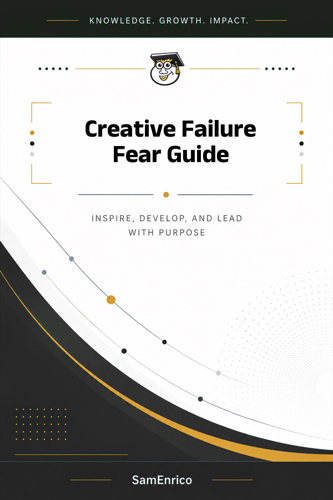
Non-FictionSelf-HelpCreative Block
Creative Failure Fear Guide eBook
Share art, writing, or music without paralysis fro
by Held Jay
Share art, writing, or music without paralysis from rejection fears.
Formats
Free sample
Chapter 1: The Graveyard of Almost--–- You have already created something. A draft of a novel sits in a folder named "Work in Progress" that has not been opened in fourteen months. A recording of your original song lives on your phone, three chords and a verse, labeled "Demo - not ready." A half-finished canvas leans against the wall of your studio, face turned inward, as if it, too, is ashamed to be seen. These are not failures. They are not even finished failures.
They are something more insidious: the unshared. The almost. The creative graveyard where perfectly good art goes to die not because it was bad, but because its maker could not bear to let it be seen.If you are reading this book, you are not someone who lacks ideas. You are not someone who lacks skill. You are someone who has felt the cold hand of fear wrap around your throat the moment before sharing, and you have learned, through painful repetition, that it is safer to keep things hidden.
This chapter is not about teaching you to create. It is about diagnosing why you refuse to let creation leave your hands. And it begins with a single, uncomfortable question: what are you so afraid will happen if someone actually sees what you made?Before we answer that, we must first name the enemy. Not the trolls on the internet. Not the dismissive friend.
Not the crowded marketplace. Those are external threats, and while they exist, they are not the reason your work stays in the drawer. The real enemy lives much closer. It lives in your own head. It has your voice, your vocabulary, and an uncanny ability to sound exactly like reasonable caution.
It is called Resistance.The Architecture of Avoidance Resistance is the internal, invisible, self-sabotaging force whose sole purpose is to keep you from doing your most meaningful work. I borrow this term from Steven Pressfield’s The War of Art, but I will expand it here with a precision that book does not fully deliver. Resistance is not laziness. Lazy people do not spend years writing novels they never publish. Resistance is not a lack of talent.
Talented people fill hard drives with unreleased music every single day. Resistance is fear disguised as logic, wearing a business casual suit and carrying a clipboard full of perfectly reasonable excuses.Listen for its voice. It whispers in your ear with your own inflection: "Just one more edit before you show anyone." "Wait until you're less busy next month." "You need feedback from someone more qualified first." "The timing is wrong." "The world doesn't need another [painter/poet/songwriter/podcaster]." "No one wants to hear this." "You'll embarrass yourself." "You can always share it later."That last one is particularly cruel. "Later" is a lie Resistance tells you because Resistance knows that later never comes. Later is not a date on the calendar.
Later is a wormhole into which ambition disappears. Resistance does not need you to stop creating. It only needs you to stop shipping. It is perfectly happy to let you write, paint, record, and rehearse forever, as long as none of it ever reaches another human being. Because the moment it reaches another human being, you become vulnerable.
And vulnerability is what Resistance cannot survive.This is the central paradox of the creative life: the force that protects you from rejection is the same force that prevents you from mattering.The Perfectionism Trap The most sophisticated disguise Resistance wears is perfectionism. Not the genuine, craftsman-like pursuit of excellence—that is rational refinement, and we will honor it—but the neurotic, paralyzing belief that your work must be flawless before it can be seen. Perfectionism says: "If I share this and it has a flaw, that flaw will be me. The work is me. The flaw is me.
Therefore, I will eliminate all flaws before anyone sees." But here is the trap: you cannot eliminate all flaws because flaws are not objective. One reader's clumsy metaphor is another reader's surprising originality. One listener's pitchy vocal is another listener's raw humanity.Perfectionism is not a high standard. It is a cage. And the bars are made of a single, seductive sentence: "I'll share it when it's perfect."Let me be blunt.
You will never share anything if you wait for perfect. The books that have changed your life were not perfect. The songs that made you weep were not perfect. The paintings that stopped you in a museum gallery had brushstrokes their own creators cursed. Perfection is not a standard you can meet.
It is a moving target that retreats every time you get closer. And Resistance knows this. Resistance is the one holding the target on a stick, backing away slowly, grinning as you exhaust yourself chasing an impossibility.The difference between the amateur and the professional is not talent. It is not even hard work. It is the willingness to release imperfect work into the world.
The amateur creates for the joy of the act but stops at exposure. The professional creates on a schedule and ships regardless of fear. Notice that I said "regardless of fear," not "without fear." The professional is terrified too. The professional feels the same sick lurch in the stomach before hitting "post." The professional also lies awake some nights replaying every criticism. The difference is that the professional ships anyway.Rational Refinement vs.
Irrational Procrastination We must be careful here. Not all hesitation is Resistance. Sometimes you genuinely need another draft. Sometimes a song truly is unfinished. Sometimes a painting needs to dry before you can add another layer.
The question is not "Am I hesitating?" The question is "Is my hesitation serving the work or serving my fear?"Rational refinement has three characteristics. First, it has a clear, achievable goal. ("I need to revise the third paragraph so the transition is clearer.") Second, it has a deadline. ("I will finish this revision by Friday.") Third, it does not expand to fill infinite time. When you finish the revision, you stop.
You do not invent a new reason to delay.Irrational procrastination looks different. It has vague goals. ("I need to make it better." Better how? By what measure?) It has no deadline. ("I'll share it when I'm ready." When is that?
What event will signal readiness?) And it expands endlessly. Finishing one revision simply reveals another, and another, and another, like a set of Russian dolls with no smallest doll.Here is a practical test. Take whatever piece of work you have been hiding. Ask yourself: if I had to share this in its current state with one trusted person by tomorrow afternoon, could I do it? Would the work be comprehensible?
Would it represent my genuine effort? If the answer is yes, then your hesitation is likely Resistance. If the answer is no—if the work is genuinely missing a critical component—then you have identified a real task. Complete that task. Then share.Do not complete infinite tasks.
Complete the necessary ones. Then ship.The Two Dimensions of the Professional Let me clarify something that confuses many creative people. When I say "professional,"…
This is the end of the free sample. Get the eBook to keep going. Buy now
About this book
Details
- Author
- Held Jay
- Publisher
- SamEnrico
- Language
- English
- Genre
- Non-Fiction, Self-Help, Creative Block
- Released
- 2026-06-10
- Pages (approx.)
- 143
- Available as
- eBook, Audiobook

Read better in the ZLOADR app
Your eBooks on your phone or tablet. Sign in with your SamEnrico account and start reading.
More by Held Jay
 Emotional Intelligence For EducatorsHeld Jay$11.99
 The Caregiver Traumatic Brain Injury GuideHeld Jay$11.99
 Carson EPA Formation Influence GuideHeld Jay$11.99
 B Vitamin Homocysteine Reduction GuideHeld Jay$11.99
 The Summit Seekers: Everest’s Genetic Pioneers and the Race to the Roof of the WorldHeld Jay$11.99
 The Forgotten Codex: A Scribe’s Vanished ManuscriptHeld Jay$11.99
 Understanding Focal Or Multifocal Malformations In Neuronal MigrationHeld Jay$17.99
 How to Start a Printing By Embossers Business (Beginners Guide)Held Jay$11.99
 Promotion Case Length GuideHeld Jay$12.99
 User Paying Intent HandbookHeld Jay$12.99
You may also like
 Hong Kong Handover 1997Dunn Johnnie$11.99
 Zumba For Postnatal Recovery CourseNeal Christian$11.99
 Zumba for BeginnersLadner Nikia$11.99
 YouTube Comment Mining GuideHumes Pandora$12.99
 Worry Box MeditationCarlin Rudy$11.99
 Workplace Stress MeditationNguyen Lynn$11.99
 Workplace Stress and Sleep RepairHawley Ivory$11.99
 Workplace Perfectionism CureDelaney Jeffry$11.99
 Workplace Injustice Anger GuideWallen Isabelle$11.99
 Work Addiction and Burnout LinkGreenwood Ester$11.99
 Women in Yoga and WellnessBeattie Galina$11.99
 Women in Stand Up ComedyChun Evangeline$11.99