
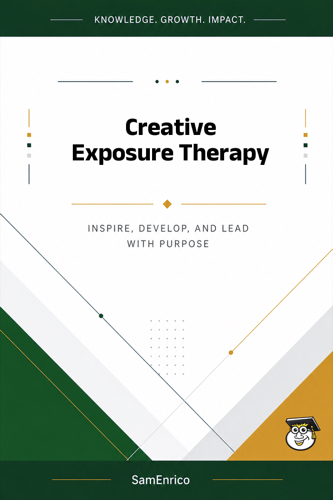
Non-FictionSelf-HelpExposure Therapy
Creative Exposure Therapy eBook
Gradually face creative fears from sharing to perf
by Rogers Vicki
Gradually face creative fears from sharing to performing with this guide.
Formats
Free sample
Chapter 1: The Tiger Inside--–- Mira’s hands hovered over her keyboard like a pianist about to play a concerto, except instead of music, she was trying to write a single sentence. Just one. Any sentence. It didn’t have to be good. It didn’t even have to be true.
But her fingers refused to move, and her chest had tightened into a knot so familiar she’d stopped noticing it years ago.This is what creative fear looks like: not a dramatic explosion, not a screaming meltdown, but a quiet, polite paralysis. The kind that convinces you to check your email instead of opening the document. The kind that tells you to reorganize your bookshelf before you pick up the paintbrush. The kind that makes you believe, deep down, that you are the only person who feels this way.You are not.Every artist, writer, musician, and creator who has ever tried to make something new has faced this same invisible wall. The ones who succeed are not the ones who feel less fear.
They are the ones who have learned to walk through it anyway.This chapter is about why that wall exists. Not the philosophical why—not “what is the meaning of fear?”—but the biological why. The neurological why. The evolutionary why. Because once you understand why your brain treats a blank page like a tiger, you can stop fighting yourself and start working with the machinery you were given.Let’s begin with a story about rustling grass.The Amygdala’s Mistake Two hundred thousand years ago, your ancestor heard a rustle in the tall grass.
Before they had time to think, their body reacted: heart racing, pupils dilating, breath shortening, muscles flooding with blood. This was the amygdala—two small clusters of neurons deep in the brain—doing exactly what it evolved to do. It detected a potential threat and launched a full-body response to survive it.If the rustle was a predator, your ancestor fought or fled. If it was just the wind, they calmed down and continued foraging. Either way, the system worked.
The ones whose amygdalae reacted fastest were the ones who lived long enough to pass on their genes.You are descended from the most anxious hominids on the savanna. The ones who didn’t worry enough got eaten.Now fast forward to today. You are sitting at a desk. There is no predator. The room is quiet.
But when you open a blank document or face an empty canvas, your body does the same thing your ancestor’s body did in the tall grass. Your heart races. Your palms sweat. Your breathing becomes shallow. Your mind, searching for an escape route, suddenly remembers that you haven’t checked your phone in seven minutes.This is not a flaw in your design.
This is your ancient alarm system doing its job. The problem is not that the alarm is ringing. The problem is that the alarm is ringing in response to the wrong stimulus.Your amygdala cannot tell the difference between a tiger and a blank page.Let that land. Your brain, the most sophisticated organ in the known universe, is literally incapable of distinguishing between a mortal threat and a creative project. Evolution did not equip you with a separate “art fear” circuit.
It gave you one threat-detection system, and that system fires whether you are being chased by a lion or trying to write the first sentence of a novel.This is what I call the Creative Fear Response—a term we will use throughout this book. It is the name for that specific, predictable cascade of physical sensations and avoidance behaviors that arise when you face a creative trigger. And once you learn to recognize it, you can stop being ruled by it.The Three-Part Loop The Creative Fear Response operates like a machine with three moving parts. Once you see the parts, you can begin to interfere with the machine.Part One: The Trigger Something activates the response. Triggers are personal, but they tend to fall into predictable categories:The empty vessel: a blank page, canvas, timeline, or document.The deadline: a submission date, a performance time, a promised delivery.The audience: real or imagined, one person or one thousand.The comparison: seeing someone else’s work and feeling small.The memory: a past rejection, a humiliating comment, a teacher who told you that you weren’t good enough.For some people, the trigger is as specific as opening a particular folder on their computer.
For others, it is as diffuse as the hour of the day when they usually try to create. But the pattern is always the same: trigger, then response.Part Two: The Physical Response This is where your body prepares for a threat that does not exist. Common physical sensations include:Racing or pounding heart Shallow, rapid breathing Tightness in the chest or throat Sweating, especially the palms Trembling or shaking hands Dizziness or lightheadedness Nausea or stomach discomfort Tunnel vision or difficulty focusing A sense of being hot or flushed Numbness or tingling in the fingers None of these sensations are dangerous. I want to repeat that because your brain will try to convince you otherwise. None of these sensations are dangerous.
They are uncomfortable. They are unpleasant. They are not harmful. Your body is simply doing what it evolved to do: mobilizing energy for action.The problem is not the sensations themselves. The problem is what you tell yourself about them.Part Three: The Interpretation and Avoidance This is where the loop completes—and where most people get stuck.
You feel the physical sensations, and your brain automatically interprets them as a sign of danger. Not discomfort. Danger. You think: “My hands are shaking, so I must not be ready.” Or: “My heart is racing, so I should wait until I calm down.” Or: “This feels terrible, so something must be wrong.”This is called the catastrophic misinterpretation. You are mistaking the alarm for the fire.Then you do something to escape.
You close the document. You open social media. You get a snack. You clean your desk. You tell yourself you’ll try again tomorrow, when you feel more inspired.
You show your work only to people who will praise you. You frame your attempt as “just practice” so it doesn’t really count.Each of these avoidance behaviors provides immediate relief. That relief is a reward. And that reward teaches your brain that avoidance works. The next time you face the same trigger, your amygdala will sound the alarm even louder, because now it has proof: last time we saw that thing, we ran away.
That means it was dangerous. Next time, we need to run faster.This is how creative paralysis compounds. It is not that you are becoming more afraid over time. It is that you are becoming more practiced at avoiding. And your brain is becoming more convinced that the avoiding was necessary.Danger Versus Discomfort Here is the single most important distinction in this entire book.
I want you to write it down, put it on your wall, and repeat it to yourself every time you…
This is the end of the free sample. Get the eBook to keep going. Buy now
About this book
Details
- Author
- Rogers Vicki
- Publisher
- SamEnrico
- Language
- English
- Genre
- Non-Fiction, Self-Help, Exposure Therapy
- Released
- 2026-06-07
- Pages (approx.)
- 141
- Available as
- eBook, Audiobook

Read better in the ZLOADR app
Your eBooks on your phone or tablet. Sign in with your SamEnrico account and start reading.
More by Rogers Vicki
 Flight Nurse Air Medical StressRogers Vicki$11.99
 Saudi Arabian Edge CrossingRogers Vicki$11.99
 Waiting Anger TriggersRogers Vicki$11.99
 Body Scan For Children GuideRogers Vicki$11.99
 Body Image For Hair Loss Acceptance GuideRogers Vicki$11.99
 Creative Industry Work AddictionRogers Vicki$11.99
 Big Brother DiaryRogers Vicki$11.99
 The Weeknd: Darkness into PopRogers Vicki$11.99
 Maui’s Fishing Rod and the Birth of IslandsRogers Vicki$11.99
 Baba Yaga's Bone-Legged Waltz: The Witch of the ForestRogers Vicki$11.99
 The Mineral Guide to AndraditeRogers Vicki$11.99
 AI Prompts for Scenario SimulationRogers Vicki$11.99
You may also like
 Hong Kong Handover 1997Dunn Johnnie$11.99
 Zumba For Postnatal Recovery CourseNeal Christian$11.99
 Zumba for BeginnersLadner Nikia$11.99
 YouTube Comment Mining GuideHumes Pandora$12.99
 Worry Box MeditationCarlin Rudy$11.99
 Workplace Stress MeditationNguyen Lynn$11.99
 Workplace Stress and Sleep RepairHawley Ivory$11.99
 Workplace Perfectionism CureDelaney Jeffry$11.99
 Workplace Injustice Anger GuideWallen Isabelle$11.99
 Work Addiction and Burnout LinkGreenwood Ester$11.99
 Women in Yoga and WellnessBeattie Galina$11.99
 Women in Stand Up ComedyChun Evangeline$11.99