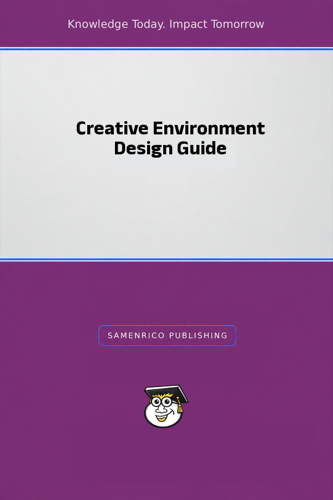
Creative Environment Design Guide Audiobook
Arrange your physical space to invite inspiration
Arrange your physical space to invite inspiration and reduce resistance.
Formats
Free sample
Chapter 1: The Messy Genius Myth...--–- The image is familiar. The writer surrounded by crumpled paper, the painter with splattered clothes and a chaotic studio, the inventor at a bench cluttered beyond recognition. We romanticize this figure—the creative genius who is too lost in inspiration to bother with order. The mess, we tell ourselves, is evidence of deep thinking. It is a sign that the creative mind operates on a plane above mundane concerns like organization.It is a seductive myth.
It is also wrong.Decades of research in environmental psychology and neuroscience have shown that the relationship between environmental order and creative output is neither simple nor universal. Some people do thrive in apparent chaos. But for most, environmental clutter functions as cognitive load—a constant, low-grade drain on attention that leaves less mental energy for actual creative work. Your physical environment is not neutral. Every visible object, every stack of paper, every unused item in your peripheral vision is either supporting your creative work or silently resisting it.This chapter dismantles the myth of the messy genius and establishes the foundational principle of this book: your environment is either an active collaborator in your creative work or an active resistor.
There is no neutral ground.The Cognitive Cost of Clutter In 2011, researchers at Princeton University conducted a landmark study on the effects of visual clutter on attention. Participants were asked to perform tasks in both tidy and cluttered environments while their brain activity was monitored using functional magnetic resonance imaging (f MRI). The results were striking: clutter competed for attention, reducing the brain's ability to process information efficiently. The effect was measurable, consistent, and significant. Participants in cluttered environments made more errors, took longer to complete tasks, and reported higher levels of frustration—all while their brains showed increased activity in regions associated with effortful processing.This is not about tidiness as a moral virtue.
You will not find any lectures in this book about how clean people are better people. This is about cognitive economics. Your brain has a limited amount of attentional resources. These resources are like a budget: you can spend them on deep creative work, or you can spend them on processing irrelevant information. Every time your eyes land on a stack of unpaid bills, a pile of unsorted papers, or a collection of unused items, your brain must process that information.
It must decide: is this relevant? Should I ignore it? Is there action required? These micro-decisions happen dozens or even…
This is the end of the free sample. Get the Audiobook to keep going. Buy now
About this book
Details
- Author
- Tatum Cristin
- Publisher
- SamEnrico
- Language
- English
- Genre
- Non-Fiction, Self-Help, Environment Design
- Released
- 2026-06-06
- Pages (approx.)
- 123
- Available as
- eBook, Audiobook

Listen in the VoxFlicks app
Audiobooks and audio dramas wherever you go. Sign in with your SamEnrico account and press play.
More by Tatum Cristin
 Keto Diet For Beginners GuideTatum Cristin$11.99
 Expedition Leadership In Borneo JunglesTatum Cristin$11.99
 Flow For ChefsTatum Cristin$11.99
 The Silent Architect: How a Forgotten Engineer Saved Millions from a Deadly Bridge CollapseTatum Cristin$11.99
 How to Start a Lodging House (private) Business (Beginners Guide)Tatum Cristin$11.99
 How to Produce Camera and Optic Replacement CablesTatum Cristin$11.99
 Hospital VolunteerTatum Cristin$11.99