
Non-FictionSelf-HelpTeam Conflict
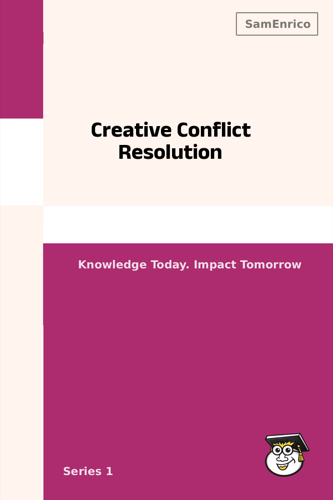
Creative Conflict Resolution eBook
Turn personality clashes into diverse perspectives
Turn personality clashes into diverse perspectives for innovation.
Formats
Free sample
Chapter 1: The Expensive Lie--–- The conference room was silent. Twelve people sat around a polished oak table, nodding in perfect, miserable unison. The CEO had just proposed a quarter-four strategy that everyone in the room knew would fail. The head of product had data proving it. The finance lead had run the numbers showing the cash burn.
The operations director had watched this exact play fail at their previous company. Not one person spoke.After the meeting, three of them gathered by the coffee machine. "Can you believe that plan?" the product head whispered. "It's going to kill us." The others nodded vigorously. Then they returned to their desks and executed the doomed strategy for six weeks until the emergency board meeting where everyone blamed everyone else.This is not a story about a bad CEO.
This is a story about a culture that confused niceness with safety. And it is the single most expensive mistake teams make today.The Silent Epidemic No One Talks About Let me name the problem directly: most workplaces have traded honest disagreement for a counterfeit version of harmony. They call it "professionalism" or "team culture" or "keeping things positive." I call it The Expensive Lie—the belief that high-performing teams are peaceful teams.The data tells a very different story. In a landmark study of failed product launches across 500 companies, researchers found that the number one predictor of failure was not lack of talent, insufficient budget, or even bad strategy. It was the absence of dissent.
Teams that failed had the same meetings, the same Power Points, the same polite nodding as successful teams—except successful teams fought.Let me say that again. Successful teams fought. Not personally, not viciously, but they disagreed openly, early, and often. Failed teams smiled and died.I have seen this pattern destroy millions of dollars in value. I have watched quiet, agreeable teams ship products that everyone privately knew were broken.
I have seen brilliant engineers leave their best ideas unsaid because "that's not how we do things here." And I have watched managers celebrate "no drama" as if the absence of conflict were the same as the presence of trust.It is not. The absence of conflict is often just the presence of fear.Psychological Safety vs. Permanent Niceness To understand why niceness is so expensive, we must first draw a critical distinction that most leaders get wrong. In recent years, the concept of psychological safety has become a management buzzword. Coined by Harvard researcher Amy Edmondson, psychological safety refers to the shared belief that a team is safe for interpersonal risk-taking.
People can speak up, admit mistakes, ask questions, or offer dissenting opinions without fear of punishment or humiliation.This is good. This is necessary. This is not the problem.The problem is that many leaders have conflated psychological safety with what I call permanent niceness—the systematic suppression of all disagreement to avoid temporary discomfort. Where psychological safety says "you can speak up without fear," permanent niceness says "you should not speak up if it might upset anyone." Where psychological safety encourages candor, permanent niceness polices tone. Where psychological safety asks "what do you really think?", permanent niceness asks "can we just move on?"The difference is not subtle, but it is often invisible to the people inside the culture.
Consider these two team behaviors:Psychological Safety in Action:"Aisha, I disagree with your approach. Here's why. And I trust you enough to tell you directly."Permanent Niceness in Action:"That's an interesting idea. Has anyone else thought about... maybe...
possibly... another direction? No? Okay, let's go with Aisha's plan." (Later, in private: "That plan was terrible.")The first statement contains conflict but builds trust. The second statement avoids conflict but erodes trust.
And here is the cruel irony: teams that practice permanent niceness believe they are being kind. They believe they are protecting relationships by smoothing over disagreement. In reality, they are starving their team of the very friction required for innovation.The Anatomy of Toxic Positivity The Expensive Lie expresses itself through a pattern psychologists call toxic positivity—the excessive and ineffective overgeneralization of a happy, optimistic state across all situations. On a team, toxic positivity sounds like this:"Let's focus on solutions, not problems." (Translation: don't raise issues)"Can we keep this constructive?" (Translation: don't express frustration)"I love the energy in this room!" (Translation: please stop disagreeing)"We're all on the same team here." (Translation: fall in line)Each of these phrases sounds reasonable. Each can be used appropriately.
But in a culture of permanent niceness, they become weapons of suppression. Team members learn quickly: dissent is uncomfortable, discomfort is unwelcome, and unwelcome opinions are career-limiting.The result is what I call silent groupthink. Unlike traditional groupthink—where a team explicitly agrees on a bad idea—silent groupthink happens when individuals disagree privately but assume (incorrectly) that everyone else agrees publicly. Each person thinks "I'm the only one who sees this problem." Each person stays quiet. The bad idea moves forward.
And six months later, everyone says "how did we miss that?"You did not miss it. You were just too nice to say it.The Real Cost of Avoidance Let me show you what The Expensive Lie actually costs. I have tracked these numbers across dozens of teams, and the pattern is consistent:Direct Costs:Failed product launches: 40-60% higher in low-dissent teams Project overruns: 3x more likely when concerns are raised only after decisions are locked Employee turnover: 2x higher among high-performers who feel they cannot speak freely Indirect Costs:Passive-aggressive communication (emails sent at 11 PM, Slack messages that say "per my last email")Siloed work (people stop collaborating because they don't trust the process)Post-meeting meetings (the real conversation happens in parking lots and coffee corners)Decision fatigue (the same topics get rehashed because no one actually resolved anything)But the most expensive cost is invisible: the ideas that never get born. The quiet engineer who knows a better way but has learned to stay silent. The junior designer with a radical insight who defers to the "more experienced" voice.
The new hire who sees the fatal flaw in the strategy but doesn't want to be "difficult."Every silenced idea is a tax on your team's potential. And most teams are paying that tax every single day.Case Study: The Smiling Nodder Let me introduce you to someone you will recognize. I call her The Smiling Nodder. She attends every meeting. She takes detailed notes.
She asks clarifying questions. She never, ever disagrees.After the meeting, she sends polite follow-up emails. She completes her action items on time. She is universally described as "a pleasure to work with."And she knows the strategy is wrong.The Smiling Nodder has learned that dissent is dangerous. Perhaps she was punished for disagreeing earlier in her career.
Perhaps she watched a colleague get sidelined for speaking up. Perhaps her organization's values statement includes words like "collaboration" and "alignment," which she has correctly decoded as "don't make waves."The Smiling Nodder is not the problem. She is a symptom. The problem is a system that rewards silence and punishes candor.I have seen…
This is the end of the free sample. Get the eBook to keep going. Buy now
About this book
Details
- Author
- Swain Vicenta
- Publisher
- SamEnrico
- Language
- English
- Genre
- Non-Fiction, Self-Help, Team Conflict
- Released
- 2026-06-09
- Pages (approx.)
- 132
- Available as
- eBook, Audiobook

Read better in the ZLOADR app
Your eBooks on your phone or tablet. Sign in with your SamEnrico account and start reading.
More by Swain Vicenta
 Family Role in Medicated DetoxSwain Vicenta$11.99
 Overthinking Stopping SleepSwain Vicenta$11.99
 Systems Thinking IntegrationSwain Vicenta$11.99
 Peninsular War GuideSwain Vicenta$11.99
 Blue Zone Family ChecklistSwain Vicenta$11.99
 Validating Joy GuideSwain Vicenta$11.99
 Remote Work for ParentsSwain Vicenta$11.99
 The Quantum Pioneers: Black Geniuses Who Shaped the UniverseSwain Vicenta$11.99
 The Poisoned Chalice: The Sisters Who Defied a Killer DoctorSwain Vicenta$11.99
 Service Providers Guide to Pediatric Allergy & ImmunologySwain Vicenta$11.99
 How to Start a Pile Knitted Fabric Business (Beginners Guide)Swain Vicenta$11.99
 How to Produce ICE Maker AccessoriesSwain Vicenta$11.99
You may also like
 Hong Kong Handover 1997Dunn Johnnie$11.99
 Zumba For Postnatal Recovery CourseNeal Christian$11.99
 Zumba for BeginnersLadner Nikia$11.99
 YouTube Comment Mining GuideHumes Pandora$12.99
 Worry Box MeditationCarlin Rudy$11.99
 Workplace Stress MeditationNguyen Lynn$11.99
 Workplace Stress and Sleep RepairHawley Ivory$11.99
 Workplace Perfectionism CureDelaney Jeffry$11.99
 Workplace Injustice Anger GuideWallen Isabelle$11.99
 Work Addiction and Burnout LinkGreenwood Ester$11.99
 Women in Yoga and WellnessBeattie Galina$11.99
 Women in Stand Up ComedyChun Evangeline$11.99