
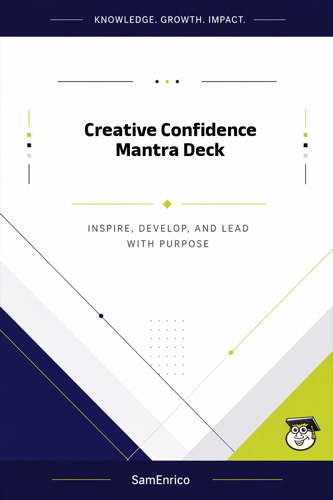
Non-FictionSelf-HelpAffirmations
Creative Confidence Mantra Deck eBook
Use spoken affirmations to counter creative self d
Use spoken affirmations to counter creative self doubt before starting.
Formats
Free sample
Chapter 1: The 3-Second Gap...--–- You are about to begin something important. A painting. A business plan. A difficult conversation. A piece of music.
A first date. A new recipe. The opening lines of a novel. Your fingers hover over the keyboard. Your brush pauses an inch from the canvas.
Your mouth opens, then closes. And then—nothing. The moment stretches. Your heart beats faster. A voice whispers: Maybe later.
Maybe when you're more ready. Maybe when you're better. And just like that, the spark is gone.This has happened to you thousands of times. It is not a character flaw. It is not laziness.
It is not a lack of discipline. It is a predictable, measurable, neurological event. And once you understand how it works, you can disarm it in less time than it takes to sneeze.Welcome to the 3-Second Gap.The Anatomy of a Freeze Let us rewind the tape and watch what just happened in slow motion.Moment Zero: You have an impulse to create. This impulse is real. It comes from a deep, ancient part of your brain called the anterior cingulate cortex, which is responsible for initiating action.
The impulse feels like a small spark—a tingle, a sudden idea, a surge of "I should do this now."Moment One: Almost instantly, another part of your brain activates. The amygdala—your brain's smoke detector—scans the impulse for threat. It asks a single question: Could this action lead to judgment, failure, or rejection? If the answer is yes (and for any creative act, the answer is always yes), the amygdala sounds the alarm.Moment Two: The alarm triggers a cascade of stress hormones—cortisol, adrenaline, norepinephrine. Your muscles tense.
Your breathing becomes shallow. Your attention narrows. This is the freeze response, a cousin of fight-or-flight. Your body is preparing for a threat that does not exist.Moment Three: The freeze reaches your conscious mind as a feeling. You call it many things: writer's block, stage fright, procrastination, perfectionism, lack of motivation, imposter syndrome.
But underneath all those labels is the same physiological event. Your body has decided that creating is dangerous, and it has hit the brakes.The entire sequence takes approximately three seconds.Three seconds from impulse to paralysis.This is the 3-Second Gap.Why Thinking Cannot Save You Most books about creative block make a fundamental error. They assume that the freeze is a thinking problem—that you have a false belief, a cognitive distortion, a lack of the right mindset. And so they offer thinking solutions: reframe your beliefs, visualize success, affirm your worth, challenge your negative thoughts.These strategies work beautifully in a quiet room when you are not trying to create. They fail miserably in the 3-Second Gap.Here is why.The thinking brain (the prefrontal cortex) is where logic, planning, and conscious self-talk happen.
It is also the slowest part of your brain—processing at roughly 40 bits per second. The fear brain (the amygdala) is lightning-fast—processing at roughly 11 million bits per second. When the amygdala sounds the alarm, the prefrontal cortex gets shut down. Blood flow is redirected. Oxygen is diverted.
Your "thinking brain" literally goes offline.Try to use a silent affirmation in the 3-Second Gap—"I am confident, I am capable, I am enough"—and what happens? Your amygdala does not hear it. The words never arrive. They bounce off the freeze like a feather against a brick wall.Silent self-talk is thinking. And thinking is exactly what the freeze disables.You cannot think your way out of a neurological override.You can, however, speak your way out.The Power of the Spoken Word Sound is different from thought.When you speak aloud, you are not just "thinking out loud." You are creating a physical event.
Your vocal cords vibrate. Your larynx produces sound waves. Those waves travel through the air, enter your own ears, and travel along the auditory nerve to your brainstem. From there, they bypass the amygdala's alarm system entirely and activate the vagus nerve—the body's longest cranial nerve, which runs from your brainstem to your gut.The vagus nerve is the off-ramp for fear.When the vagus nerve is stimulated, it triggers the parasympathetic nervous system—the "rest and digest" branch. Heart rate slows.
Blood pressure drops. Cortisol decreases. Oxytocin (the bonding and safety hormone) increases. The freeze response literally dissolves from the bottom up.This is not magic. This is neuroanatomy.A single spoken sentence, delivered in the 3-Second Gap, can do what an hour of silent self-talk cannot.
It can reach the body directly, without the permission of the frightened mind.But not just any sentence. The words themselves matter.The Mantra: "I Move Before the Mood Strikes"Most people wait for motivation before they act. They believe that feeling ready is a prerequisite for doing. This is backwards.Neuroscience has shown that action precedes motivation, not the other way around. Dopamine—the "motivation molecule"—is released after you take the first step, not before.
Your brain rewards movement. It does not reward waiting.The mantra "I move before the mood strikes" is a direct counter to the waiting trap. It has four components:"I move" – A command to the body, not a request to the mind. The verb is active, physical, immediate. It does not say "I think about moving" or "I prepare to move." It says "I move.""Before" – A temporal declaration.
It acknowledges that the mood (the feeling of readiness, inspiration, confidence) is coming—but it is coming after the action. The action goes first."The mood" – An honest acknowledgment that you do not feel ready. The mantra does not pretend you are confident. It does not fake it. It simply refuses to wait for confidence that has not arrived."Strikes" – A playful but precise word.
Moods strike like lightning. You cannot predict them. You cannot summon them. You can only act in their absence.The mantra works because it does not fight the fear. It outruns it.
It says: Fear, you can stay. Doubt, you can stay. I am moving anyway.The Ritual: The Countdown Bypass A mantra without a ritual is just a nice sentence. The Countdown Bypass is the physical container that makes the mantra effective.Step One: Feel the Hesitation Do not ignore it. Do not fight it.
Simply notice it. You are staring at the blank page. Your cursor is blinking. Your hand is hovering. Your heart is beating faster.
Name it to yourself: "I am hesitating." That is all.Step Two: Count Out Loud Say: "One... two... THREE."Do not whisper. Do not mumble. Say it at normal speaking volume.
The counting serves two purposes. First, it occupies the analytical mind, giving it something simple to do instead of generating excuses. Second, the rhythm of counting creates a predictable auditory pattern that the brain finds calming.Step Three: Speak the Mantra On "three," say: "I move before the mood strikes."Again, normal volume. Do not shout (that activates threat response). Do not whisper (that lacks impact).
Say it as if you are telling a friend a simple fact.Step Four: Take One Tiny Physical Action Immediately—within one second of…
This is the end of the free sample. Get the eBook to keep going. Buy now
About this book
Details
- Author
- Mcneely Glennie
- Publisher
- SamEnrico
- Language
- English
- Genre
- Non-Fiction, Self-Help, Affirmations
- Released
- 2026-06-09
- Pages (approx.)
- 141
- Available as
- eBook, Audiobook

Read better in the ZLOADR app
Your eBooks on your phone or tablet. Sign in with your SamEnrico account and start reading.
More by Mcneely Glennie
 Indian BPO Vendor SelectionMcneely Glennie$11.99
 Boredom To Flow BridgeMcneely Glennie$11.99
 The Codebreakers of Timbuktu: Africa's Forgotten CryptographersMcneely Glennie$11.99
 Profit Margin Calculations Study GuideMcneely Glennie$12.99
 How to Start a Agents and Agencies in Placement of Plays With Publishers Producers Business (BeginnMcneely Glennie$11.99
 Hothouse GardeningMcneely Glennie$11.99
 How to Produce Camera Bags and CasesMcneely Glennie$11.99
You may also like
 Hong Kong Handover 1997Dunn Johnnie$11.99
 Zumba For Postnatal Recovery CourseNeal Christian$11.99
 Zumba for BeginnersLadner Nikia$11.99
 YouTube Comment Mining GuideHumes Pandora$12.99
 Worry Box MeditationCarlin Rudy$11.99
 Workplace Stress MeditationNguyen Lynn$11.99
 Workplace Stress and Sleep RepairHawley Ivory$11.99
 Workplace Perfectionism CureDelaney Jeffry$11.99
 Workplace Injustice Anger GuideWallen Isabelle$11.99
 Work Addiction and Burnout LinkGreenwood Ester$11.99
 Women in Yoga and WellnessBeattie Galina$11.99
 Women in Stand Up ComedyChun Evangeline$11.99