
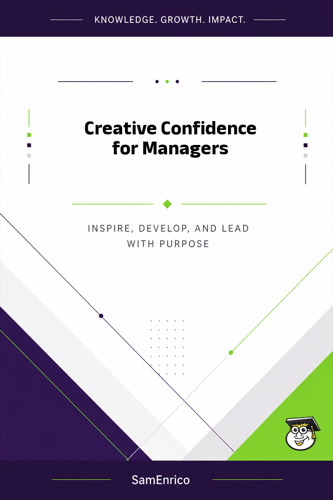
Creative Confidence for Managers eBook
Fosters innovation in teams.
Fosters innovation in teams.
Formats
Free sample
Chapter 1: The Confidence Audit--–- Most managers murder creativity every morning before their first cup of coffee, and they have no idea they are doing it.The email arrives at 8:47 AM. A junior designer named Maya has spent the weekend building a rough prototype of a feature no one asked for—a playful, almost whimsical addition to the company’s serious analytics dashboard. She clicks send. Her manager, David, opens the email during his commute. He has seventeen other unread messages.
His boss is demanding quarterly projections by noon. A major client just threatened to leave. And here is Maya, sending him… a cartoon dinosaur that eats data points?David sighs. He types back quickly: “Interesting idea, but let’s focus on the core priorities this week. Can you circle back on the Jones report instead?”He doesn’t think twice about it.
It was a reasonable response. Efficient, even. He redirected a low-value distraction toward higher-priority work. That is what good managers do.But Maya doesn’t send another unsolicited idea for the next eleven months. And when she does, it arrives buried in a spreadsheet, under a heading called “Optional,” with a note that says “probably not important.” Her creative confidence, which had been blooming like a seedling reaching for sunlight, was snipped at the stem with eleven words.
David never saw the cut. Maya felt it immediately.This is the invisible epidemic of modern management: the daily, unintentional, and completely avoidable murder of creative potential by well-meaning people who simply do not know any better.The Paradox of the Well-Managed Team Let us begin with an uncomfortable truth. The very behaviors that make you an effective manager in stable times—efficiency, predictability, error-correction, rapid decision-making—are the same behaviors that systematically destroy your team’s capacity for innovation. This is not a moral failing. It is a structural paradox built into the architecture of traditional management.Think about how you were trained to manage.
You learned to set clear goals, measure progress against those goals, correct deviations quickly, and reward outcomes. These are the pillars of classical management theory. They work beautifully when the problem is known, the solution is known, and the only question is execution. But innovation operates in the opposite territory: unknown problems, unknown solutions, and a requirement for exploration rather than execution.When you apply execution logic to exploration work, you get disaster. You get teams that stop experimenting because experiments fail.
You get people who hide their half-baked ideas until they are fully baked, by which time they are usually stale. You get a culture where safety is rewarded and creativity is quietly punished, not because anyone wrote a policy saying “creativity is forbidden,” but because the reward system says “certainty is safe and failure is dangerous.”This chapter is about the first and most important intervention a manager can make: recognizing that your own beliefs, fears, and behaviors are the primary lever for unlocking or suppressing your team’s creative potential. Before you can build creative confidence in others, you must first conduct an honest audit of your own.The Innovation Radar: Why Your Team Already Knows There is a concept borrowed from organizational psychology that explains why David’s quick response to Maya was so devastating. It is called the “innovation radar,” and while we will treat it as a metaphor rather than a literal instrument, it captures something real and powerful about team dynamics.Imagine that every team develops an intuitive, almost subconscious ability to detect whether their manager genuinely believes in creative exploration. This radar is not infallible—teams can be wrong, and they can be overly cynical—but it is remarkably sensitive to behavioral cues.
It picks up on the tiny, almost invisible signals you emit every day: the slight tension in your jaw when someone proposes a wild idea, the way you redirect conversations toward “real work,” the people you praise publicly versus the people you praise privately, the questions you ask in meetings, and the questions you never ask.The innovation radar works because human beings are exquisitely tuned to threat detection. Your team is constantly scanning for evidence of psychological danger. Are you safe to disagree with? Will you punish failure? Do you actually want new ideas, or do you just say you do?
The radar aggregates thousands of small data points into a single, gut-level conclusion: “My manager believes in us” or “My manager is just going through the motions.”David’s response to Maya was processed by her innovation radar in milliseconds. She heard: “Your creative initiative is less important than my immediate priorities. Do not bother me with unfinished thoughts. The only work that matters is the work I already assigned.” None of those messages were in David’s words. All of them were transmitted anyway.The Self-Diagnostic: Identifying Your Creativity Blind Spots Before we can fix anything, we need to see it.
This chapter provides a self-diagnostic tool designed to surface the hidden beliefs and fears that shape your management behavior. These are not character flaws; they are learned responses to a corporate environment that has, for decades, rewarded predictability over possibility. But they are also changeable.The Creativity Blind Spot Inventory Take a few minutes to answer these questions honestly. There is no score to publish and no penalty for uncomfortable answers. The only requirement is truthfulness.First, recall the last three times a team member proposed an idea that was significantly outside the scope of their current work.
For each instance, ask yourself: What was your first internal reaction? Did you feel curiosity, annoyance, anxiety, or something else? How long did you take to respond? What did you actually say?Second, consider your last performance review cycle. Of the people you praised most highly, what was the common thread?
Was it flawless execution, meeting deadlines, or coming up with novel solutions? If you are like most managers, your top performers are those who make your life easiest—the ones who deliver predictable results without surprises. This is not a coincidence. Your reward system is optimized for safety.Third, complete this sentence without overthinking: “If one of my team members spends three days on an experiment that completely fails, I would feel __________.” The blank space will tell you more about your creative leadership than any MBA textbook.Now, let us name the most common fear triggers that sabotage creative confidence:The Fear of Looking Foolish. You have your own boss to answer to.
If you champion a wild idea that fails, you look bad. So you subtly discourage wild ideas before they can become public. Your team notices.The Fear of Wasting Budget. Innovation costs money. Experiments consume resources.
Every dollar spent on a failed prototype is a dollar not spent on something “safe.” But this logic only works if you assume you know exactly which investments would have succeeded—which you do not.The Fear of Losing Control. Creative teams are messy. They generate conflicting ideas. They go down blind alleys. This chaos is terrifying to managers who have built their careers on order and predictability.
So you impose structure too early, killing exploration before it can bear fruit.The Fear of Being Wrong. Perhaps the deepest…
This is the end of the free sample. Get the eBook to keep going. Buy now
About this book
Details
- Author
- Christy Brant
- Publisher
- SamEnrico
- Language
- English
- Genre
- Non-Fiction, Self-Help, Management
- Released
- 2026-06-06
- Pages (approx.)
- 153
- Available as
- eBook, Audiobook

Read better in the ZLOADR app
Your eBooks on your phone or tablet. Sign in with your SamEnrico account and start reading.
More by Christy Brant
 Pitch Deck Storytelling GuideChristy Brant$11.99
 Manufacturing Plant ClosureChristy Brant$11.99
 Gap Analysis Mapping ManualChristy Brant$11.99
 Radiation for Prostate CancerChristy Brant$11.99
 Anger After Divorce ParentingChristy Brant$11.99
 The Door in Face TechniqueChristy Brant$11.99
 Joy of Simple LivingChristy Brant$11.99
 The Vanishing Masterpiece: The 1975 Heist of Van Gogh’s ‘Sunflowers’Christy Brant$11.99
 The Red and the White at Perekop: The Bloody Gateway to CrimeaChristy Brant$11.99
 How to Start a Cold Rolled Steel Sheet Business (Beginners Guide)Christy Brant$11.99
 American Foxhounds: History, Hunting Instincts & Breed StandardChristy Brant$11.99
 VoIP Auto Attendant WorkbookChristy Brant$12.99
You may also like
 The OKR Execution HandbookCarney Filomena$11.99
 Manager Confidence GuideRains Millie$11.99Manager Confidence GuideRains Millie$11.99
 Time Blocking For Managers GuideClement Enedina$11.99
 Manager Employee Empathy GuideHerrick Ashley$11.99
 Group Creative Playbook For Managers ManualLowell Drew$11.99
 Call Center Manager Stress GuideMcafee Jamison$11.99
 Layoff Conversations GuideWhaley Cherly$11.99
 Difficult Conversations with EmployeesTeal Hermine$11.99
 Weekly Review for ManagersBrunner Hunter$11.99
 SMART Goals for ManagersRicks Sidney$11.99
 Relationship Building for ManagersCreamer Corrie$11.99