
Non-FictionSelf-HelpArchitecture
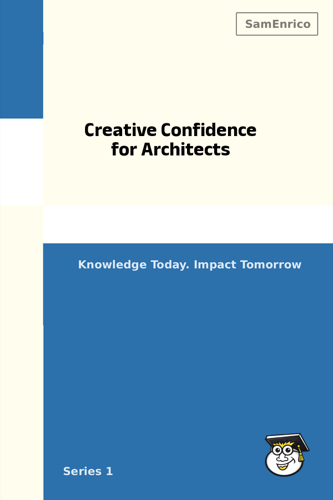
Creative Confidence for Architects eBook
Bold design solutions.
by Thorne Joya
Bold design solutions.
Formats
Free sample
Chapter 1: The Broken Pencil--–- You are holding a broken pencil. Not a literal one, perhaps, but a metaphorical one. Somewhere along the line—between your first architecture studio, where you stayed up all night building a cardboard model that felt like a cathedral, and your third year of professional practice, where you learned to say “that’s not in the budget” before anyone even asked—something snapped. You still have the skills. You still have the software licenses.
You still have the degree on the wall. But the thing that made you want to draw in the first place? That reckless, joyful, slightly delusional belief that you could rearrange the world into something better? It’s gone quiet.This book is the sharpener.Before you dismiss that as self-help nonsense, consider this: every bold building you have ever admired—every folded facade, every impossible cantilever, every space that made you catch your breath—was designed by someone who was, at some point, terrified. Not someone born with a “creative gene.” Not someone who never doubted themselves.
Someone who learned, often through painful failure, that creative confidence is not a personality trait. It is a set of behaviors. And behaviors can be taught.This chapter dismantles the single most damaging lie in architectural education: the myth of the “creative type.”The Creative Fallacy: Where Architects Go Wrong Architecture schools are remarkably good at producing two kinds of graduates. The first kind believes they are not creative enough. They look around the studio at midnight and see someone else’s model with the perfect light slot, the elegant section, the hand-drawn perspective that looks like a Piranesi print.
They compare their own clunky massing model—the one held together with hot glue and regret—and conclude: I don’t have it. They retreat into technical production, BIM management, project coordination. They become competent, reliable, and quietly miserable.The second kind believes they are so creative that the normal rules do not apply to them. These are the starchitect aspirants. They wear black.
They speak in manifestos. They design buildings that look incredible on Instagram and leak on the third floor. They confuse iconoclasm with insight. And when their projects fail—during value engineering, at the planning board, or after occupancy—they blame the client, the contractor, the budget, the era. Anyone but themselves.Both groups suffer from the same delusion: that creativity is a fixed trait, a gift you either receive at birth or do not.Call this The Creative Fallacy.It is wrong.
Scientifically, demonstrably, catastrophically wrong.Neuroplasticity and the Learnable Mind The human brain is not a static organ. It is a dense forest of neural pathways that grow stronger with use and wither with neglect. Every time you solve a spatial problem, your brain strengthens the circuits involved in spatial reasoning. Every time you reframe a constraint as an opportunity, you build a habit of reframing. Every time you push through the fear of a blank page, you weaken the neural connection between “blankness” and “anxiety.”This is neuroplasticity.
It is the reason a forty-year-old can learn the violin. It is the reason a fifty-year-old can learn Mandarin. And it is the reason you—right now, at whatever stage of your career—can learn to be bolder.The psychologists Carol Dweck and David Yeager have spent decades studying what they call growth mindset: the belief that abilities can be developed through effort and strategy. People with a fixed mindset see a difficult design problem and think, What if I’m not good enough? People with a growth mindset see the same problem and think, What can I learn from this?
The difference is not talent. The difference is a belief.Here is the uncomfortable truth: architecture schools, despite their progressive rhetoric, often reward fixed mindset behaviors. The studio critique system—the famous “crit”—is structured around judgment, not iteration. A student pins up their work. A professor (or a visiting critic, or a jury of both) delivers a verdict.
Good or bad. Promising or hopeless. This is not a growth mindset environment. This is a talent show.No wonder so many architects emerge from school convinced that creativity is something you either have or you do not. The system trained them to believe that.But the system is wrong.The Hidden Figures: Who Really Saves Buildings If creativity were a fixed trait reserved for famous starchitects, then only famous starchitects would produce bold solutions.
But that is not how buildings get built.Consider the Sydney Opera House. The iconic sails are attributed to Jørn Utzon, the Danish architect who won the competition in 1957. Utzon was undoubtedly a visionary. But the geometry of those shells—the actual, buildable, structurally sound curves—was solved by a team of engineers led by Ove Arup and his partner Jack Zunz. The problem was this: Utzon had sketched a beautiful form, but no one knew how to build it.
The shells were originally designed as parabolic curves, but parabolas could not be repeated consistently across the structure. The team spent years iterating. They built physical models. They ran calculations by hand. And finally, they discovered that the shells could be constructed from sections of a single sphere.
A breakthrough. A bold solution.Who was the “creative type” in that story? Utzon had the vision. Arup and Zunz had the persistence. The building exists because both were in the room.Or consider a smaller story, the kind that happens every day in every architecture firm.
A project architect—let us call her Maria—is working on a mid-rise office building. The structural engineer has specified a standard grid of columns. But Maria notices that one column in the lobby landing right where the reception desk should go. She could move the desk. That would be easy.
Instead, she asks the structural engineer: “What if we shifted this column eighteen inches to the left?” The engineer says no. The shear wall alignment won’t work. Maria asks: “What if we double the thickness of the slab in that bay to redistribute the load?” The engineer pauses. He has never been asked that before. He runs a quick calculation.
It would add two percent to the concrete budget. But it would save the entire lobby concept. The client agrees. The building gets built. No one outside the project team ever knows Maria’s name.Maria is not a starchitect.
She does not have a monograph. But she saved the boldness of that building. And she learned to ask that question not because she was born with a gift, but because she had practiced reframing constraints. She had learned the behavior of creative confidence.This book is for Maria. And for everyone who wants to become her.The Bug List: Finding Innovation in Friction If creative confidence is a set of learnable behaviors, where do you start?
Not with a blank page. The blank page is paralyzing. You start, instead, with friction.Every day, in your workflow, you encounter small annoyances. The BIM model crashes when you try to model a particular corner condition. The building code has a requirement that seems arbitrary and prevents a beautiful…
This is the end of the free sample. Get the eBook to keep going. Buy now
About this book
Details
- Author
- Thorne Joya
- Publisher
- SamEnrico
- Language
- English
- Genre
- Non-Fiction, Self-Help, Architecture
- Released
- 2026-06-05
- Pages (approx.)
- 145
- Available as
- eBook, Audiobook

Read better in the ZLOADR app
Your eBooks on your phone or tablet. Sign in with your SamEnrico account and start reading.
More by Thorne Joya
 Thunberg Plastic Pollution CrusadeThorne Joya$11.99
 Mansa Musa Pilgrimage WealthThorne Joya$11.99
 Security Guard LayoffThorne Joya$11.99
 The Parenting Difficult TalkThorne Joya$11.99
 Six Wives LiveThorne Joya$11.99
 Self Esteem for Social WorkersThorne Joya$11.99
 Gratitude for VeteransThorne Joya$11.99
 The Pink Panther Heist: The Unbelievable True Story of the 1993 Tokyo Diamond CaperThorne Joya$11.99
 The Ghosts of Monte Cassino: The Unbreakable Monks and the Mountain of BloodThorne Joya$11.99
 How to Become a Hair WorkerThorne Joya$11.99
 How to Produce Other Packaging MaterialsThorne Joya$11.99
 How to Produce Compost AeratorsThorne Joya$11.99
You may also like
 Hong Kong Handover 1997Dunn Johnnie$11.99
 Zumba For Postnatal Recovery CourseNeal Christian$11.99
 Zumba for BeginnersLadner Nikia$11.99
 YouTube Comment Mining GuideHumes Pandora$12.99
 Worry Box MeditationCarlin Rudy$11.99
 Workplace Stress MeditationNguyen Lynn$11.99
 Workplace Stress and Sleep RepairHawley Ivory$11.99
 Workplace Perfectionism CureDelaney Jeffry$11.99
 Workplace Injustice Anger GuideWallen Isabelle$11.99
 Work Addiction and Burnout LinkGreenwood Ester$11.99
 Women in Yoga and WellnessBeattie Galina$11.99
 Women in Stand Up ComedyChun Evangeline$11.99