
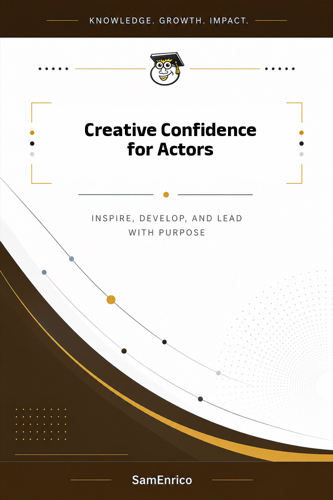
Creative Confidence for Actors eBook
Bold character choices.
by Galvez Arron
Bold character choices.
Formats
Free sample
Chapter 1: The Censor on Your Shoulder...--–- You have already given the performance of your life. You gave it last Tuesday at 11:47 PM, alone in your living room, wearing sweatpants, holding a coffee mug like it was a dying lover’s hand. The choices were electric. The impulses were raw. You didn’t stop to ask if they were “right.” You just followed the feeling, and something real happened.Then you walked into the rehearsal room the next day, and that actor vanished.In her place stood someone cautious, polite, and technically correct.
You hit your marks. You said your lines. You even felt something—but you showed almost none of it. When the director asked, “What else have you got?” your mind went blank. You knew there were other choices in you.
You’d made them just hours earlier. But now, with eyes on you, the well was dry.This is not a failure of talent. This is not a lack of training. This is the work of an invisible enemy that every actor faces, from the first-year drama student to the Oscar winner. Its name is the Censor, and it is the single greatest obstacle to bold, alive, unforgettable performance.The Actor’s Dilemma: Why Home Is Easy and the Room Is Hard Let us name the problem precisely.
You read a script at home, perhaps on a couch or at a kitchen table. No one is watching. No one will judge. In that private space, you are free to try anything—a bizarre accent, a physical tic, a subversive reading of a line that turns comedy into threat. You laugh at your own bad ideas.
You throw them away and try others. Somewhere in that play, you stumble onto something that feels true. It is not polished. It is not “correct.” But it is alive.Then you step into an audition, a rehearsal, or a classroom. The moment the door closes behind you, something shifts.
Your shoulders rise toward your ears. Your breath becomes shallow. The wild, playful actor from last night is replaced by a professional who wants to get it right. You make the safe choice—the one you know the director will approve, the one that won’t embarrass you, the one that demonstrates you understand the material. You perform your understanding of the scene rather than your experience of it.The audience—whether a casting director, a teacher, or a single scene partner—feels the difference immediately.
They don’t know what you did last night. They only know that what they’re seeing now is careful. And careful, in acting, is the enemy of compelling.This gap between private inspiration and public paralysis is so universal that many actors assume it is simply the cost of doing business. “Of course I’m more free at home,” they say. “No one is watching.” But this acceptance of mediocrity in the room is a form of surrender.
The actor who performs worse under observation is not a realist. They are a victim of the Censor.Introducing the Censor: The Voice That Keeps You Safe and Small The Censor is an internal voice that prioritizes safety over spontaneity, approval over discovery, and correctness over truth. It speaks in complete sentences, often in your own voice, and it is relentless. Its vocabulary includes phrases like:“That’s too much.”“They won’t get it.”“You’ll look stupid.”“Stick to the text.”“Just be professional.”“What will they think?”The Censor is not malevolent. It is not trying to ruin your career.
On the contrary, it believes it is protecting you. The Censor evolved for a world where social rejection meant expulsion from the tribe, which often meant death. It is a survival mechanism. When you step into an audition, your Censor does not know the difference between a casting director rejecting you and a prehistoric clan leaving you to freeze in the snow. To your nervous system, they are the same threat.The problem is not that the Censor exists.
The problem is that actors—trained to be their own directors, their own critics, their own quality control—invite the Censor to sit in the driver’s seat during the creative act. They mistake self-editing for professionalism. They mistake caution for craft.But here is the truth that separates working actors from brilliant ones: The Censor belongs in the editing room, not the rehearsal room.The Two Selves: Analytical vs. Creative To understand the Censor, we must understand the architecture of your own mind. Drawing on decades of research in cognitive psychology and design thinking, we can distinguish between two modes of thought that coexist within every actor.The Analytical Self is the critic, the editor, the judge.
It operates in the prefrontal cortex—the part of your brain responsible for planning, reasoning, impulse control, and future-oriented thinking. This is the self that reads a script and asks, “What is the character’s objective?” It compares your performance to an internal standard of excellence. It notices when you drop a line or miss a beat. It is essential for rehearsal—for refining, shaping, and polishing. But it is a disaster when it shows up during performance.The Creative Self is the impulsive artist, the child, the “yes” machine.
It operates in the limbic system—the part of your brain responsible for emotion, memory, and immediate response. This is the self that, when you read a script at home, suddenly stands up and tries a line with an accent you’ve never attempted before. It does not ask permission. It does not check for correctness. It simply does.
It is the source of every surprising, thrilling, alive moment you have ever created.The problem is not that actors have an Analytical Self. The problem is that actors, trained to be their own directors, habitually allow the Analytical Self to sit in the driver’s seat during the creative act. This is like trying to write a poem and edit it simultaneously. It is like trying to cook a meal and critique every bite before it reaches the plate. You cannot create and judge at the same time.
The brain is not wired for it.Research from the book My Character Wouldn’t Do That confirms what working actors have always known: self-consciousness spikes dramatically when an actor feels “watched”—even when the only watcher is themselves. The mere presence of an internal observer triggers the Analytical Self to flood the system with doubt. The actor begins to perform for the observer rather than from the character.The Neurological Metaphor: Why You Can’t Think Your Way to Creativity Let us get specific about what is happening in your brain, because understanding the mechanism is the first step to disarming it.Your prefrontal cortex (the home of the Analytical Self) is responsible for what psychologists call “executive function.” It plans. It predicts consequences. It inhibits impulses that might lead to negative outcomes.
When you are about to do something risky—like make a strange choice in an audition—your prefrontal cortex fires a warning signal. It says, “Stop. Consider the consequences. What if they don’t like it?”Your limbic…
This is the end of the free sample. Get the eBook to keep going. Buy now
About this book
Details
- Author
- Galvez Arron
- Publisher
- SamEnrico
- Language
- English
- Genre
- Non-Fiction, Self-Help, Acting
- Released
- 2026-06-06
- Pages (approx.)
- 141
- Available as
- eBook, Audiobook

Read better in the ZLOADR app
Your eBooks on your phone or tablet. Sign in with your SamEnrico account and start reading.
More by Galvez Arron
 Addiction Recovery CareerGalvez Arron$11.99
 Market Segmentation OverlayGalvez Arron$11.99
 The Difficult Diagnosis ConversationGalvez Arron$11.99
 Timbuktu Learning CenterGalvez Arron$11.99
 Self Esteem for Technical WorkersGalvez Arron$11.99
 Public Speaking for SalespeopleGalvez Arron$11.99
 Gratitude Garden GuideGalvez Arron$11.99
 The Silk and Gold Gambit: The Untold Fortune of Madam C.J. WalkerGalvez Arron$11.99
 Love on the Global Stage: The Scandalous Marriage That Shook the 1896 OlympicsGalvez Arron$11.99
 How to Produce CompoundsGalvez Arron$11.99
 Bandicoots: Peramelemorphia of Australia & New GuineaGalvez Arron$11.99
 A Collector's Handbook to the Sunbeam Twenty-five (1934-35)Galvez Arron$11.99
You may also like
 Hong Kong Handover 1997Dunn Johnnie$11.99
 Zumba For Postnatal Recovery CourseNeal Christian$11.99
 Zumba for BeginnersLadner Nikia$11.99
 YouTube Comment Mining GuideHumes Pandora$12.99
 Worry Box MeditationCarlin Rudy$11.99
 Workplace Stress MeditationNguyen Lynn$11.99
 Workplace Stress and Sleep RepairHawley Ivory$11.99
 Workplace Perfectionism CureDelaney Jeffry$11.99
 Workplace Injustice Anger GuideWallen Isabelle$11.99
 Work Addiction and Burnout LinkGreenwood Ester$11.99
 Women in Yoga and WellnessBeattie Galina$11.99
 Women in Stand Up ComedyChun Evangeline$11.99