
Non-FictionSelf-HelpArtistic Process
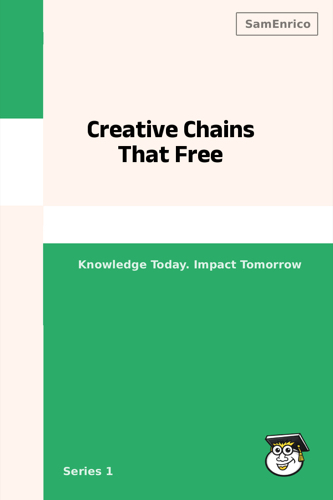
Creative Chains That Free eBook
Paradoxical guide to using self imposed rules for
by Mccallum Lu
Paradoxical guide to using self imposed rules for artistic liberation.
Formats
Free sample
Chapter 1: The Freedom Trap--–- In 1997, a small team of Silicon Valley geniuses gathered in a converted warehouse in Menlo Park. They had unlimited funding from Sony, Apple, and Motorola. They had the brightest minds from Atari and Xerox PARC. They had a vision so far ahead of its time that they called it "the next big thing" years before that phrase existed. Their name was General Magic, and they were building the first smartphone—touch screen, emojis, apps, internet—a full decade before the i Phone.They had everything.
Every resource. Every brilliant mind. Every ounce of freedom a creative team could dream of.And they failed so completely that when the company collapsed in 2002, the building was cleared out so fast that employees left coffee mugs on their desks, frozen in time like a creative Pompeii. The technology worked. The team was genius.
The vision was correct. So what killed them?Not lack of talent. Not lack of resources. Not lack of vision.They had too much of everything.The Paradox You Weren't Supposed to Notice Let me tell you a story about my own creative collapse, because it's less embarrassing if I volunteer it first.In 2015, I had a studio. Not a corner of a bedroom—an actual studio, with high ceilings, north-facing windows, and enough space for a drafting table, a computer station, and a wall of supplies that would make an art supply store jealous.
I had ninety-six colored pencils. I had three brands of watercolor paper. I had a drawing tablet, a scanning station, and software that could simulate any medium known to human civilization.And I made nothing.For eighteen months, I would walk into that studio, sit down in front of all that glorious possibility, and feel my chest tighten. I would open a drawer of perfectly organized brushes and feel nausea. I would scroll through fonts—hundreds of fonts—and then close the laptop and go watch Netflix.
I told myself I was "blocked." I told myself I needed inspiration. I told myself that any day now, the muse would visit, and then I would finally use all those beautiful, expensive, freedom-giving tools.The muse never came.What I didn't understand—what I couldn't see from inside the prison of infinite possibility—was that I had built myself a cage made of options. Every pencil was a decision I hadn't made yet. Every font was a path I hadn't committed to. Every blank sheet of paper was a tiny scream of "what if you choose wrong?"I wasn't blocked.
I was drowning in freedom.The Jam Experiment That Explains Everything In 2000, psychologists Sheena Iyengar and Mark Lepper set up a tasting booth at an upscale grocery store in Menlo Park, California. On some days, they offered shoppers a selection of 24 exotic jams. On other days, they offered just 6.You would think more choices would mean more sales. More flavors means more people find something they like, right?Wrong.The booth with 24 jams attracted more shoppers—60% of customers stopped to look. But only 3% of them bought anything.
The booth with 6 jams attracted fewer initial glances—only 40% stopped—but 30% of them made a purchase.That's right. Offering one-fourth as many jams led to ten times more sales.But here's the part that should terrify every creative person: the shoppers who saw 24 jams didn't just buy less. They reported less satisfaction with their choice, even when they did buy. They spent more time deciding, felt more anxious during the process, and were more likely to regret their decision afterward. The people who chose from 6 jams?
They walked away happy, confident, and already planning to buy again.This is the paradox of choice: beyond a certain point, more options don't liberate you. They paralyze you.Now look at your creative life. How many fonts do you have installed? How many brushes? How many unfinished projects are sitting in a folder labeled "Ideas"?
How many tabs do you have open right now in the browser where you're reading this?You are standing in front of the 24-jam booth every single day. And you are walking away with nothing.The Neuroscience of Creative Paralysis Here's what's happening inside your brain when you face unlimited options.The prefrontal cortex—that evolutionary marvel behind your forehead, the part that makes you human rather than hungry—has a limited fuel tank. Neuroscientists call it ego depletion. Every decision you make, from "what should I eat for breakfast" to "which word should I use in this sentence" draws from the same cognitive reservoir.When you have twenty-four jams, your prefrontal cortex has to compare twenty-four options. Color.
Price. Brand. Sugar content. Memories of previous jams. The shape of the jar.
By the time you've done that comparison ten times, your decision-making fuel is gone. You can still choose—but you'll choose badly, or not at all, or with deep regret.Now apply this to creativity.You sit down to write a poem. How many forms could you choose? Sonnet? Villanelle?
Free verse? Haiku? Prose poem? That's five options already. How many first lines could you write?
Infinite. How many words exist in the English language? Over 170,000. Your prefrontal cortex looks at this landscape and says, politely, "I cannot. Please come back when you have removed 99.9% of these options."The blank page isn't intimidating because it's empty.
It's intimidating because it represents infinite possibility, and infinite possibility is computationally impossible for a finite brain.This is not a character flaw. This is not a lack of discipline. This is neuroscience.And the solution is not more willpower. The solution is fewer options.The Myth of the Bohemian Genius We have been sold a lie about creativity for two hundred years.It started with the Romantics—poets like Byron and Shelley who turned the artist into a wild, untamed force of nature, a genius who created best when drunk, heartbroken, and completely free from rules. The image stuck.
We still imagine the painter in a chaotic loft, splashing paint wherever inspiration strikes. The jazz musician improvising without a net. The writer chain-smoking cigarettes and staring at the ceiling until the muse descends.Here's the truth they didn't tell you: Byron had a rigid daily schedule. Shelley wrote in specific notebooks with specific pens at specific hours. The chaos was performance.
The structure was reality.Modern research has systematically dismantled the "bohemian genius" myth. When psychologists studied highly creative people across disciplines—from Nobel laureates to Mac Arthur "genius grant" winners—they found one consistent trait. Not openness to experience. Not risk-taking. Not even intelligence.It was persistence.
And persistence doesn't come from freedom. It comes from routine.Dean Keith Simonton, who has spent forty years studying genius, analyzed the work habits of 120 significant creative figures—Einstein, Picasso, Mozart, Virginia Woolf. He found that virtually all of them worked on a fixed schedule, in a fixed place, with fixed tools. They didn't wait for inspiration. They showed up, followed their rules, and let inspiration catch up to them if it could.Mozart composed at the same hours every day.
Dickens wrote from 9 AM to 2 PM, no exceptions. Maya Angelou rented a local hotel room—not a home office…
This is the end of the free sample. Get the eBook to keep going. Buy now
About this book
Details
- Author
- Mccallum Lu
- Publisher
- SamEnrico
- Language
- English
- Genre
- Non-Fiction, Self-Help, Artistic Process
- Released
- 2026-06-10
- Pages (approx.)
- 152
- Available as
- eBook, Audiobook

Read better in the ZLOADR app
Your eBooks on your phone or tablet. Sign in with your SamEnrico account and start reading.
More by Mccallum Lu
 Kopo Kopo Acquisition StoryMccallum Lu$11.99
 HRT Laboratory Monitoring HandbookMccallum Lu$11.99
 Nuclear Fusion Capital ForecastMccallum Lu$11.99
 Sciatica Nerve Pain Management GuideMccallum Lu$11.99
 The Illusionist's Secret: How a 16th-Century Magician Fooled the PopeMccallum Lu$11.99
 Food Pop Up in Three Cities GuideMccallum Lu$12.99
 Multi Gateway Integration StrategyMccallum Lu$12.99
 Understanding Peripheral Type NeurofibromatosisMccallum Lu$17.99
 How to Become a Spray-gun RepairerMccallum Lu$11.99
 Staff Software EngineerMccallum Lu$11.99
You may also like
 Hong Kong Handover 1997Dunn Johnnie$11.99
 Zumba For Postnatal Recovery CourseNeal Christian$11.99
 Zumba for BeginnersLadner Nikia$11.99
 YouTube Comment Mining GuideHumes Pandora$12.99
 Worry Box MeditationCarlin Rudy$11.99
 Workplace Stress MeditationNguyen Lynn$11.99
 Workplace Stress and Sleep RepairHawley Ivory$11.99
 Workplace Perfectionism CureDelaney Jeffry$11.99
 Workplace Injustice Anger GuideWallen Isabelle$11.99
 Work Addiction and Burnout LinkGreenwood Ester$11.99
 Women in Yoga and WellnessBeattie Galina$11.99
 Women in Stand Up ComedyChun Evangeline$11.99