
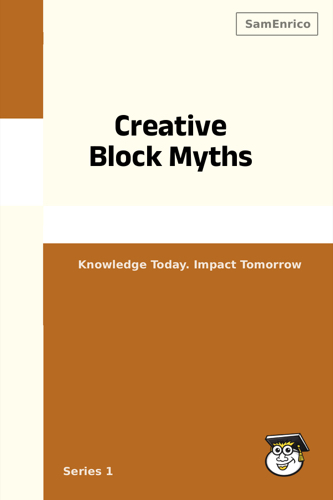
Non-FictionSelf-HelpMyth Busting
Creative Block Myths eBook
Debunk misconceptions about inspiration and artist
Debunk misconceptions about inspiration and artistic struggle.
Formats
Free sample
Chapter 1: The Couch Trap...–- The painter had not touched a brush in six months. She told everyone she was waiting for inspiration. She believed it herself. Every morning, she walked past her studio door, felt a small twist of guilt in her stomach, and told the same story: “I’m not ready yet. The feeling hasn’t arrived.”She was not lazy.
She was not untalented. She was trapped inside the most destructive myth about creativity—the belief that inspiration must strike before you begin.This chapter dismantles that myth. You will learn why waiting is a neurological dead end, why professional creators never wait, and how a ten-minute “low-fidelity start” can break any block. By the end, you will no longer ask, “Am I inspired?” You will ask, “Have I started?”The Myth in Depth: Why We Wait The myth of inspiration as a prerequisite is ancient. The Greeks called it the Muse.
The Romans called it genius—not something you were, but something that visited you. For centuries, artists have described their best work as a gift from outside themselves, a divine download, a lightning bolt.There is nothing wrong with this metaphor. It is beautiful, humble, and often accurate to the felt experience of creation. The problem is not the metaphor. The problem is what we do while waiting for the lightning.Here is what most people do: they sit on the couch.
They scroll. They clean their desk. They reorganize their bookshelf. They tell themselves they will start tomorrow, or Monday, or after the holidays, or when they feel more confident. They mistake the metaphor for an instruction manual.The result is paralysis.
The painter who waits for inspiration does not paint. The writer who waits for the muse does not write. The entrepreneur who waits for the perfect idea does not launch. And the longer they wait, the guiltier they feel, and the guiltier they feel, the harder it is to start. This is the Couch Trap—a self-reinforcing cycle of waiting, shame, and more waiting.The trap has three walls.Wall One: The Romance of Effortlessness.
We have been raised on stories of geniuses who produced masterpieces in fever dreams. Mozart wrote entire symphonies in his head before touching a quill. Jack Kerouac typed On the Road on a single scroll in three weeks. These stories are either wildly exaggerated or omit the decade of practice that preceded the burst. But they lodge in our minds as the standard.
If creativity does not feel effortless, we assume we are doing it wrong.Wall Two: The Equation of Struggle with Incompetence. When something is hard, we conclude we lack talent. This is backward. Difficulty is not a sign that you are on the wrong path. Difficulty is a sign that you are on *a* path—and paths have rocks.
The belief that struggle means you are not a “real” creative is the fastest route to quitting.Wall Three: The Tyranny of the Blank Page. The blank page, the empty canvas, the silent instrument—these are not neutral. They are accusatory. They seem to ask, “Well? What do you have to say?” That question is paralyzing because it demands a finished thought before you have begun thinking.
No one can answer it. The trap is that you think you should be able to.Together, these three walls create a prison. The key is not inspiration. The key is action—specifically, action taken before you feel ready.The Debunking: Inspiration Is an Outcome, Not a Prerequisite Every professional creator knows something that amateurs do not: inspiration arrives during work, not before it. You do not wait for the lightning.
You walk into the storm, raise a metal rod, and accept that you will get wet.Consider the evidence.Neurological. The brain’s default mode network (DMN) is the region associated with creativity, insight, and the linking of distant ideas. The DMN activates most strongly not when you are sitting and thinking, but when you are engaged in low-stakes, physical, repetitive activity. Walking. Showering.
Driving on a familiar road. Doodling. Freewriting. The DMN does not respond to commands. It responds to gentle, low-pressure action.
The moment you demand, “Be creative now,” the DMN shuts down and the executive control network (task-focused, critical, judgmental) takes over. This is why staring at a blank page makes your mind go blank. You have activated the wrong network.Behavioral. The writer Stephen King writes every single morning, including Christmas and his birthday. He aims for six pages.
He does not wait for the mood. The dancer and choreographer Twyla Tharp takes a taxi to her studio at the same time every day. She does not ask whether she feels like working. The composer Leonard Bernstein said, “To achieve great things, two things are needed: a plan and not quite enough time.” None of these people have more inspiration than you. They have more discipline—and discipline is simply the refusal to wait for inspiration.Empirical.
Psychologists have studied the relationship between mood, motivation, and creative output. The finding is consistent across dozens of studies: mood is a result of action, not a cause. People who start working before they feel motivated report higher mood after working than those who waited for motivation to strike. Acting does not require feeling good. Acting makes you feel good.Here is the counterintuitive truth: inspiration is not the fuel for work.
Work is the fuel for inspiration.The Low-Fidelity Start: A Ten-Minute Rebellion If waiting is the problem, starting badly is the solution.The “Low-Fidelity Start” is a practice designed to bypass every wall of the Couch Trap. It requires ten minutes. It requires zero talent. It requires no feeling of inspiration. It only requires that you move your hands and accept that what you produce will be ugly, stupid, wrong, or embarrassing.The Rules:Set a timer for ten minutes.
Not nine. Not eleven. Ten.Choose a low-stakes, low-quality version of your art.If you are a writer: freewrite without punctuation, capitalization, or grammar. Write “I don’t know what to write” fifty times if necessary. Write nonsense.If you are a painter: smear leftover paint on cardboard.
Use your fingers. Mix colors randomly. Do not attempt to represent anything.If you are a musician: hum nonsense melodies. Play random notes. Do not try to compose.If you are a photographer: take ten deliberately bad photos.
Blurry. Overexposed. Crooked.If you are a chef: combine three ingredients that should not go together. Taste it. Spit it out if necessary.No editing.
No erasing. No judging. No deleting.When the timer ends, stop. Do not continue because you are “on a roll.” The roll will return tomorrow. Trust the process.Repeat for three consecutive days before evaluating.Why This Works:The Low-Fidelity Start works for four reasons, each targeting a specific wall of the Couch Trap.Reason One: It lowers the stakes to zero.
Perfectionism thrives on high stakes. When you believe that what you make matters, your inner critic wakes up and starts shouting. The Low-Fidelity Start announces, “Nothing that happens in the next ten minutes matters.” The critic has nothing to criticize. The…
This is the end of the free sample. Get the eBook to keep going. Buy now
About this book
Details
- Author
- Knudsen Melodi
- Publisher
- SamEnrico
- Language
- English
- Genre
- Non-Fiction, Self-Help, Myth Busting
- Released
- 2026-06-08
- Pages (approx.)
- 153
- Available as
- eBook, Audiobook

Read better in the ZLOADR app
Your eBooks on your phone or tablet. Sign in with your SamEnrico account and start reading.
More by Knudsen Melodi
 Immigrant Dance Studio Chain SuccessKnudsen Melodi$11.99
 Active Listening For Grief SupportKnudsen Melodi$11.99
 Wholesaling Dialer SystemsKnudsen Melodi$11.99
 Triathlon Injury PreventionKnudsen Melodi$11.99
 The Car Ride HomeKnudsen Melodi$11.99
 Assertiveness With Aging ParentsKnudsen Melodi$11.99
 Traffic Jam Patience GuideKnudsen Melodi$11.99
 Hollywood Family Master GuideKnudsen Melodi$11.99
 The Last Laugh: How a 19th-Century Joke Changed the WorldKnudsen Melodi$11.99
 Whispers from the Underworld: The Secret Burials of the Roman EliteKnudsen Melodi$11.99
 The Enlightenment: Seeds of Modern ReasonKnudsen Melodi$11.99
 The Mineral Guide to SantiteKnudsen Melodi$11.99
You may also like
 Hong Kong Handover 1997Dunn Johnnie$11.99
 Zumba For Postnatal Recovery CourseNeal Christian$11.99
 Zumba for BeginnersLadner Nikia$11.99
 YouTube Comment Mining GuideHumes Pandora$12.99
 Worry Box MeditationCarlin Rudy$11.99
 Workplace Stress MeditationNguyen Lynn$11.99
 Workplace Stress and Sleep RepairHawley Ivory$11.99
 Workplace Perfectionism CureDelaney Jeffry$11.99
 Workplace Injustice Anger GuideWallen Isabelle$11.99
 Work Addiction and Burnout LinkGreenwood Ester$11.99
 Women in Yoga and WellnessBeattie Galina$11.99
 Women in Stand Up ComedyChun Evangeline$11.99