
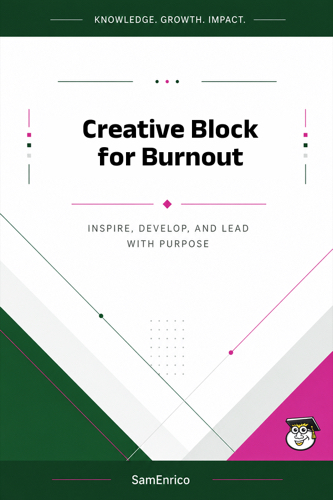
Creative Block for Burnout eBook
Recover creative energy after professional exhaust
Recover creative energy after professional exhaustion.
Formats
Free sample
Chapter 1: The Sacred Lie...--–- You are sitting in a room that once sparked joy. Perhaps it is your home office, where the curtains have been drawn for three weeks. Perhaps it is a coffee shop where you used to write furiously, now reduced to nursing a single cold latte for two hours while you scroll through nothing. Perhaps it is your studio, where half-finished work stares at you like accusatory ghosts. You have a deadline approaching—or maybe it passed yesterday, or last week, or last month, and you lied about needing "just a few more days." You tell yourself you have a creative block.
You have lost your muse. You are waiting for inspiration to return. And you believe, with the quiet desperation of someone drowning in plain sight, that if you just try harder, push longer, wake earlier, stay later, drink more caffeine, delete more distractions, and shame yourself more ruthlessly, the spark will reignite.It will not.Not because you are weak. Not because you lack talent. Not because you are lazy or undisciplined or somehow less than the people who seem to create effortlessly while you sink.
You are failing to recover because you are treating a broken leg with a band-aid, and the band-aid is labeled "productivity hacks." You have been sold a sacred lie, and you have believed it so deeply that you have built your entire creative identity around it. The lie is this: Creative block is a psychological problem, and the cure is more effort.This book exists because that lie is killing your creative soul, one exhausted hour at a time.The Difference Between Stuck and Empty Before we go anywhere else, we need to perform a surgical incision. We need to separate two conditions that look identical from the outside but require opposite treatments. One is creative block—the classic, romanticized, anxiety-driven paralysis that every artist knows. The other is burnout block—the physiological, spiritual, and neurological collapse that no amount of "showing up" can fix.Creative block says: "I have ideas, but I am afraid they are not good enough."Burnout block says: "I do not have ideas.
I do not even want ideas. I want to sleep for a year."Creative block feels like a dam. The water is there—churning, pressurized, alive—but the release valve is stuck. You can feel the potential energy behind the wall. It is uncomfortable, even painful, but it is also alive.
Burnout block feels like a dry riverbed. There is no water behind any dam because the river has stopped flowing entirely. You look up at the sky, and there are no clouds. You look inside yourself, and there is no voice. The silence is not peaceful; it is the silence of a tomb.Here is the critical distinction that most creative advice gets catastrophically wrong: Creative block requires you to show up.
Burnout block requires you to stop.When you have classic creative block, the standard prescriptions work. Write morning pages. Set a timer. Lower your standards. Produce garbage.
The act of showing up breaks the dam because the water was there all along. But when you are burned out, showing up is not brave—it is destructive. It is like taking a marathon runner with two stress fractures and telling them to "just keep running." They will not break through. They will break down.And you have been breaking down, quietly, for months. Perhaps years.The Martyr Myth Why do we confuse these two conditions?
Why do we keep pushing when we are empty rather than when we are merely afraid? The answer is one of the oldest and most seductive stories in Western culture: the myth of the tortured artist.We have been raised on a diet of romantic suffering. Van Gogh cutting off his ear. Hemingway with his shotgun. Sylvia Plath with her oven.
Miles Davis bleeding for his horn. The cultural narrative is undeniable: great art requires great pain, and great pain requires great sacrifice, and great sacrifice requires—eventually—great exhaustion. We have confused suffering with authenticity. If you are not suffering, the logic goes, you are not really an artist. If you are not exhausted, you are not really working.
If you are not burning the candle at both ends, you are not committed.This is not wisdom. It is a death cult disguised as romanticism.The data tells a different story. In a longitudinal study of creative professionals across writing, visual arts, and music, researchers found that the most prolific and sustained creators were not the ones who worked the longest hours or tolerated the most pain. They were the ones who worked rhythmically—intense focus followed by deliberate rest, hard labor followed by genuine leisure. The tortured artist burns bright and dies young, leaving behind a mythology but also a tragedy.
The disciplined artist burns steadily for decades, producing their best work in their fifties, sixties, and seventies, precisely because they learned to distinguish between productive struggle and self-destructive exhaustion.But we do not celebrate the disciplined artist. We do not make movies about the painter who took a nap every afternoon and lived to be ninety-two. We make movies about the genius who drank himself to death by forty. And so we internalize the wrong model. We believe that if we are not bleeding, we are not creating.
We believe that rest is weakness. We believe that burnout is a badge of honor.It is not. It is a diagnostic signal. And you are here because that signal has become a scream.The Relentless Personality If the cultural myth is one half of the trap, the other half is your own personality—or rather, the personality that your profession has rewarded you for developing.Think about the qualities that have made you successful. Perhaps you are relentless.
When a project goes wrong, you do not quit; you double down. Perhaps you are available. You answer emails at midnight, take calls on vacation, and never say "no" to a new opportunity. Perhaps you are high-output. You measure your worth in finished projects, closed deals, published pieces, delivered designs.
Perhaps you are reliable. When you say you will do something, you do it, even if it costs you sleep, health, or sanity.These qualities got you promoted. They got you clients. They got you praise, status, income, and identity. Your boss loves your relentlessness.
Your collaborators depend on your availability. Your portfolio proves your high output. Your reputation rests on your reliability.And every single one of these qualities is directly causal in creative burnout.The same relentlessness that makes you finish projects also makes you unable to stop. The same availability that makes you valuable also makes you permeable—work seeps into every corner of your life. The same high-output drive that builds your career also destroys your capacity for rest because rest produces nothing visible.
The same reliability that earns trust also earns exhaustion because you never let yourself fail, drop a ball, or disappoint anyone.You have been trained like a performing seal. Every time you push through fatigue, you get a fish. Every time you say "yes" when…
This is the end of the free sample. Get the eBook to keep going. Buy now
About this book
Details
- Author
- Glass Maribeth
- Publisher
- SamEnrico
- Language
- English
- Genre
- Non-Fiction, Self-Help, Burnout
- Released
- 2026-06-11
- Pages (approx.)
- 152
- Available as
- eBook, Audiobook

Read better in the ZLOADR app
Your eBooks on your phone or tablet. Sign in with your SamEnrico account and start reading.
More by Glass Maribeth
 Boxing Hand Wrapping GuideGlass Maribeth$11.99
 Wholesaling Outsourcing GuideGlass Maribeth$11.99
 Immigrant Roofing Contractor To EmpireGlass Maribeth$11.99
 Active Listening For ToddlersGlass Maribeth$11.99
 Assertiveness With NeighborsGlass Maribeth$11.99
 Cure Period Enforcement LogGlass Maribeth$11.99
 The Laundry TantrumGlass Maribeth$11.99
 Short Breath Long Breath PracticeGlass Maribeth$11.99
 Operation Midnight Sun: The Secret War to Save the ArcticGlass Maribeth$11.99
 The Troll King's Last Lesson: A Nordic Wisdom SagaGlass Maribeth$11.99
 The Architect of Chaos: How a Shadow Advisor Shaped Modern PoliticsGlass Maribeth$11.99
 How to Start a Advertising Light Business (Beginners Guide)Glass Maribeth$11.99
You may also like
 Hong Kong Handover 1997Dunn Johnnie$11.99
 Zumba For Postnatal Recovery CourseNeal Christian$11.99
 Zumba for BeginnersLadner Nikia$11.99
 YouTube Comment Mining GuideHumes Pandora$12.99
 Worry Box MeditationCarlin Rudy$11.99
 Workplace Stress MeditationNguyen Lynn$11.99
 Workplace Stress and Sleep RepairHawley Ivory$11.99
 Workplace Perfectionism CureDelaney Jeffry$11.99
 Workplace Injustice Anger GuideWallen Isabelle$11.99
 Work Addiction and Burnout LinkGreenwood Ester$11.99
 Women in Yoga and WellnessBeattie Galina$11.99
 Women in Stand Up ComedyChun Evangeline$11.99